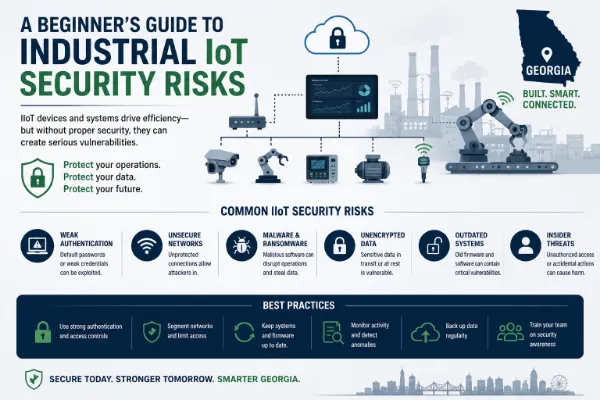
Most introductions to IIoT security risk read like a generic list borrowed from IT cybersecurity content, with "industrial" swapped in for "enterprise." That misses what actually makes industrial security different, and it overlooks a genuinely useful fact for Georgia manufacturers specifically: the state is home to one of the country's deepest concentrations of cybersecurity expertise, anchored by U.S. Army Cyber Command at Fort Eisenhower in Augusta and the $100 million Georgia Cyber Center next door the largest single state government investment in a cybersecurity facility in the country. A manufacturer in Georgia evaluating IIoT security isn't starting from zero on available expertise the way a similarly sized manufacturer in most other states might be.
Traditional IT security assumes a few things that don't hold true on a factory floor: systems can be patched regularly, a compromised device can usually be isolated or shut down without major consequence, and the primary risk is data theft. Industrial environments break all three assumptions.
- Patching is often impractical. A PLC controlling a production line that's been running for fifteen years may not have a supported patching path at all, and even when patches exist, applying them typically requires scheduled downtime that a continuously running plant can't always accommodate on a vendor's timeline.
- Shutting down a compromised device has real-world consequences. Isolating a compromised laptop from a corporate network is a routine incident response step. Isolating a compromised controller on an active production line can itself cause a safety event or an unplanned stop the response to a security incident has to account for physical process risk, not just data risk.
- The primary risk often isn't data theft. While data matters, the more consequential industrial IoT risk is usually manipulation of physical processes a compromised system that alters temperature setpoints, safety interlocks, or equipment behavior, with consequences ranging from quality defects to genuine safety incidents.
Historically, industrial control systems ran on networks physically or logically isolated from corporate IT and the internet. IIoT's entire value proposition depends on breaking that isolation connecting plant-floor data to cloud platforms, enterprise systems, and remote access tools. Every new connection point is a potential entry point that didn't exist when the control system was originally designed and isolated.
Many industrial protocols and controllers were designed decades ago, when the assumption was that anyone with network access to a control system was already authorized to be there. Protocols like Modbus, in their original form, have no built-in authentication at all any device on the network can send a command, and the receiving equipment has no way to verify it's legitimate. This isn't a bug to be patched; it's a fundamental design characteristic of equipment that predates the idea of connecting industrial networks to anything external.
Industrial equipment, historians, and HMIs are frequently deployed with default manufacturer credentials that are never changed, particularly on equipment installed years before anyone anticipated it would eventually be connected to a broader network. This is one of the most common and most preventable entry points in documented industrial security incidents.
Equipment vendors, integrators, and maintenance contractors frequently need remote access to industrial systems for support and troubleshooting. Each of these access points is a potential entry vector, and the security posture of a third-party vendor's remote access tools is often outside the plant's direct control, even though a compromise there can affect the plant directly.
Ransomware attacks increasingly target operational technology directly, not just corporate IT systems, because the operational disruption from a halted production line creates far more pressure to pay quickly than a compromised email server does. A ransomware event that reaches OT systems can halt production entirely until systems are restored or a decision is made about ransom payment, an outcome with financial consequences on the scale of the downtime costs the manufacturing industry already tracks closely.
As more of Georgia's manufacturing base from automotive suppliers in the Kia and Hyundai Metaplant ecosystem to legacy SCADA-controlled operations in the Dalton carpet industry layers IIoT connectivity onto existing control systems, the OT/IT convergence risk described above becomes a live concern rather than a theoretical one. Every gateway connecting a plant-floor historian to a cloud analytics platform is exactly the kind of new connection point that didn't exist when the underlying control systems were designed, and it needs to be treated as security-critical infrastructure, not just a data pipe.
- Inventory what's actually connected. Many industrial facilities don't have a complete, accurate picture of every device with network connectivity, including older equipment that was connected informally over time. An accurate asset inventory is the necessary first step before any other security measure can be prioritized correctly.
- Segment OT and IT networks. Rather than a flat network where a compromise anywhere can potentially reach anything, segmenting industrial control networks from corporate IT and from the internet-facing IIoT platform layer limits how far a compromise can spread.
- Prefer one-way or read-only data flows where possible. A data pipeline that can pull information out of a control system but has no path to send commands back into it significantly limits what an attacker could accomplish even if that pipeline were compromised.
- Change default credentials and enforce access control on every device and system that supports it, particularly historians, HMIs, and remote access tools, which are common and preventable entry points.
- Audit third-party and vendor remote access regularly, since these access points are frequently outside the plant's direct security controls but carry the same risk as an internal connection.
- Build an incident response plan that accounts for physical process safety, not just data recovery deciding in advance how a compromised controller will be isolated without creating a safety event is a very different exercise than a standard IT incident response plan.
This is the part most generic security guides can't offer: Georgia manufacturers evaluating IIoT security don't have to start from a blank slate on available expertise. Augusta's cybersecurity ecosystem, anchored by U.S. Army Cyber Command and the Cyber Center of Excellence at Fort Eisenhower, alongside the Georgia Cyber Center's public-private partnership model, has built a regional talent pipeline specifically around cybersecurity including the Georgia Cyber Range, used for practicing incident response and penetration testing. A manufacturer building out an OT/IT security program in Georgia has a genuinely deeper local talent pool and training infrastructure to draw from than most states offer, whether through direct hiring, contracted assessment services, or partnerships with the academic and training programs concentrated in the Augusta region.
Security maturity in an industrial environment isn't a single project with a finish line it's an ongoing program. For a facility just getting started, reasonable early milestones look like:
- A complete, accurate inventory of every network-connected device on the plant floor, including informally connected legacy equipment.
- Network segmentation separating OT systems from corporate IT and from direct internet exposure.
- Default credentials changed across all equipment that supports it.
- A documented incident response plan that specifically addresses how to isolate a compromised industrial system without creating a safety or process risk.
None of these require replacing existing control systems or making a large capital investment they're primarily a matter of visibility, network architecture, and process discipline, which makes them a reasonable starting point regardless of a facility's size or existing security maturity.
Industrial IoT security risk isn't a copy-paste version of IT security risk it's shaped by legacy equipment that can't always be patched, a primary risk profile centered on physical process manipulation rather than just data theft, and an expanding attack surface created by the very connectivity that makes IIoT valuable in the first place. For Georgia manufacturers, the state's unusually deep cybersecurity ecosystem in Augusta is a genuine, underused resource for building the expertise this problem requires, rather than treating industrial security as an afterthought to the IIoT rollout itself.
Frequently asked questions
Many industrial controllers run continuously in production environments where scheduled downtime for patching is difficult to arrange, and some older equipment may not have a supported patching path at all. Patching decisions in industrial settings have to account for production continuity and process safety, not just security.
The connection point itself is typically the highest-risk element, since it creates a new pathway between a historically isolated control network and external systems. One-way, read-only data flows and network segmentation at that connection point significantly reduce the risk.
Yes. Industrial equipment, historians, and HMIs deployed years before anyone anticipated future network connectivity frequently still run on default manufacturer credentials, making this one of the most common and most preventable entry points in documented industrial security incidents.
A ransomware event that reaches operational technology can halt physical production entirely, creating direct and immediate financial pressure tied to downtime costs, which is often more severe and more urgent than the disruption caused by a compromised office IT system.
The scale of investment should match the facility's size and risk profile, but foundational steps asset inventory, network segmentation, credential management, and incident response planning are low-cost, high-value starting points appropriate for facilities of any size.
Georgia has an unusually deep cybersecurity ecosystem concentrated in Augusta, including U.S. Army Cyber Command, the Cyber Center of Excellence at Fort Eisenhower, and the Georgia Cyber Center, which includes training programs, a cyber range for practicing incident response, and a regional talent pipeline manufacturers can draw on for security expertise.
Related articles

 Industrial IoT (IIoT)