 Industrial IoT (IIoT)

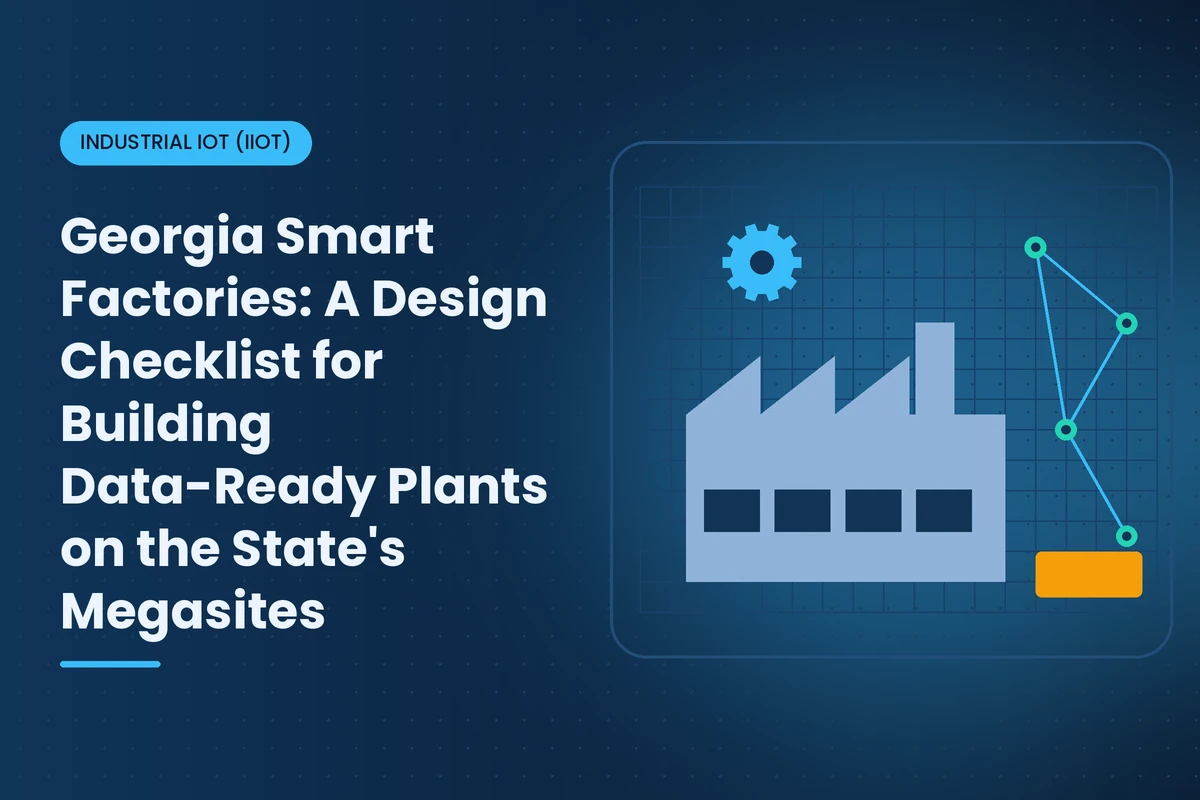
Georgia Smart Factories: A Design Checklist for Building Data-Ready Plants on the State's Megasites
Industrial IoT (IIoT)
Published by IOT Georgia Research & Editorial Team
- Why the Design Phase Decides So Much
- The Smart Factory Design Checklist
- 1. Network architecture
- 2. Power, power quality and energy data
- 3. Data model and naming
- 4. Equipment specifications
- 5. Commissioning with data
- 6. Cybersecurity by design
- 7. Edge and cloud balance
- 8. Workforce pipeline
- Lessons From Georgia's Largest Projects
- Supplier Plants: Smaller Budgets, Same Expectations
- An Illustrative Example
- Expanding an Existing Georgia Plant
- Common Mistakes on New Plant Projects
- Where Georgia Smart Factories Are Heading
Georgia is in the middle of one of the largest factory building waves in its history. Hyundai Motor Group Metaplant America opened in Ellabell in 2025. Rivian began vertical construction at Stanton Springs North in 2026 and has said it now plans initial capacity of 300,000 vehicles a year, with production expected in late 2028. Battery, solar and component suppliers have followed, and dozens of smaller plants are rising along the I-16, I-75, I-85 and I-20 corridors.
Every one of these projects faces the same decision point: design data and connectivity in from the start, or bolt them on later. Retrofitting is always possible, but it costs more, disrupts production and usually delivers less. This article is a practical design checklist for owners, engineers and project teams building or expanding a smart factory in Georgia. For a broader view of maturity levels, see our smart manufacturing maturity ladder.
Why the Design Phase Decides So Much
Once walls are up and equipment is set, some choices are expensive to change. Cable trays, network rooms, power distribution, equipment specifications and naming conventions all get locked in early. A plant that specifies open data access in every equipment purchase order will have a connected floor at launch. A plant that does not will spend years negotiating with machine builders for access to their own data.
| Decision | Cost to Get Right at Design | Cost to Fix After Startup |
|---|---|---|
| Network cabling and equipment rooms | Modest, part of construction | High, requires work in a running plant |
| Data access clauses in equipment contracts | Near zero, contract language | High, custom integration per machine |
| Asset naming and data model | Low, a planning exercise | High, rework across every system |
| Energy submetering | Low during electrical design | Moderate to high, shutdowns needed |
| Cybersecurity architecture | Moderate | High, redesign under production pressure |
The Smart Factory Design Checklist
1. Network architecture
- Separate office, production and safety networks, with controlled connections between them.
- Plan redundant fiber paths to critical areas so a single cut does not stop a line.
- Design wireless coverage for the actual floor, including mobile robots, handheld devices and wireless sensors. Consider private LTE or 5G for very large sites.
- Reserve space, power and cooling in network rooms for growth. Plants almost always add devices faster than expected.
2. Power, power quality and energy data
- Include submeters on major loads and production areas from day one.
- Install power quality monitoring at the main service and critical feeders. Georgia's summer thunderstorms make voltage sags and transients a real risk for drives and robots.
- Coordinate early with the utility. Large new loads on Georgia megasites often need new transmission and substation work, and demand charges shape how you schedule energy-intensive processes.
3. Data model and naming
- Agree on a single naming structure for sites, areas, lines and assets before equipment arrives. Standards such as ISA-95 provide a useful framework.
- Use the same asset IDs in engineering drawings, the maintenance system, the MES and the data platform.
- Decide where data will be contextualized, whether at the edge, in a central platform or both.
4. Equipment specifications
- Require open, documented data interfaces such as OPC UA or MQTT on new machines.
- Specify which data points each machine must publish, including state, counts, faults, cycle times and key process values.
- Include cybersecurity requirements for vendor equipment and remote access.
- Require documentation and ownership of data, not just machine functions.
5. Commissioning with data
- Include data validation in factory acceptance and site acceptance tests. A machine is not accepted until its data arrives correctly in the plant systems.
- Capture baseline performance during ramp-up so later improvements can be measured.
6. Cybersecurity by design
- Use a zones and conduits model, such as the one in the IEC 62443 series, to segment control systems.
- Centralize and monitor vendor remote access rather than allowing individual modems or accounts.
- Plan asset inventory and patch management for operational technology from the start. Our IIoT security primer covers the basics.
7. Edge and cloud balance
- Keep time-critical control and safety local.
- Use edge computing for data filtering, buffering during network outages and local analytics. See our guide to edge computing in Georgia industrial settings.
- Send contextualized data to cloud platforms for enterprise reporting and heavier analytics.
8. Workforce pipeline
- Plan training for technicians who can maintain robots, networks and data systems, not only mechanical equipment.
- Use Georgia's programs. Georgia Quick Start provides free customized training to qualifying new and expanding companies. Rivian, working with the Technical College System of Georgia, runs a technical trades apprenticeship for its Stanton Springs plant, with tuition covered by HOPE Grants.
- Involve maintenance and operations leads in design reviews so the plant is built around the people who will run it.
Lessons From Georgia's Largest Projects
Hyundai describes its Ellabell plant as a software-defined factory that integrates AI and robotics throughout production. In September 2026, Boston Dynamics opened a Robotics Metaplant Application Center on the campus to train Atlas humanoid robots on real manufacturing tasks. Rivian's Georgia plant will be built around its midsize vehicle platform, and the company has pointed to advanced automation as part of the plant's design. The common thread is that data infrastructure and automation are treated as core building systems, like power and water, rather than as IT add-ons.
Few projects operate at that scale, but the principle applies to a 150,000-square-foot supplier plant as much as a gigafactory. Decide what data you need, design the building and contracts to deliver it, and train people to use it.
Supplier Plants: Smaller Budgets, Same Expectations
Many of the new plants in Georgia are suppliers to larger OEMs, often built quickly to meet launch dates. They face the same customer expectations for traceability, quality data and delivery performance with far smaller engineering teams. Practical priorities for these plants include:
- Standardizing on one controls platform and one data platform where possible.
- Buying equipment with data interfaces already included instead of adding them later.
- Designing traceability for parts and lots into the process, because customers will ask for it.
- Using integrators with experience at similar supplier plants in the Southeast.
An Illustrative Example
Consider a hypothetical tier-one supplier building a 200,000-square-foot plant along the I-16 corridor to supply interior modules to an EV assembly plant. The project team has 14 months from groundbreaking to first shipment. Early in design, the team writes a one-page data specification that every equipment vendor must meet: publish machine state, counts, faults and key process values over OPC UA, support centralized remote access only, and deliver tag lists with the machine documentation. The electrical engineer adds submeters on each production cell and the compressed air system. The IT and controls leads agree on asset names that match the maintenance system.
At launch, every line reports into one dashboard on day one. During ramp-up, the data shows that one welding cell is running well below its planned rate because of fixture changeover delays, and the team fixes it within weeks instead of discovering it months later through missed shipments. When the customer requests traceability records during an early quality issue, the supplier produces them the same day. None of that required advanced technology. It required a few decisions made before equipment was ordered.
Expanding an Existing Georgia Plant
Not every smart factory is greenfield. Expansions are an opportunity to raise the standard. Build the new area to your target design, then connect legacy areas through gateways and wireless sensors over time. Avoid the trap of making the new line match the old one's limitations just for consistency. Our overview of industrial IoT in Georgia explains the brownfield side.
Common Mistakes on New Plant Projects
- Leaving data to the end. When construction schedules slip, data integration is often cut first, leaving a plant that launches blind.
- Letting every machine builder choose their own approach. The result is a mix of incompatible systems and remote access paths.
- Underestimating wireless needs. Mobile robots, scanners and sensors can overwhelm a network designed only for laptops.
- No owner for plant data. Someone must be accountable for data quality after the project team leaves.
- Treating cybersecurity as an IT task. Operational technology security needs operations and engineering involvement.
Where Georgia Smart Factories Are Heading
Over the next few years, expect more physical AI on Georgia factory floors, starting at the largest plants, and more AI assistants helping technicians troubleshoot with live data. Energy will become a design driver as large plants and data centers compete for grid capacity, making on-site energy management and demand response more valuable. And the gap between plants designed for data and plants that were not will widen. Projects breaking ground today have a one-time chance to land on the right side of that gap.
For related reading, see our look at IoT on Georgia construction jobsites and our guide to grid edge IoT and demand response. To find integrators and platform providers, browse the IoT Georgia company directory or explore industrial IoT providers in Savannah and construction and real estate IoT in Atlanta. Browse more of our Industrial IoT coverage.
Tags:
Related articles
Industrial IoT (IIoT)
 Industrial IoT (IIoT)
Industrial IoT in Georgia: How Legacy Mills and New Gigafactories Use Connected Operations Differently
 Industrial IoT (IIoT)
Industrial IoT in Georgia's Process Plants: Paper, Chemicals, and Materials
 Industrial IoT (IIoT)