 Manufacturing IoT

Smart Manufacturing in Georgia: A Five-Rung Maturity Ladder from First Sensor to Humanoid Robots
Manufacturing IoT
Published by IOT Georgia Research & Editorial Team
- The Smart Manufacturing Ladder
- Rung One: Connected
- Rung Two: Visible
- Rung Three: Predictive
- Rung Four: Adaptive
- Rung Five: Autonomous
- Where Digital Twins Fit
- How the Largest Plants Raise the Bar for Everyone Else
- The People Side of Smart Manufacturing
- A Quick Self-Assessment
- Risks to Manage on the Way Up
- What Comes Next for Georgia Plants
"Smart manufacturing" gets used to describe almost anything, from a tablet on a workstation to a plant where humanoid robots sequence parts. That vagueness makes it hard for Georgia manufacturers to know where they stand or what to do next. A more useful way to think about it is as a ladder. Each rung builds on the one below, each has a clear payoff, and very few plants need to reach the top.
This article lays out a five-rung maturity ladder, shows what each level looks like in Georgia, and explains the workforce and data foundations needed to climb. It is meant for owners, plant managers and engineers who want a realistic roadmap rather than a vision statement.
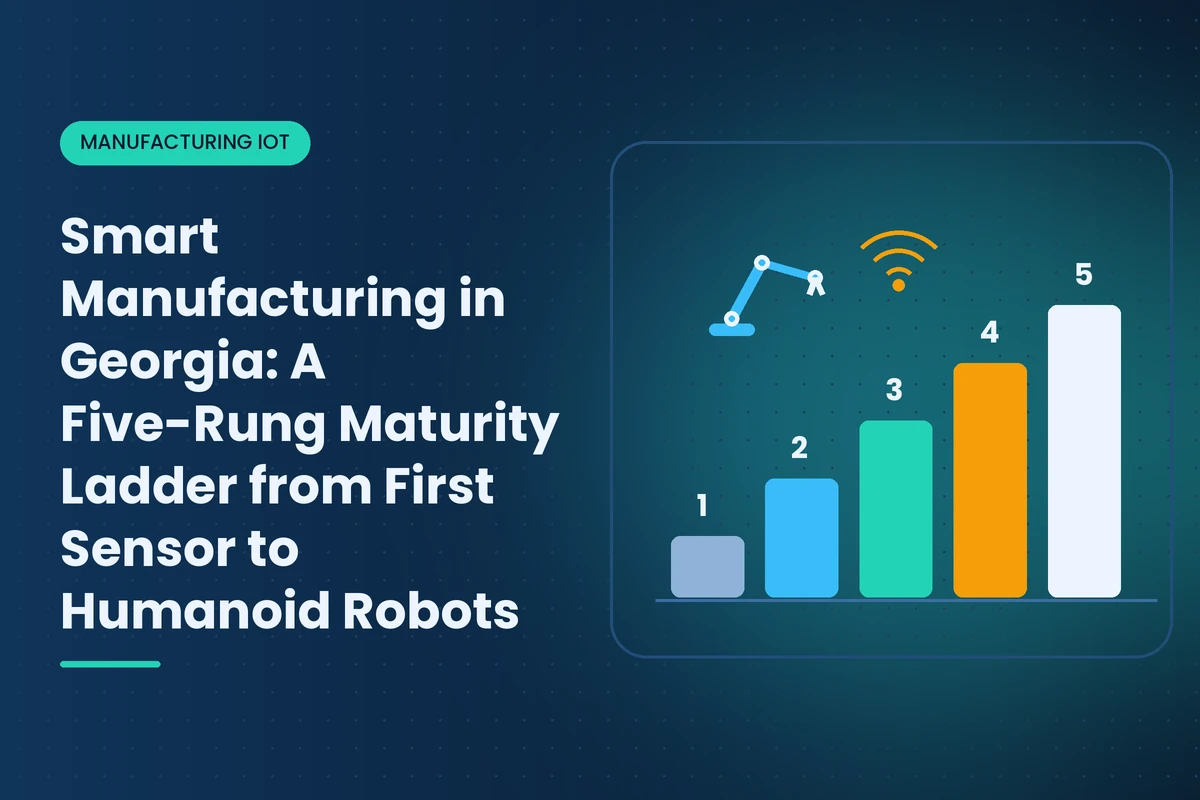
The Smart Manufacturing Ladder
| Rung | What It Looks Like | Key Question Answered | Skills Needed |
|---|---|---|---|
| 1. Connected | Critical machines report state and counts automatically | What is happening right now? | Basic networking, sensor installation |
| 2. Visible | Dashboards show OEE, energy and quality by line and shift | Where are we losing time and money? | Data literacy for supervisors |
| 3. Predictive | Models flag equipment and quality problems before they occur | What is about to go wrong? | Condition monitoring, basic analytics |
| 4. Adaptive | Systems adjust schedules, settings or maintenance automatically within limits | What should we change, and can the system do it? | Controls engineering, MES integration |
| 5. Autonomous | AI and robots plan and execute tasks with human oversight | How do we run with people supervising rather than operating? | AI, robotics, systems engineering |
Most Georgia plants sit between rungs one and two. That is not a failure. The largest gains per dollar usually come from moving up the first two rungs, because they expose losses that nobody could see before.
Rung One: Connected
Being connected means data flows without someone writing it down. Machine run states, part counts, fault codes and energy use arrive automatically. For older equipment, this often means non-invasive sensors on motor feeds and stack lights. For newer equipment, it means reading data the controller already has.
The trap at this rung is collecting everything. Connect the constraint machines first, the ones that set your plant's output, and add others only when there is a question to answer. Our 90-day IoT plan for Georgia manufacturers walks through this step in detail.
Rung Two: Visible
Visibility turns raw data into a shared picture. A supervisor can see that second shift loses 40 minutes a night to changeovers, or that one press uses far more energy than its twin. The payoff is cultural as much as technical: arguments about what happened are replaced by a common set of numbers.
The key discipline here is keeping it simple. A handful of metrics reviewed every day beats a wall of charts. Tie every metric to someone who can act on it.
Rung Three: Predictive
Predictive plants use trends to spot problems early. Vibration and temperature data reveal bearing wear weeks ahead of failure. Process data shows when a mold, oven or extruder is drifting toward bad parts. This is where condition monitoring and machine learning start to pay, especially on equipment where a failure is expensive or dangerous.
For a deeper look at the maintenance side, see our guide to predictive maintenance in Georgia's climate and our analysis of predictive maintenance ROI for Georgia manufacturers.
Rung Four: Adaptive
At this level, systems stop just warning people and start adjusting within guardrails. A scheduling system resequences orders when a machine goes down. A process controller tweaks temperatures to keep quality in range. Maintenance work orders open automatically when a condition threshold is crossed. Adaptive plants need tight integration between shop floor systems, manufacturing execution software and business systems, and they need clear rules about what the system may change on its own.
Rung Five: Autonomous
Georgia now has one of the country's clearest examples of a plant designed to reach this rung. Hyundai Motor Group Metaplant America in Ellabell opened in March 2025 and is described by the company as a software-defined factory that integrates AI and robotics. In September 2026, Boston Dynamics opened a Robotics Metaplant Application Center on the campus to train Atlas humanoid robots on tasks like preparing and sequencing parts for assembly, and Hyundai has said it plans to deploy humanoids at the plant starting in 2028, with Kia's West Point plant expected to follow.
For most manufacturers, the lesson is not to buy humanoids. It is that autonomy sits on top of the four rungs below it. Robots and AI agents need reliable connectivity, clean data, predictive insight and integrated systems before they can act safely.
Where Digital Twins Fit
Digital twins, virtual models of a machine, line or plant that update from real data, are often presented as a smart manufacturing starting point. In practice they belong around rungs three and four. A twin is only as good as the data feeding it, so plants without reliable machine connectivity end up with an attractive simulation that does not match reality. Once data is trustworthy, twins become useful for testing layout changes, balancing lines before a new product launch and training operators on scenarios that are too risky to practice on live equipment. Georgia Tech's research facilities and several Atlanta-area integrators work in this area, which gives Georgia plants local options when they are ready.
How the Largest Plants Raise the Bar for Everyone Else
When a software-defined factory sits at the top of a supply chain, its expectations move down the chain. Hyundai has committed billions of dollars to localizing parts and logistics around its Georgia operations, and automakers generally ask suppliers for electronic quality records, traceable lot data and reliable delivery performance. A supplier at rung one can still win work, but a supplier at rung two or three can prove its performance with data, respond faster to quality questions and plan capacity with more confidence. For many tier two and tier three plants in Georgia, climbing the ladder is becoming a customer requirement rather than an internal project.
The People Side of Smart Manufacturing
Technology is rarely what stops a plant from climbing. Skills and trust are. Georgia has invested heavily in both.
- Georgia Quick Start has provided free, customized workforce training to qualifying new and expanding companies since 1967. It helped design the Kia Georgia Training Center, where the company's Georgia workforce received training in robotics, welding and electronics.
- Georgia AIM, backed by a $65 million federal grant, supports AI in manufacturing through an AI Manufacturing Pilot Facility at Georgia Tech and partners including the Technical College System of Georgia and Spelman College. Its stated goal is AI that complements workers rather than replacing them.
- The Technical College System of Georgia operates 22 colleges with 88 campuses that offer industrial maintenance, mechatronics and controls programs, plus contract training for employers.
- GaMEP at Georgia Tech helps small and mid-sized manufacturers with operational improvement, technology adoption and workforce development.
Roles change as plants climb. Maintenance technicians become condition analysts who interpret trend data. Supervisors manage by metrics rather than walking the floor to count parts. Controls engineers become integrators who connect systems across the plant. Planning for those shifts early makes adoption smoother and keeps experienced people engaged instead of sidelined.
A Quick Self-Assessment
Answer these honestly to find your rung:
- Can you see the current status of your constraint machine without walking to it?
- Do you know your OEE for last week, calculated from machine data rather than estimates?
- Has a sensor alert prevented a breakdown in the last six months?
- Does any system change a schedule, setting or work order automatically?
- Do any machines or software agents make decisions that a person only reviews?
Your rung is the last question you can answer with a confident yes. Your next project should aim at the question right after it.
Risks to Manage on the Way Up
- Cybersecurity. Every connection adds exposure. Segment production networks and control remote access. Our IIoT security guide covers the basics.
- Data silos. Separate systems for maintenance, quality and production make higher rungs impossible. Agree on shared asset names and IDs early.
- Pilot purgatory. Proofs of concept that never scale waste budget and credibility. Define what success looks like before each pilot starts.
- Skipping rungs. AI projects built on unreliable data disappoint. Fix the foundation first.
What Comes Next for Georgia Plants
Three trends will shape smart manufacturing in Georgia over the next few years. Physical AI will move from demonstration to production at the largest plants, starting with repetitive and higher-risk tasks. AI assistants will help technicians diagnose faults by combining manuals, maintenance history and live sensor data. And supplier expectations will keep rising as large OEMs ask their supply chains for more digital data. Plants that climb steadily, one rung at a time, will be in a strong position to take advantage of all three.
For more context, read our state of IoT in Georgia report and our look at edge computing in industrial settings. To find partners, browse the IoT Georgia company directory or explore manufacturing IoT providers in Savannah and Atlanta. Browse more of our Manufacturing IoT coverage.
Tags:
Related articles
Manufacturing IoT
 Manufacturing IoT
Robotics and IoT Are Changing Automotive Manufacturing in Georgia: What the Robot Fleet Needs to Run Well
 Manufacturing IoT
Hyundai's Georgia Metaplant: Inside the State's New Smart-Manufacturing Model
 Manufacturing IoT