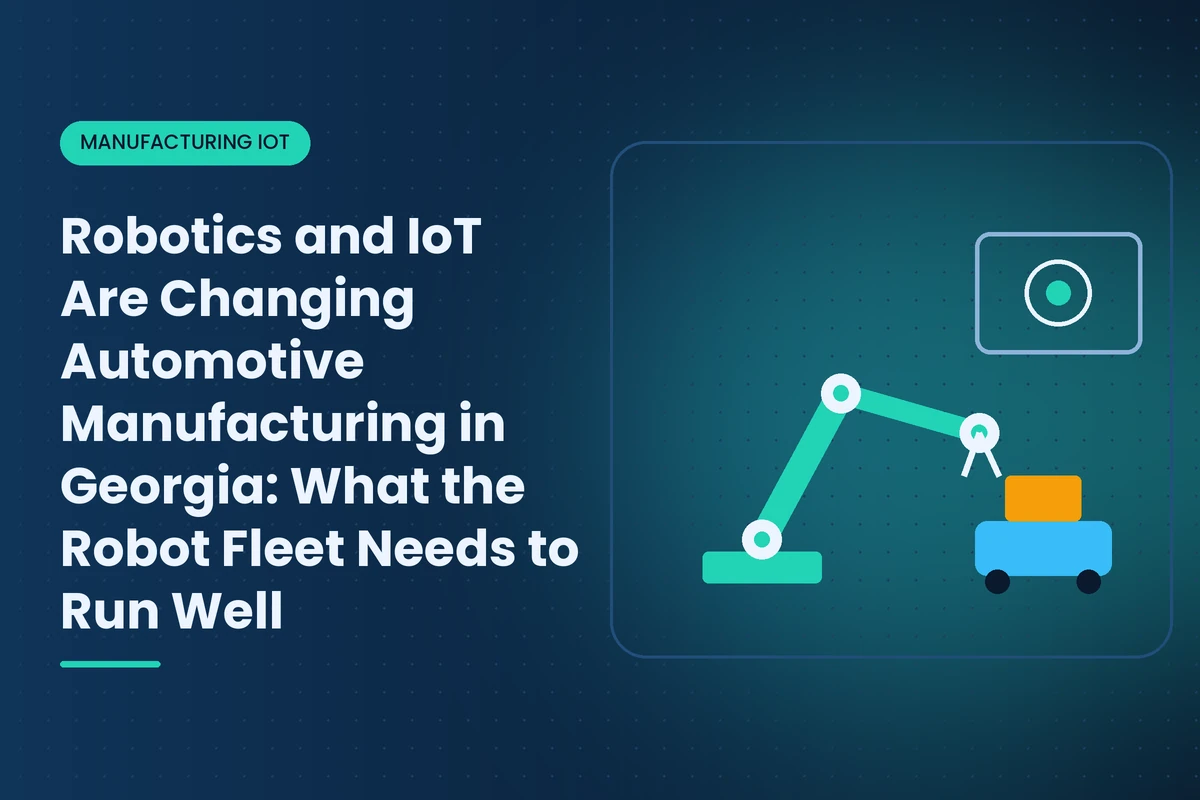
Walk through a modern Georgia auto plant and the robots are hard to miss. Articulated arms weld body panels and apply sealer. Painting robots coat every vehicle. Autonomous mobile robots carry parts to the line, and camera systems inspect gaps, welds and paint finish. At the Hyundai Metaplant in Ellabell, Boston Dynamics opened a Robotics Metaplant Application Center in September 2026 to train Atlas humanoid robots on real production tasks, with deployment planned from 2028 and Kia's West Point plant expected to follow.
What gets less attention is the layer underneath. Every robot is also a connected device that generates data, needs monitoring, depends on networks and must be secured. A plant with hundreds of robots is effectively running a large IoT fleet. This article looks at robotics in Georgia automotive manufacturing from that angle: what kinds of robots are on the floor, what data they produce, how plants keep them running, and what changes as robots become more autonomous. For a shop-by-shop overview of auto plant IoT, see our article on IoT in automotive manufacturing.
| Robot Type | Typical Tasks | Key Data It Produces | Main IoT Need |
|---|
| Industrial articulated robots | Welding, sealing, material handling, painting | Joint torque, motor current, cycle time, faults, process parameters | Health monitoring and process quality |
| Collaborative robots (cobots) | Screwdriving, light assembly, inspection, ergonomically hard tasks | Force readings, task completion, safety stops | Safety logging and task verification |
| Autonomous mobile robots (AMRs) | Moving parts and kits to the line | Location, battery state, mission status, obstacles | Fleet management and wireless coverage |
| Vision and inspection systems | Gap and flush, weld and paint inspection | Images, measurements, pass and fail results | Data storage and links to vehicle records |
| Legged inspection robots | Facility patrols for heat, sound and gauge readings | Thermal images, acoustic data, readings | Integration with maintenance systems |
| Humanoid robots (emerging) | Parts sequencing and handling, planned from 2028 at the Metaplant | Task performance, perception data, interventions | Training data, safety and supervision |
When a robot stops in a body shop, the whole line can stop with it. In high-volume plants, that can idle hundreds of people and cost significant output per hour. That is why robot health monitoring is one of the most valuable IoT applications in automotive plants.
- Reducer and gearbox wear. Rising torque or motor current for the same motion is an early sign of wear in the gear reducers inside robot joints.
- Cable and hose packages. Dress packs that flex millions of times eventually crack. Intermittent faults in specific positions often point here.
- Welding consumables. Spot weld tip wear and dressing cycles affect weld quality and can be tracked automatically.
- Cycle time drift. A robot that slowly takes longer to complete its program may have mechanical, programming or upstream problems.
- Fault patterns. Repeated minor faults at the same station often predict a larger failure.
Most major robot makers offer connected monitoring tools that collect this data. Plants that combine those tools with their own maintenance systems, so a warning creates a work order and parts request automatically, get the most value. Our guide to predictive maintenance in Georgia's climate explains how humidity and power quality affect robot controllers and drives too.
AMRs and automated guided vehicles have become standard for moving parts from receiving or sequencing areas to the line. Unlike fixed conveyors, they can be rerouted in software as layouts and model mixes change, which suits plants building EVs and hybrids side by side. They also bring new IoT demands:
- Wireless coverage everywhere. AMRs depend on reliable Wi-Fi or private cellular across the entire route, including dense racking and near large metal equipment.
- Fleet management. Software assigns missions, manages traffic and schedules charging. Data on mission times and delays reveals bottlenecks.
- Battery management. Charging schedules, battery health and temperature affect availability, especially in hot areas of a building during Georgia summers.
- Integration with production systems. Missions should be triggered by line consumption and sequence data, not manual calls.
Collaborative robots are designed to work near people with built-in force and speed limits. In auto plants and supplier facilities, they often take on tasks that are hard on the body, such as overhead screwdriving, repetitive lifting or tight-space assembly. IoT data from cobots helps in two ways. It verifies that each task was completed correctly, such as screw torque and count, and it records safety-related stops that show where layouts or processes need adjustment. International robot safety standards, ISO 10218 parts 1 and 2, were revised in 2025 to give clearer guidance on collaborative applications, and plants should review installations against current requirements.
Camera-based inspection produces far more data than most other plant systems. A single vehicle can generate many images across body, paint and final inspection. Plants need to decide what to keep, for how long and where. Edge computing near the cameras can process images and send only results and exceptions to central systems. Linking inspection results to vehicle identification numbers turns them into traceability records and helps teams trace defects back to specific stations or robots. See our guide to edge computing in Georgia industrial settings.
Robot controllers, AMR fleets and vision systems all connect to plant networks, and many vendors need remote access for support. Each connection is a potential path for attackers. Practical safeguards include:
- Placing robot cells and AMR fleets in segmented network zones.
- Centralizing vendor remote access through monitored, time-limited connections.
- Keeping an up-to-date inventory of robot controllers, software versions and network addresses.
- Planning patches and updates during scheduled downtime with rollback plans.
- Backing up robot programs and configurations so cells can be restored quickly.
Our IIoT security primer covers these basics in more detail.
Robotics is not limited to the big assembly plants. Tier one and tier two suppliers across Georgia use robots for welding, molding part removal, palletizing and machine tending. For smaller plants, the business case often rests on labor availability and consistency rather than speed. Starting with one well-understood task, connecting the robot to a monitoring system from day one and training in-house technicians to maintain it usually works better than large, complex cells. Our guide to machine monitoring in Georgia factories shows how to track robot cells alongside other equipment.
Imagine a supplier in Troup County that welds and assembles seat frames for nearby assembly plants. It runs 24 welding robots in six cells. Unplanned stops were frequent, and maintenance found problems only after they caused downtime. The plant connected each robot controller to a monitoring platform that tracked motor current, fault codes, weld counts and cycle time. Within three months, the data showed that two robots had steadily rising torque on one axis, which led to planned reducer replacements during a weekend instead of failures during production. Weld tip dressing was also adjusted based on actual weld counts rather than fixed intervals, reducing quality rejects. The supplier now uses the same data to plan staffing for maintenance on each shift.
- What data does the robot controller expose, and can it feed our monitoring and maintenance systems directly?
- How will remote support work, and how is that access secured?
- What spare parts and service response can we expect locally in Georgia?
- How will our technicians be trained to maintain and reprogram the cell?
- How does the cell handle product variants and future model changes?
Plants increasingly need technicians who can troubleshoot robots, read trend data and work with networks. Georgia has several pipelines. Georgia Quick Start provides free customized training for new and expanding companies and helped create the Kia Georgia Training Center, where workers trained in robotics, welding and electronics. The Technical College System of Georgia offers robotics and mechatronics programs across the state. Georgia AIM at Georgia Tech supports manufacturers adopting AI and automation with an emphasis on tools that complement workers. Plants that budget for training alongside robots get far more value from both.
Three trends will shape the next few years. Humanoid robots will move from training centers to limited production use, starting with the Metaplant's plans for 2028. AI will make robots easier to program and adapt, reducing the engineering time needed for model changes. And robot data will increasingly feed plant-wide analytics, connecting robot health, quality results and production schedules. The plants that benefit most will be those that treat their robot fleet as part of a connected system, monitored, secured and maintained with the same discipline as any other critical infrastructure.
For related reading, see our profile of Hyundai's Georgia Metaplant and our article on sensors that reduce downtime on Georgia factory floors. To find robotics and automation partners, browse the IoT Georgia company directory or explore manufacturing IoT providers in Columbus and Savannah. Browse more of our Manufacturing IoT coverage.
Frequently asked questions
Robots weld, seal, paint, handle materials, assemble parts, move parts with autonomous mobile robots and inspect vehicles with vision systems. Humanoid robots are planned at the Hyundai Metaplant from 2028.
Robot stops can halt entire lines. Monitoring motor current, torque, faults and cycle times reveals wear and problems early so maintenance can be planned before failures occur.
AMRs carry parts and kits from storage or sequencing areas to the line. They need reliable wireless coverage, fleet management software, battery management and integration with production schedules.
Cobots are designed with force and speed limits for work near people, but each application needs a risk assessment. The ISO 10218 robot safety standards were revised in 2025 with clearer guidance on collaborative use.
Segment robot networks, centralize and monitor vendor remote access, maintain an inventory of controllers and software, plan updates carefully and back up robot programs.
Georgia Quick Start, the Technical College System of Georgia and programs supported by Georgia AIM at Georgia Tech offer robotics, mechatronics and automation training.
Related articles

 Manufacturing IoT