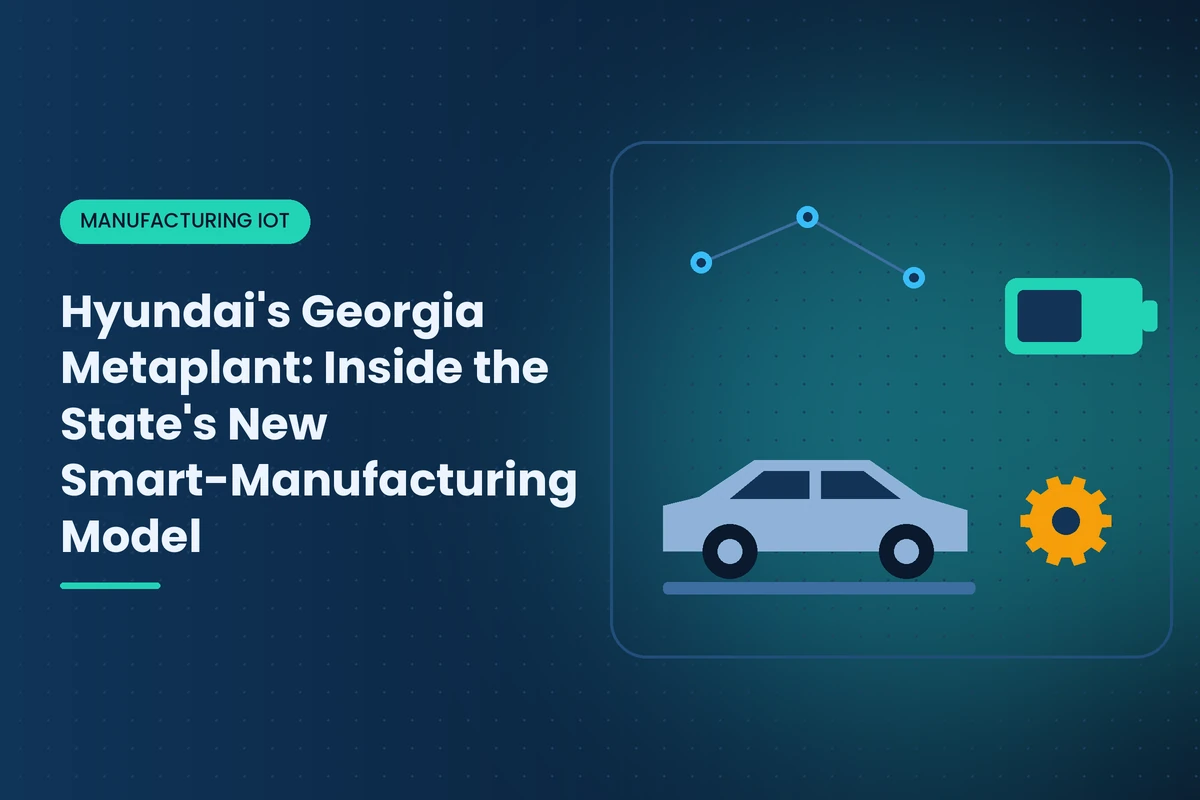
When the first Hyundai IONIQ 5 rolled off the line in Ellabell on October 3, 2024, less than two years after groundbreaking, Georgia gained more than a car plant. Hyundai Motor Group Metaplant America (HMGMA) is the centerpiece of what the company describes as a $12.6 billion investment in Georgia and the largest economic development project in the state's history. It is also the clearest working example in the Southeast of a plant designed from the start around data, connectivity and automation.
This article looks at the Metaplant as a model rather than a headline. What is actually different about how it is built and run? Which parts of that model can other Georgia manufacturers borrow, and which only make sense at a gigafactory scale? And what has the plant's first two years taught about the risks of building this way?
| Item | Detail |
|---|
| Location | Ellabell, Bryan County, about 20 miles west of Savannah |
| First vehicle | Hyundai IONIQ 5, October 3, 2024 |
| Current models | Hyundai IONIQ 5 and IONIQ 9 EVs, Kia Sportage Hybrid |
| Target capacity | 500,000 EVs and hybrids a year across Hyundai, Kia and Genesis |
| Jobs goal | 8,500, which Hyundai reaffirmed in September 2026 |
| On-site battery cells | Joint venture with LG Energy Solution designed for 40 GWh a year |
| Related Georgia battery plant | Hyundai and SK On joint venture in Bartow County, initial production in June 2026 |
Hyundai calls the site a Metaplant and describes it as an intelligent manufacturing plant where order collection, procurement, logistics and production are optimized with AI and data. Stripped of marketing language, that comes down to a few practical design choices.
In many older plants, sales orders, supplier schedules, production sequencing and quality records live in separate systems that exchange data in batches. The Metaplant model connects them so that a change in customer orders flows through to parts orders, logistics and line sequencing quickly. For suppliers, that means schedules and quality expectations arrive electronically and change more often.
The plant was designed to build both EVs and hybrids, and that flexibility was tested early. As U.S. EV demand cooled after federal consumer tax credits for EVs ended, Hyundai added the Kia Sportage Hybrid in 2026, the plant's first Kia model and first hybrid. Industry coverage noted that the line absorbed hybrid production with little interruption. Hyundai has said it plans to offer more than 10 hybrid models in North America by 2030 while keeping its 500,000-vehicle target for the plant. That kind of mix change is far easier when stations identify each vehicle digitally and load the right programs, parts and checks automatically.
Battery cells come from the on-site joint venture with LG Energy Solution, now called HLBMA, which employs more than 500 people. Cells move to a Hyundai Mobis battery system assembly operation that packages them onto the vehicle's skateboard chassis, which then travels into the assembly area by conveyor. Short, connected supply loops like this reduce inventory and transport, but they also make each operation dependent on the others' data and uptime.
Robots handle much of the heavy and repetitive work, and the plant has served as a proving ground for Hyundai's robotics affiliate, Boston Dynamics. In September 2026, Boston Dynamics opened a Robotics Metaplant Application Center on the campus to train Atlas humanoid robots on real production tasks, and Hyundai has said it plans to deploy humanoids at the plant starting in 2028. Our article on robotics and IoT in Georgia automotive manufacturing goes deeper on that shift.
Most Georgia plants will never operate at Metaplant scale, but several of its principles translate well to a 200-person supplier or a mid-sized food or chemical plant.
| Metaplant Principle | How a Smaller Plant Can Apply It |
|---|
| Connected order-to-production data | Link ERP orders to shop floor schedules and machine data, even with simple integrations |
| Flexible lines | Use digital work instructions and barcode or RFID identification so stations adapt to product variants |
| Data access designed in | Require open data interfaces in every new equipment purchase |
| Close supplier integration | Share schedules, quality data and shipping notices electronically with key customers and suppliers |
| Automation where it pays | Automate ergonomically hard or repetitive tasks first, measured against real downtime and quality data |
Our smart factory design checklist turns these principles into specific decisions for new plants and expansions, and our smart manufacturing maturity ladder helps existing plants see which step comes next.
Hyundai has framed its Georgia investment as a localization strategy, with large sums committed to building parts and logistics capacity near its plants. Hyundai Glovis handles logistics for the site, and a growing ring of suppliers has set up in the counties surrounding the plant. For those suppliers, the Metaplant's data-driven approach shows up in daily requirements:
- Electronic schedules that update frequently and must be acknowledged.
- Delivery in sequence, where parts arrive in the exact order vehicles are built.
- Traceability records for safety-critical parts, linked to vehicle identification numbers.
- Quality data shared quickly when issues arise, often within hours.
- Returnable container management, which our guide to IoT asset tracking in Georgia covers in detail.
Suppliers that can produce this data automatically spend less time on manual reporting and are better positioned for new programs.
The plant was announced during a period of fast EV growth. Since then, federal EV purchase incentives have ended, and U.S. EV sales have been roughly flat as a share of the market. Georgia's wider EV supply chain has felt it: SK Battery America laid off 958 workers at its Commerce plant in March 2026. The Metaplant's ability to add hybrids without changing its long-term targets shows why flexibility belongs in the design of any new plant, not just the largest ones.
In September 2025, a federal immigration enforcement operation at the battery plant construction site detained hundreds of workers, most of them South Korean nationals, and was reported to have delayed battery production by two to three months. Whatever one's view of the enforcement action, the episode showed how dependent advanced plant launches are on specialized installation crews and how much schedule risk sits in equipment commissioning.
Even highly automated plants ramp up gradually, and the Metaplant is no exception. Hiring, training, supplier readiness and quality stabilization all take months. Data from connected systems shortens that learning curve by showing where problems occur, but it does not remove it.
The Metaplant depends on people who can work with robots, data and complex equipment. Georgia's training system has been central to that. Georgia Quick Start, the state's free customized training program for new and expanding companies, has supported major automotive projects, including the Kia Georgia Training Center in West Point. The Technical College System of Georgia offers mechatronics, industrial maintenance and robotics programs across the state, including in the Savannah region. For any manufacturer studying the Metaplant, the lesson is that technology investment and training investment have to move together.
Consider a hypothetical 150-person plastics and assembly supplier in Effingham County that wins a contract to supply interior components to the Metaplant. Its existing customer base accepted weekly schedules by email and paper inspection records. The new program requires electronic schedule updates several times a day, sequenced deliveries and lot-level traceability. The supplier connects its presses and assembly stations to a monitoring platform, adds scanning at each step, and integrates shipping notices with the customer's system. The first months are hard, but within a quarter the team can answer quality questions in hours instead of days, and on-time delivery becomes something it can prove with data rather than estimate. That is how the Metaplant model spreads: one supplier at a time.
Over the next few years, watch for three developments at and around the Metaplant. More models, including additional hybrids and Kia and Genesis vehicles, will test how far the plant's flexibility goes. Humanoid robots, starting from 2028, will show whether physical AI can handle real assembly tasks at scale. And the supplier base around Savannah will continue to grow and mature, raising the bar for data and automation across Coastal Georgia. For manufacturers elsewhere in the state, the Metaplant is less a template to copy than a reference point for what connected production can look like, and a reminder that flexibility, data and skilled people matter as much as the equipment itself.
For related reading, see our look at IoT in automotive manufacturing and our guide to industrial IoT opportunities in Georgia's EV and battery plants. To find partners, browse the IoT Georgia company directory or explore manufacturing IoT providers in Savannah. Browse more of our Manufacturing IoT coverage.
Frequently asked questions
Hyundai Motor Group Metaplant America is in Ellabell, Bryan County, about 20 miles west of Savannah. Its first vehicle, a Hyundai IONIQ 5, rolled off the line on October 3, 2024.
The plant builds the Hyundai IONIQ 5 and IONIQ 9 electric vehicles and, since 2026, the Kia Sportage Hybrid. It is designed to build EVs and hybrids for Hyundai, Kia and Genesis.
Hyundai describes it as a software-defined factory where order collection, procurement, logistics and production are optimized with AI and data. It combines flexible lines, extensive automation and on-site battery production.
Hyundai targets 500,000 EVs and hybrids a year at full capacity and has reaffirmed a goal of 8,500 jobs at the site.
Connect order and production data, build flexibility into lines, require open data access in equipment purchases, share data electronically with partners and automate where real data shows the payoff.
Suppliers face electronic schedules, sequenced deliveries, lot-level traceability and faster quality data sharing. Those that automate this data are better positioned to win and keep business.
Related articles

 Manufacturing IoT