 Logistics & Transportation

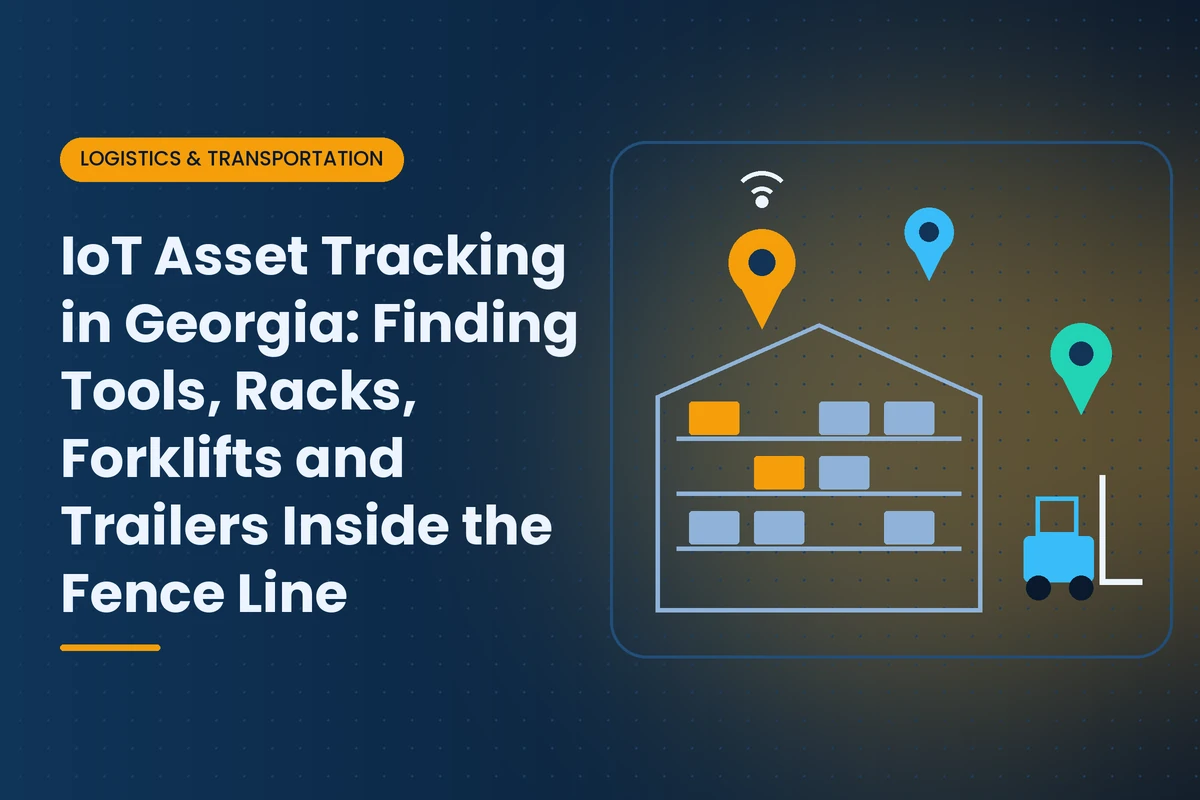
IoT Asset Tracking in Georgia: Finding Tools, Racks, Forklifts and Trailers Inside the Fence Line
Logistics & Transportation
Published by IOT Georgia Research & Editorial Team
- What Goes Missing and What It Costs
- Choosing the Right Tracking Technology
- Georgia Use Cases That Pay Back
- Returnable racks in the automotive supply chain
- Trailer yards around Savannah and Atlanta
- Tool control in aerospace and MRO
- Molds and dies in plastics and metal forming
- Forklifts and mobile equipment
- Design Decisions That Make or Break a System
- Georgia-Specific Challenges
- A Practical Rollout Plan
- Questions to Ask Tracking Vendors
- People and Privacy
- How to Think About Return on Investment
- What's Next for Asset Tracking
Every industrial site in Georgia loses things. A torque wrench disappears from a hangar. A rack of returnable containers never comes back from a customer. A trailer sits in the wrong row of a Savannah-area yard for two days. A mold that should be ready for tomorrow's run turns out to be at the repair shop. None of these events makes headlines, but together they cost plants and distribution centers real money in search time, duplicate purchases, missed shipments and idle labor.
IoT asset tracking addresses that problem by attaching tags or trackers to things that move and reading their location automatically. Our site already covers asset tracking in Georgia hospitals and fleet tracking on the road. This guide focuses on what happens inside the fence line of factories, warehouses, hangars and yards.
What Goes Missing and What It Costs
The assets worth tracking share three traits: they move, they are shared, and losing track of them stops or slows work. In Georgia industrial settings, the usual candidates are:
- Returnable packaging. Racks, bins and dunnage that shuttle between suppliers and assembly plants. Losses force expensive replacements and can halt shipments.
- Tools and test equipment. Calibrated tools in aerospace and maintenance operations, where a missing tool can mean a safety investigation.
- Molds, dies and fixtures. High-value tooling that moves between machines, storage and outside repair shops.
- Forklifts, tuggers and carts. Mobile equipment whose location and utilization affect how many units a site really needs.
- Trailers and containers. Yard assets that drive dock scheduling, detention charges and driver wait times.
- Work in process. Parts or kits moving through a plant, especially in low-volume, high-mix operations.
Choosing the Right Tracking Technology
There is no single best tracking technology. The right choice depends on how precisely you need to locate an asset, how often, over what area and at what cost per tag.
| Technology | Typical Location Precision | Tag Power | Relative Tag Cost | Best Fit |
|---|---|---|---|---|
| Barcode or QR scanning | Last scan point only | None | Lowest | Low-value items with disciplined scanning |
| Passive RFID | Portal or read zone | None | Low | Returnable containers, tools passing through doors or checkpoints |
| Bluetooth Low Energy (BLE) | Room or zone, a few meters | Battery, often years | Moderate | Carts, tools, equipment across a building |
| Ultra-wideband (UWB) | Well under a meter | Battery | Higher | Forklifts, high-value WIP, safety zones |
| LoRaWAN with GPS | Several meters outdoors | Battery | Moderate | Yard assets, large campuses, outdoor storage |
| Cellular GPS trackers | Several meters, anywhere with coverage | Battery or vehicle power | Higher, plus data plan | Trailers, containers and assets that leave the site |
Many sites end up with a mix: passive RFID at dock doors for returnable racks, BLE inside the building for tools and carts, and cellular trackers on trailers that travel beyond the yard.
Georgia Use Cases That Pay Back
Returnable racks in the automotive supply chain
Georgia's growing auto cluster, including Kia in West Point, the Hyundai Motor Group Metaplant in Ellabell and a large network of suppliers, runs on returnable packaging. Specialized racks can be expensive, and when they pile up at one location or disappear, suppliers either buy more or cannot ship. RFID tags read at dock doors, or low-cost trackers on high-value racks, show where each rack is, how long it has been there and which partner is holding it. That data supports fair charge-backs and better fleet sizing.
Trailer yards around Savannah and Atlanta
Distribution centers near the Port of Savannah and along the I-75, I-85 and I-16 corridors manage hundreds of trailers. Trackers or yard sensors give real-time trailer location, loaded or empty status and dwell time. The benefits are faster dock scheduling, fewer lost trailers and lower detention costs. Our article on IoT at the Port of Savannah covers the wider port logistics picture.
Tool control in aerospace and MRO
Georgia is home to major aircraft maintenance operations, including Delta TechOps in Atlanta and Robins Air Force Base near Macon, plus production at Gulfstream in Savannah and Lockheed Martin in Marietta. In these environments, knowing where every tool is matters for safety because a tool left inside an aircraft is a foreign object debris hazard. Tagged tools and smart tool cribs record who took what and whether it came back. See our article on IoT in Georgia aerospace manufacturing for more.
Molds and dies in plastics and metal forming
Tooling often represents a large share of a plant's capital, and much of it belongs to customers. Tracking molds and dies between presses, storage and outside repair vendors cuts search time before changeovers and simplifies customer audits of owned tooling.
Forklifts and mobile equipment
Location data on forklifts shows utilization by zone and shift. Many operations discover they have more trucks than they need in some areas and too few in others. UWB and similar systems can also support proximity warnings between forklifts and pedestrians.
Design Decisions That Make or Break a System
- Zone or exact location? Most use cases only need to know which area an asset is in. Paying for sub-meter precision everywhere adds cost with little benefit.
- Infrastructure. BLE and UWB need gateways or anchors installed throughout the building. RFID needs readers at choke points. Plan power and network drops early.
- Battery maintenance. A system with thousands of battery tags needs a replacement plan. Ask vendors for realistic battery life at your reporting rate, not the best case.
- Tag mounting. Tags on steel racks, tools and forklifts must survive impacts, heat and cleaning. Metal-mount RFID tags are different from standard labels.
- Integration. Location data is most useful when linked to your warehouse, ERP or maintenance system, so that a missing rack or tool appears in the workflow people already use.
Georgia-Specific Challenges
Metal buildings, racking and machinery reflect and absorb radio signals, so a site survey is essential before choosing technology. Summer heat inside parked trailers and on outdoor yards can exceed what some battery tags tolerate, which shortens battery life and can damage electronics. Large campuses, such as the new megasites around Savannah and east of Atlanta, stretch the range of indoor systems and often call for outdoor networks like LoRaWAN or private cellular. Coastal humidity and salt air affect exposed readers and tags near the port, so enclosures and mounting need to reflect local conditions.
A Practical Rollout Plan
- Pick one asset class with a clear cost. Returnable racks, trailers or calibrated tools are typical starting points.
- Measure the baseline. Count losses, replacement spending, search time or detention charges for at least a month.
- Run a site survey. Test signal behavior in your actual buildings and yards before committing.
- Pilot in one area. Tag a representative sample and confirm location accuracy against physical checks.
- Connect to a workflow. Alerts should go to the people who can act, such as dock supervisors or tool crib attendants.
- Scale and review. Expand once the pilot shows savings, and review battery status, missing tags and data quality monthly.
Questions to Ask Tracking Vendors
- What location accuracy will we actually get in our building, and will you prove it in a site survey?
- What is realistic battery life at our reporting interval and in Georgia summer temperatures?
- How many gateways, anchors or readers do we need, and who installs and maintains them?
- How do alerts reach our existing warehouse, ERP or maintenance systems?
- Can we export our location history if we change platforms?
Written answers to these questions make proposals easier to compare and prevent surprises after installation.
People and Privacy
Some systems also track people through badges, often for safety or labor planning. That can be valuable, especially for proximity alerts around forklifts, but it raises trust issues. Be clear with employees about what is tracked, why and how the data is used. Tracking assets is usually uncontroversial. Tracking people requires more care, clear policies and, in some cases, legal review.
How to Think About Return on Investment
Asset tracking ROI usually comes from a few sources: fewer replacement purchases, less time spent searching, better utilization that lets you run with fewer assets, faster dock turns and lower detention fees, and stronger compliance records. Build your case from your own baseline rather than vendor averages. For many sites, a single asset class such as returnable racks or trailers pays for the first phase, and later phases add value on shared infrastructure.
What's Next for Asset Tracking
Tag costs keep falling, and new battery-free tags that harvest energy from radio signals are starting to appear, which could make it practical to track far more items. Private 5G networks on large Georgia campuses will simplify coverage across indoor and outdoor areas. And location data is increasingly combined with other IoT signals, so a tracked forklift can report its battery health and impacts alongside where it is.
For related reading, see our look at connected sensors for supply chain visibility and our guide to machine monitoring in Georgia factories. To find tracking vendors and integrators, browse the IoT Georgia company directory or explore logistics IoT providers in Savannah and Atlanta. Browse more of our Logistics and Transportation coverage.
Tags:
Related articles
Logistics & Transportation
 Logistics & Transportation
Autonomous Mobile Robots in Georgia Warehouses: Running and Scaling a Fleet After the Pilot
 Logistics & Transportation
Warehouse IoT in Georgia: Turning Distribution Centers Into Sensor Networks
 Logistics & Transportation