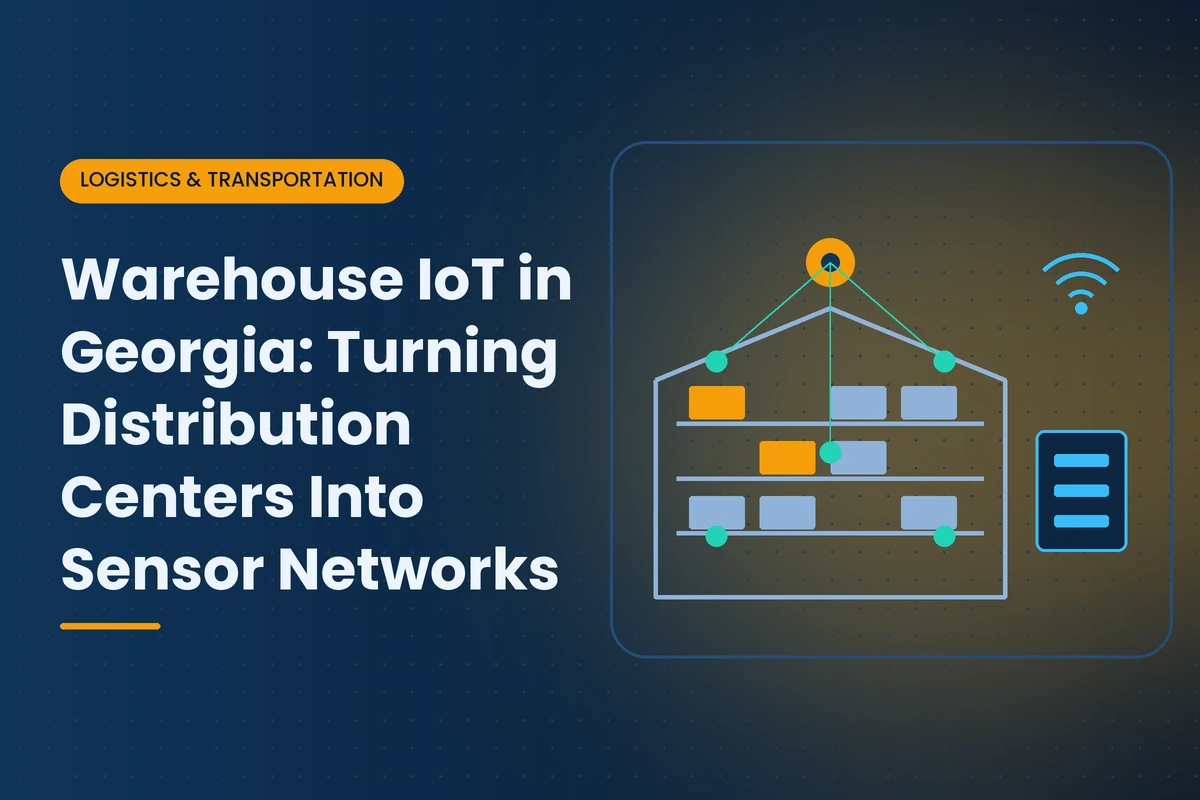
Most Georgia distribution centers already contain dozens of connected systems: forklift telematics, dock door sensors, temperature monitors, lighting controls, security cameras, conveyor controls, energy meters and, increasingly, mobile robots. The problem is that each one usually arrives as a separate project with its own network, software and login. Supervisors check one screen for forklifts, another for temperatures, another for docks, and the data never comes together.
A better approach is to treat the building as a single sensor network: a shared foundation of connectivity, gateways, data and security that every new device plugs into. This article explains how to design that foundation for a Georgia distribution center, from device layers and networks to data platforms and cybersecurity. For specific applications such as heat monitoring, robots and asset tracking, see our guides to smart warehouses, autonomous mobile robots and warehouse asset tracking.
| Layer | What It Includes | Design Questions |
|---|
| Devices | Sensors, tags, cameras, controllers, robots, telematics units | What needs measuring, at what frequency and accuracy? |
| Connectivity | Wi-Fi, private LTE or 5G, LoRaWAN, BLE, wired Ethernet | Which networks cover which devices and areas? |
| Gateways and edge | Gateways that collect data, edge computers that process it locally | What must keep working if the internet connection drops? |
| Data platform | Storage, normalization, dashboards and analytics | How is data named, combined and kept? |
| Applications | WMS, labor management, maintenance, energy and safety tools | Where do people act on the data? |
| Security and governance | Network segmentation, access control, data policies | Who can see and change what? |
Typical sensors in a Georgia distribution center include:
- Environment: temperature, humidity and heat index across zones, especially important in non-conditioned buildings during Georgia summers.
- Doors and docks: door status, trailer presence, dock leveler use.
- Mobile equipment: forklift location, impacts, utilization and battery state.
- Inventory: RFID readers, vision systems and drone scans.
- Automation: conveyor motor health, sorter faults, robot status.
- Energy: submeters on lighting, HVAC, fans, chargers and automation.
- Safety and security: cameras, access control, pedestrian proximity systems, fire system monitoring.
| Network | Best For | Considerations in Large Georgia DCs |
|---|
| Wi-Fi | Handhelds, AMRs, cameras, tablets | Dense racking and metal create dead zones; needs careful design |
| Private LTE or 5G | Large buildings and yards with many mobile devices | Higher cost, strong coverage across indoor and outdoor areas |
| LoRaWAN | Battery sensors for temperature, doors, energy | Long range, low data rates, few gateways needed |
| BLE | Asset tags, worker badges, short-range sensors | Requires gateways throughout the building |
| Wired Ethernet | Cameras, controllers, gateways, fixed equipment | Most reliable; plan cabling during construction or renovation |
Many distribution centers in metro Atlanta and around Savannah exceed a million square feet, so a site survey that tests coverage in actual racking conditions is essential. Yards and trailer lots often need separate outdoor coverage.
Gateways collect data from sensors on different networks and pass it to the data platform. Edge computers can process data locally, for example running safety alerts or robot coordination without depending on a cloud connection. In a region where summer storms and occasional power outages occur, local processing and buffering ensure critical functions continue and data is not lost. Our article on edge computing in industrial settings explains these concepts.
The data platform is what turns separate systems into a sensor network. Key principles:
- Consistent naming. Use the same names for zones, docks, aisles and assets across every system.
- Common time stamps. Synchronize clocks so events from different systems line up.
- Open interfaces. Require vendors to provide data through standard APIs or protocols such as MQTT.
- Retention rules. Decide how long to keep raw and summarized data.
- Combined views. Build dashboards that show related data together, such as dock status with inbound ETAs and labor.
When data is combined, new insights appear. Heat data overlaid with forklift impacts may show more incidents in hot afternoons. Dock data combined with energy data may reveal doors left open while cooling runs.
Every connected device is a potential entry point for attackers. Warehouse networks should segment operational devices from office IT, change default passwords, control vendor remote access and keep an inventory of devices and software versions. Governance also covers people: if worker badges or wearables collect data, employees should know what is collected and how it is used. Our IIoT security primer covers the basics.
- Inventory what exists. List every connected system, its network, data and owner.
- Design the foundation. Plan networks, gateways, naming standards and the data platform.
- Connect existing systems. Bring current data into the platform before adding new sensors.
- Add high-value sensors. Typically heat mapping, docks and energy in Georgia buildings.
- Build combined dashboards. Focus on decisions supervisors make every day.
- Set vendor requirements. Every new device must connect to the shared foundation.
- Review and expand. Add automation, robotics and analytics on the same base.
New distribution centers can include cabling, network rooms, power for gateways and chargers and wireless design from the start. Existing buildings need more careful planning, but most can be upgraded zone by zone. Companies renovating large existing buildings, such as Highline Warren's 1.1 million-square-foot center in McDonough, have an opportunity to build the foundation during renovation. See our analysis of Highline Warren's Georgia logistics center.
A sensor network is only useful if it keeps working when conditions are worst. Georgia summer storms can cause brief outages and voltage dips that reset equipment. Gateways, network switches and edge computers should be on backup power, and battery sensors should store data locally if connectivity drops. Chargers for robots and forklifts also add significant electrical load, so coordinate with electrical engineers and the utility early. Energy submetering, part of the sensor network itself, helps manage those loads and supports demand charge management. See our article on grid edge IoT and demand response.
The value of a shared sensor network shows up in several places: fewer separate software subscriptions and networks to manage, faster deployment of new systems, combined insights that single systems miss and better data for customers and audits. Track the time and cost of adding each new system before and after the foundation is in place, along with operational improvements such as energy savings, fewer incidents and better dock turns.
A shared foundation needs an owner. In many distribution centers, operations, IT, engineering and facilities each control part of the technology, and nobody owns the whole. Assign a single owner, often an operations technology manager, responsible for network standards, device onboarding, data quality and vendor requirements. For third-party logistics providers serving several clients in one building, the owner also manages how client data is separated and shared.
- Can your devices connect to our existing networks and gateways?
- Do you provide data through open APIs or standard protocols?
- What happens to your system if the internet connection fails?
- How do you handle security updates and remote access?
- Can we keep and export our data if we change vendors?
- Letting each vendor build its own network. This multiplies cost and blind spots.
- Skipping the naming standard. Data that cannot be matched across systems has limited value.
- Collecting data without decisions. Every sensor should support a specific action.
Consider a hypothetical third-party logistics provider operating an 850,000-square-foot distribution center in Henry County. It had seven separate systems for forklifts, temperature, docks, energy, cameras, robots and inventory scanning. The provider designed a shared foundation: a professionally surveyed Wi-Fi network for mobile devices, LoRaWAN for battery sensors, a few edge gateways and a central data platform with consistent zone and dock names. Combined dashboards showed supervisors dock status, inbound trailer ETAs, heat by zone and forklift availability in one view. Within months, the team found that two dock doors were frequently left open with fans running, wasting energy, and that forklift impacts rose sharply in the hottest zones, leading to schedule and cooling changes. New customers' automation now plugs into the same foundation instead of starting from scratch.
Expect warehouse sensor networks to become standard infrastructure, specified alongside power, lighting and fire protection in new Georgia distribution centers. AI tools will analyze combined data to predict labor needs, equipment failures and safety risks. Private 5G will spread in the largest buildings and yards. Operators that build a shared foundation now will add new technologies faster and at lower cost than those that keep buying disconnected systems.
For related reading, see our articles on warehouse automation in Georgia and wired versus wireless connectivity. To find partners, browse the IoT Georgia company directory or explore logistics IoT providers in Atlanta and Savannah. Browse more of our Logistics and Transportation coverage.
Frequently asked questions
It means building a shared foundation of connectivity, gateways, data platform and security that all sensors, robots and systems use, instead of separate disconnected projects.
Most use a mix: Wi-Fi for mobile devices, private LTE or 5G for very large sites, LoRaWAN for battery sensors, BLE for asset tags and wired Ethernet for fixed equipment.
Edge computing processes data locally so critical functions such as safety alerts and robot coordination keep working during internet or power disruptions.
Consistent naming of zones, docks, aisles and assets across every system, so data from different sources can be combined.
Segment operational networks from office IT, change default passwords, control vendor remote access and keep an inventory of devices and software.
Yes. Most can be upgraded zone by zone, starting with an inventory of current systems and a shared network and data foundation.
Related articles

 Logistics & Transportation