 Logistics & Transportation

Smart Warehouses in Georgia: Heat, Labor and Automation in the Southeast's Largest Distribution Market
Logistics & Transportation
Published by IOT Georgia Research & Editorial Team
Metro Atlanta has roughly 803 million square feet of industrial space, according to Cresa's first-quarter 2026 market report, and new leasing in the second quarter topped 10 million square feet, making Atlanta one of only five U.S. industrial markets to cross that mark, according to Cushman & Wakefield. Add the fast-growing warehouse clusters around the Port of Savannah and along the I-75, I-85 and I-16 corridors, and Georgia has one of the largest concentrations of distribution space in the country.
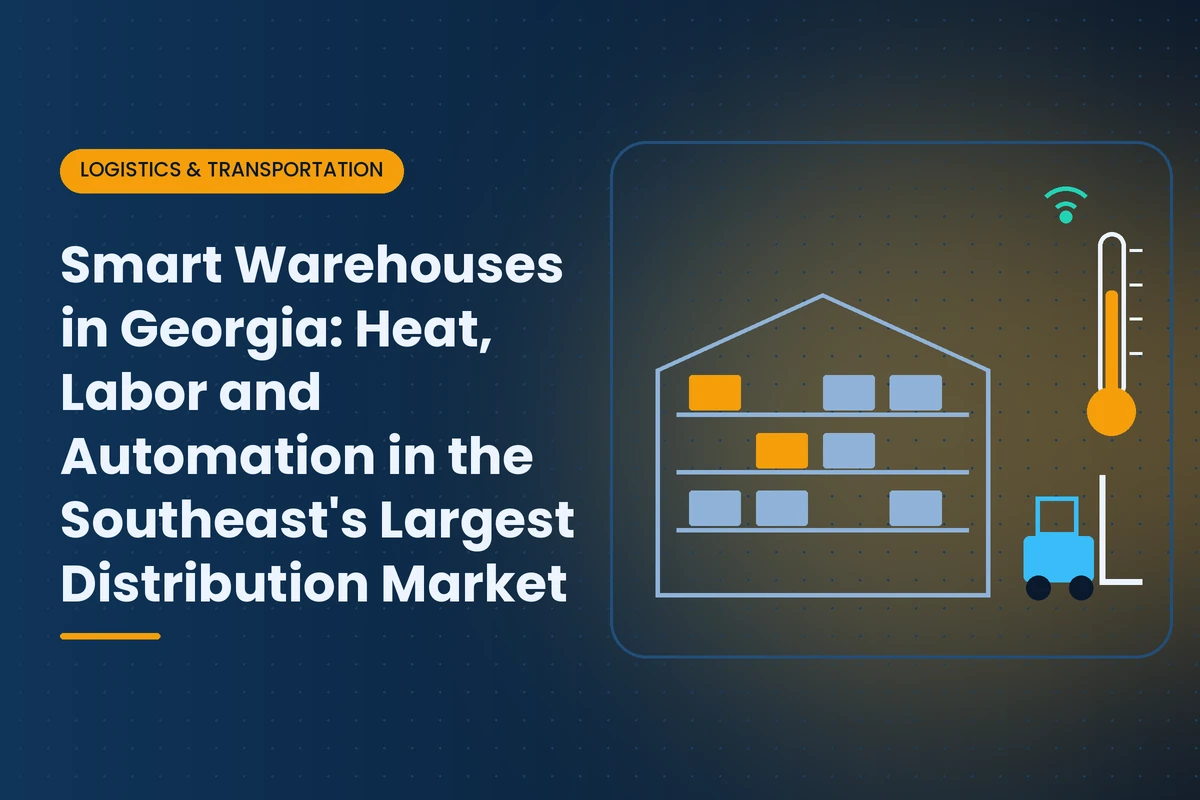
Much of that space shares a problem that smart warehouse articles rarely mention: heat. Many distribution centers in Georgia are not fully air conditioned, and summer conditions inside can be punishing for workers, equipment and some products. Add tight labor markets and growing automation, and the smart warehouse conversation in Georgia looks different from one in a mild climate. This guide focuses on those three pressures and how IoT helps manage them. For a look at automated fulfillment in grocery, see our article on retail IoT and grocery fulfillment.
Pressure One: Heat
Georgia summers bring long stretches of high temperatures and humidity. Inside large warehouses with limited cooling, conditions near the roof, in trailers at the dock and in mezzanines can be significantly hotter than outdoors. That affects three things.
Worker safety
Heat illness is a serious risk in warehouse work. OSHA has run a national emphasis program on heat hazards since 2023 and has proposed a federal heat standard, so employers should expect continued attention to heat protection. IoT helps by putting real numbers behind heat plans:
- Wireless heat index or wet bulb globe temperature sensors across zones, including docks, mezzanines and trailers being loaded.
- Automatic alerts to supervisors when conditions in a zone cross thresholds that trigger extra breaks, water and shade.
- Records showing conditions and actions taken, useful for training and inspections.
- Optional wearable devices that monitor exposure, used carefully and with clear privacy policies.
Product protection
Cosmetics, pharmaceuticals, some foods, adhesives, electronics and batteries have temperature limits. Mapping temperatures across racking heights and zones shows where sensitive products should and should not be stored. Continuous monitoring provides records for customers and quality teams.
Equipment and energy
Heat shortens battery life for forklifts and robots, stresses conveyor motors and electronics, and drives energy use for fans and cooling. Monitoring battery temperature, charging patterns and equipment health reduces failures during peak season.
Pressure Two: Labor
Warehouses compete for workers with manufacturers, construction and each other, especially in fast-growing areas around Savannah and along Atlanta's interstate corridors. IoT does not replace people, but it helps each person accomplish more and stay safer:
- Forklift telematics. Operator login, impact detection, utilization and battery status reduce damage, improve safety and show whether the fleet is the right size.
- Pedestrian proximity systems. Tags and sensors warn drivers and walkers when they are too close, reducing one of the most common serious warehouse hazards.
- Dock door sensors. Knowing which doors are occupied, open or idle helps supervisors assign labor and reduces time lost searching for trailers.
- Inventory accuracy tools. RFID and camera-based counting reduce time spent on manual cycle counts and searching for misplaced stock.
Pressure Three: Automation
Automation adoption in Georgia distribution is growing, from autonomous mobile robots and goods-to-person systems to automated storage and sortation. Every automated system depends on IoT data for its own operation and maintenance. Key considerations include:
- Network coverage. Mobile robots and handheld devices need reliable wireless coverage across the entire floor, including high-density racking.
- Uptime monitoring. Conveyors, sorters and robots are single points of failure during peak periods. Condition monitoring on motors, gearboxes and drives helps avoid breakdowns at the worst time.
- Integration. Automation must work with the warehouse management system and, often, with labor management and yard systems.
- Heat and humidity. Robots, batteries and sensors must be rated for the conditions inside the building, not just a showroom.
Our guide to predictive maintenance in Georgia's climate covers condition monitoring techniques that also apply to conveyors and sortation.
Cold Storage Warehouses
Georgia's poultry, produce and food distribution industries rely on cold storage, and new refrigerated capacity continues to be built near Savannah and Atlanta. Cold warehouses have their own IoT priorities: continuous temperature mapping across rooms and racking heights, door open alarms, refrigeration equipment monitoring, and cold-rated batteries and devices for forklifts and scanners. Condensation at freezer doors and docks can create ice, slip hazards and equipment problems, so humidity and door activity are worth monitoring too. Food safety customers will expect complete temperature records, especially as FSMA 204 traceability requirements approach in 2028. Our guide to IoT in food processing covers the upstream side.
The Smart Warehouse Stack
| Layer | Typical Technologies | What It Improves |
|---|---|---|
| Environment | Temperature, humidity and heat index sensors; HVLS fan and HVAC controls | Worker safety, product protection, energy use |
| Mobile equipment | Forklift telematics, battery monitoring, proximity systems | Safety, utilization, fleet sizing |
| Dock and yard | Door sensors, trailer tracking, appointment systems | Throughput, detention costs, labor planning |
| Inventory | RFID, barcode, camera and drone counting | Accuracy, fewer searches, faster audits |
| Automation | AMRs, conveyors, sorters, AS/RS with condition monitoring | Throughput and uptime |
| Energy | Submeters, lighting controls, solar and charging management | Operating cost, peak demand charges |
Energy: The Overlooked Win
Large distribution centers use significant energy for lighting, fans, charging and any cooling. Submetering shows how much each system uses and when. Many Georgia warehouses find savings by coordinating forklift charging to avoid peak demand periods, using occupancy-based LED lighting and tying fan and cooling operation to actual conditions rather than fixed schedules. Rooftop solar is increasingly common on big-box buildings, and combining it with smart charging adds further value. Our articles on smart lighting ROI and demand response explore these options.
Energy data also supports sustainability reporting that many large retail and consumer goods customers now request from their logistics providers, turning a cost project into a commercial advantage.
A Practical Rollout Plan
- Start with heat mapping. Place temperature and humidity sensors across zones for one summer month. The data guides safety plans, product placement and cooling investments.
- Add forklift telematics. Measure utilization and impacts before buying or leasing more trucks.
- Instrument the dock. Door and trailer visibility typically pay back quickly in busy buildings.
- Improve inventory accuracy. Choose RFID, vision or drone counting based on product type and storage density.
- Plan automation on solid data. Use the first three steps to identify where automation will actually help.
- Connect it all to your WMS. Alerts and insights should appear where supervisors already work.
An Illustrative Example
Consider a third-party logistics provider running a 700,000-square-foot building near Savannah for several import customers. Summer turnover was high, forklift damage claims were rising and one customer complained about heat-sensitive products. The operator installed heat index sensors across 20 zones, telematics on its forklift fleet and door sensors on all docks. The heat data showed that the east docks and a mezzanine pick area ran far hotter than the rest of the building in the afternoon. The team moved heat-sensitive SKUs out of the hottest racking, added fans and shade at the east docks, and shifted some loading to cooler morning hours. Telematics revealed that impact events clustered on a few shifts with newer drivers, which led to targeted retraining. Within one season, damage claims fell, the customer complaint was resolved and supervisors had data to support staffing and break schedules on the hottest days.
Questions to Ask Warehouse Technology Vendors
- Is your hardware rated for the temperatures and humidity inside our building in July and August?
- How does your system integrate with our warehouse management system?
- What wireless coverage is required, and will you conduct a site survey?
- How do you handle worker data and privacy for wearables or telematics?
- Can we export our data if we change vendors?
Common Mistakes
- Buying automation before fixing basics. Robots do not solve poor slotting or inaccurate inventory.
- Measuring temperature at one point. A single thermostat reading hides large differences across a building.
- Ignoring worker concerns. Explain what data is collected and why, especially for wearables and telematics.
- Poor wireless planning. Racking, product and metal buildings create dead zones that disrupt scanners and robots.
- Too many disconnected systems. Each tool should feed a shared view, not add another screen.
Where Georgia Smart Warehouses Are Heading
Expect heat management to become a standard part of warehouse design and operations in Georgia, both for worker safety and to support automation that does not tolerate extreme conditions. Mobile robots will spread from large e-commerce buildings to mid-sized third-party logistics sites. AI will help predict labor needs, slot products and schedule docks based on real-time data. And as the Georgia Ports Authority's inland ports and port expansions add capacity, warehouses that can process freight quickly and accurately will be best positioned to benefit.
For related reading, see our guides to IoT in Georgia logistics and IoT asset tracking. To find warehouse technology partners, browse the IoT Georgia company directory or explore logistics IoT providers in Atlanta and Savannah. Browse more of our Logistics and Transportation coverage.
Tags:
Related articles
Logistics & Transportation
 Logistics & Transportation
Autonomous Mobile Robots in Georgia Warehouses: Running and Scaling a Fleet After the Pilot
 Logistics & Transportation
Warehouse IoT in Georgia: Turning Distribution Centers Into Sensor Networks
 Logistics & Transportation