Most smart lighting ROI content stops at "LEDs use less electricity than fluorescent bulbs," which is true and also not the number that actually moves a payback calculation. The bigger lever, at least for Georgia commercial property owners, is what happens before the first kilowatt-hour is ever saved: how much of the project cost a rebate program covers before the building owner pays anything at all.
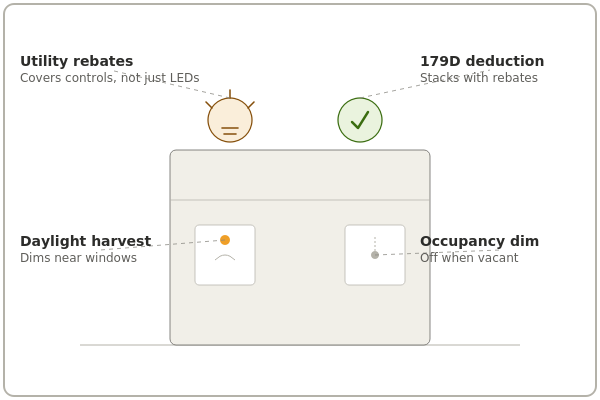
Georgia Power runs its Commercial Energy Efficiency Program (CEEP) with two tracks that matter for lighting specifically. The prescriptive track pays a set rebate per lamp or fixture for straightforward LED retrofits no engineering study required, just qualifying equipment. The Custom Savings track is where smart lighting specifically lives: it explicitly covers advanced lighting controls and sensors, not just the fixtures themselves, and a qualifying combined project (lighting plus other measures) can earn up to $350,000 per building per year under the program's larger project tier, with a $50,000-per-building-per-year baseline for standard eligible project costs.
For small businesses specifically, Georgia Power's Small Commercial Direct Install program goes further: a free on-site assessment followed by the utility covering up to 70% of the installation cost for qualifying upgrades, which for a small commercial property can dramatically compress the payback period on a smart lighting project that would otherwise take years to justify.
None of this is guaranteed money both programs require pre-approval before purchasing equipment for custom projects, and program details are reviewed annually, so terms shift. But the existence of a program that specifically names "lighting controls/sensors" as an eligible category, separate from basic LED fixtures, is a meaningful signal: Georgia Power is treating smart controls as a distinct, rebate-worthy upgrade, not just a fixture swap.
A full smart lighting system layers several capabilities on top of LED conversion, and each contributes differently to the ROI picture:
Lights that turn on when a space is used and off automatically when it's vacated eliminate the most common source of commercial lighting waste: rooms conditioned and lit for occupancy that isn't actually there. This tends to have the largest impact in intermittently used spaces conference rooms, storage areas, restrooms, stairwells.
Fixtures near windows dim automatically as natural light increases, rather than running at full output regardless of ambient conditions. This matters most in perimeter offices and glass-heavy commercial spaces, which describes a growing share of new Atlanta-area office construction.
Rather than a single building-wide setting, different zones run on different schedules matched to actual use patterns useful in mixed-occupancy buildings where some floors run near capacity and others sit partially empty, a pattern that's become more common as hybrid work reshapes office attendance.
LED fixtures last substantially longer than the fluorescent or incandescent fixtures they typically replace, and smart systems can flag failing fixtures automatically rather than relying on a facilities team noticing a dark hallway during a walkthrough.
Vendor-provided payback estimates are a reasonable starting point, but they typically model an idealized, best-case building. A more grounded estimate accounts for the specific factors that make actual results vary:
| Factor |
Effect on Payback |
| Currently running old fluorescent/incandescent fixtures |
Faster payback larger baseline energy gap to close |
| Already converted to LED, no controls |
Slower payback on the controls layer specifically, since fixture savings are already captured |
| High proportion of intermittent-use space |
Faster payback from occupancy-based control |
| Near-constant occupancy throughout the building |
Slower payback from occupancy sensing specifically, though scheduling/zoning still helps |
| Eligible for Custom Savings or Direct Install rebates |
Meaningfully faster payback rebates can offset a large share of upfront project cost |
Beyond utility rebates, commercial building owners may also be eligible for the federal Section 179D Energy Efficient Commercial Building Deduction, updated under the Inflation Reduction Act, which provides a tax deduction for qualifying energy-efficient improvements to commercial buildings, including lighting systems that meet the required efficiency thresholds. This is a federal program administered through the IRS, separate from and stackable with Georgia Power's utility rebates in many cases worth raising with a tax professional during project planning rather than treating utility rebates as the only available offset.
Interior office lighting tends to dominate smart lighting conversations, but for many commercial properties particularly retail centers, multi-family developments, and office parks with structured or surface parking exterior and parking lot lighting quietly represents one of the largest single lighting loads on the property. These fixtures typically run dusk to dawn, every day of the year, regardless of actual usage, which makes them a disproportionately large contributor to the lighting portion of a utility bill relative to how much attention they usually get in a retrofit plan.
Smart controls applied to exterior lighting work somewhat differently than interior occupancy sensing. Rather than turning lights fully on or off based on presence, most exterior smart lighting systems use dimming: fixtures run at a reduced output level by default and brighten to full output when motion is detected nearby, then dim back down after a set interval. This preserves the safety and security benefit of consistently lit exterior areas a fully dark parking lot is rarely acceptable from a liability or tenant-safety standpoint while still capturing meaningful savings during the long stretches when the area is empty.
Because exterior fixtures often qualify under the same prescriptive per-fixture rebate structure as interior LED retrofits, and because the energy and maintenance baseline (older HID or metal halide fixtures left running unattended for years) tends to be worse than interior lighting, exterior retrofits frequently post some of the fastest, most straightforward payback of any lighting project on a property worth evaluating on its own rather than assuming interior offices are always the higher priority.
For owners deciding where to begin, the sequence that tends to produce the fastest, most defensible ROI is:
- Start with the rebate-eligible categories first. If a project qualifies for Custom Savings or Direct Install support, that changes which upgrades make sense to bundle together into a single pre-approved project rather than phasing them separately.
- Target high-traffic, intermittent-use areas first. Stairwells, restrooms, and storage areas typically show the fastest, most obvious payback from occupancy sensors specifically.
- Prioritize perimeter and window-adjacent spaces for daylight harvesting. These areas see disproportionate savings relative to interior spaces with no natural light to harvest.
- Treat parking structures and exterior lighting as a serious candidate, not an afterthought they're often the single largest lighting energy line item in a commercial property and a strong first project on their own.
- Has this project been scoped to qualify for Georgia Power's Custom Savings or Small Commercial Direct Install programs, and has pre-approval been factored into the timeline?
- Does the proposed payback estimate account for your building's actual occupancy pattern, or is it based on a generic model?
- Is the 179D federal deduction being considered as part of the overall project economics, or only utility-level incentives?
- What's the maintenance and fixture-failure monitoring capability of the proposed system, separate from the energy savings pitch?
Smart lighting ROI in Georgia isn't just an energy math problem it's a rebate-eligibility problem first. A project scoped to qualify for Georgia Power's Custom Savings or Direct Install programs, and structured to take advantage of the federal 179D deduction where applicable, can see a meaningfully faster payback than the same equipment installed without accounting for either. Building owners who treat rebate program design as part of the project plan, not an afterthought, tend to see the strongest returns.
Frequently asked questions
Yes. Georgia Power's Commercial Energy Efficiency Program's Custom Savings track explicitly lists lighting controls and sensors as an eligible project category, separate from basic LED fixture rebates under the prescriptive track.
Program terms are reviewed annually and vary by project type, but eligible projects can earn up to a set amount per building per year under the standard tier, with higher caps available for larger combined-measure projects under Custom Savings. Confirm current figures directly with Georgia Power before finalizing a project budget, since amounts are subject to change.
For Custom Savings projects specifically, yes applications must be submitted and approved before equipment is purchased. Prescriptive rebates for standard LED retrofits generally have a more straightforward application process.
It's a Georgia Power program for small business customers that includes a free on-site energy assessment and covers a significant portion historically up to 70% of installation costs for qualifying upgrades, including lighting. Eligibility is based on business size and Georgia Power account status; contact the program directly to confirm current qualification criteria.
Potentially, through the Section 179D Energy Efficient Commercial Building Deduction, which is separate from utility-level rebates. Eligibility depends on meeting specific efficiency thresholds; a tax professional should be consulted to confirm applicability to a specific project.
Intermittently used spaces stairwells, restrooms, storage areas, and conference rooms tend to show the fastest payback from occupancy-based controls specifically, while perimeter offices and window-adjacent spaces see the strongest returns from daylight harvesting.
Related articles

 Smart Buildings