Buckhead's office vacancy rate sits near 29 percent, even after a recent decline of more than a full percentage point, and it remains one of the more challenged submarkets in a metro Atlanta office market that has been reshaped by hybrid work. Yet Class A properties continue to represent roughly 73 percent of all leasing activity across the metro, and businesses are increasingly willing to pay premium rates for buildings that support employee recruitment, retention, and productivity rather than simply offering square footage. That gap between overall vacancy and strong demand for the right kind of space is exactly why Atlanta landlords have started treating smart building technology as a leasing tool rather than a back-office operations upgrade.
The city's own sustainability program offers a useful window into how this shift happened. The Atlanta Better Buildings Challenge, a public-private partnership that now spans more than 120 buildings across Downtown, Midtown, and Buckhead totaling over 65 million square feet, was built around a simple premise articulated by one participating landlord: it has reached the point where Class A office space is simply expected to be green and energy conscious, not as a marketing bonus but as a baseline requirement for competing in the market. Fifteen years after that program's Buckhead expansion, the same logic now applies to a much broader set of connected building technologies beyond energy efficiency alone.
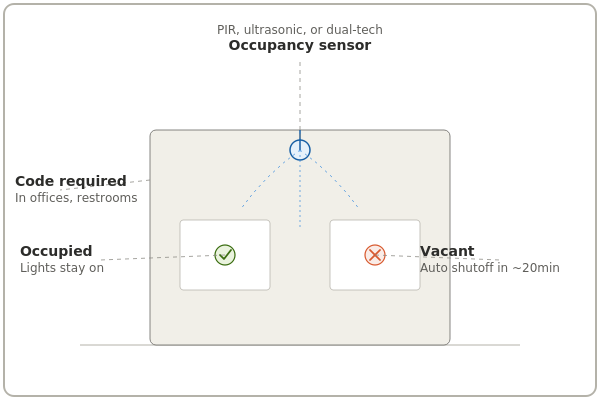
Rather than adding more sensors for their own sake, the priority in 2026 has shifted toward sensor fusion, combining occupancy, temperature, and usage data to create decision-grade insight rather than isolated readings. For a landlord trying to win a tenant weighing a lease renewal against a move, being able to show precisely how efficiently a floor plate is being used, and how quickly building systems respond to actual occupancy patterns rather than a fixed schedule, has become a meaningful part of the pitch.
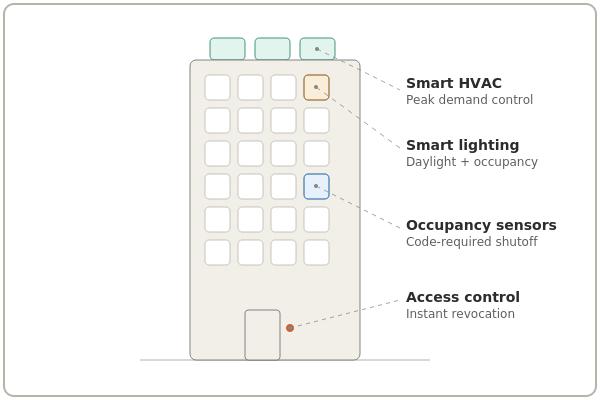
Building control systems that were historically managed separately by facilities teams on proprietary networks are increasingly moving onto IP-based infrastructure managed alongside the building's IT systems. For tenants evaluating a lease, this convergence often shows up as more reliable connectivity, tighter security integration between building access control and cybersecurity policy, and fewer disruptions from disconnected legacy systems.
Digital twin platforms that continuously update from real building sensor data are becoming more accessible even outside the largest trophy towers, letting building operators model space planning changes, predict HVAC load from a proposed floor reconfiguration, or demonstrate energy performance data to a prospective tenant's sustainability team before a lease is signed.
As multi-vendor device ecosystems mature, buildings are increasingly able to offer tenants a more seamless experience across access control, parking, and amenity booking systems, rather than requiring tenants to navigate a patchwork of separate apps and credentials for each building system.
| Market Condition |
How Smart Building Technology Responds |
| 29 percent vacancy in Buckhead despite strong Class A demand elsewhere |
Differentiates a specific building from same-submarket competitors carrying similar base rents |
| Class A properties capturing 73 percent of metro leasing activity |
Signals that tenants are actively paying a premium for buildings with stronger operational and experience credentials |
| Businesses using office space to support recruitment and retention |
Connected building experience becomes part of a tenant's own pitch to prospective employees, not just a landlord amenity |
| Rising energy and operating costs |
IoT-driven energy optimization reduces operating expenses that would otherwise be passed through to tenants |
Consider a Class A tower in Buckhead facing a major tenant's lease expiration, with that tenant actively touring newer, more amenity-rich buildings in Midtown as an alternative. Rather than competing purely on rental rate, the landlord invests in occupancy sensors and a tenant-facing dashboard that shows real-time air quality, space utilization data by floor, and energy performance benchmarked against the Atlanta Better Buildings Challenge cohort the property already participates in. During renewal negotiations, the landlord can point to concrete, sensor-verified operational data rather than general claims about building quality, giving the tenant's own facilities and sustainability teams something specific to evaluate against the alternative properties under consideration. Combined with a modest rent concession, the data-backed differentiation is enough to retain the tenant at a renewal that would otherwise have been a coin flip.
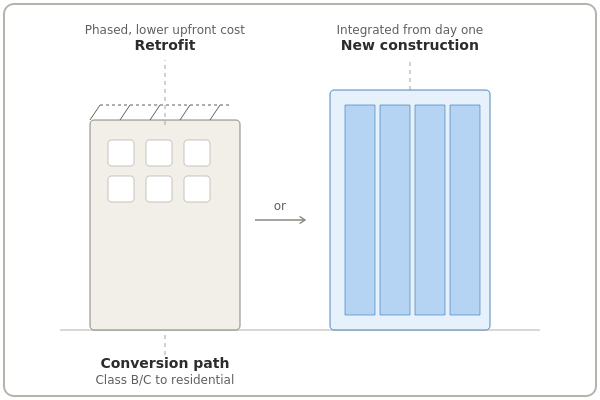
Much of Atlanta's office inventory, particularly in submarkets like Buckhead and Downtown, predates modern sensor and IT infrastructure standards, meaning retrofits require more extensive cabling and system integration work than a ground-up new construction project would.
Building owners, particularly those managing assets for institutional investors, often need a clear, documented link between smart building investment and leasing outcomes before committing capital, which is harder to establish than a straightforward energy-savings calculation.
The current emphasis across the smart building industry on sensor fusion over sensor volume reflects a real lesson learned in the market: buildings that deployed sensors without a clear governance and data standard often ended up with more data than anyone had the capacity to act on, undermining the return on the original investment.
A typical Atlanta office tower may run separate vendor systems for HVAC, access control, lighting, and energy management, each historically siloed. Achieving the kind of unified tenant experience that actually differentiates a leasing pitch requires real integration work across these previously separate systems.
- Tenant-facing sustainability dashboards as standard practice. As more corporate tenants face their own sustainability reporting requirements, expect landlords to increasingly provide real-time, sensor-verified building performance data as a standard part of the leasing package rather than a special request.
- Expansion of programs like the Atlanta Better Buildings Challenge. Public-private efficiency programs that already span more than 65 million square feet across Downtown, Midtown, and Buckhead are likely to expand further as landlords look for third-party validation of their building's operational performance.
- Interoperability standards reducing vendor lock-in. As multi-vendor device standards mature, building owners will have more flexibility to add best-in-class sensors and systems over time rather than committing to a single vendor's proprietary ecosystem.
- Smart building performance influencing lease terms directly. Expect more lease negotiations in competitive submarkets like Buckhead to explicitly reference sensor-verified energy and occupancy data as part of the underlying economic terms, not just a marketing amenity mentioned in a leasing brochure.
- Start with occupancy and energy sensor fusion on your highest-vacancy or highest-renewal-risk floors rather than a full-building rollout.
- Join or expand participation in an established local efficiency program, since third-party validation carries more weight with prospective tenants than internal claims alone.
- Prioritize IT and OT network convergence before adding new sensor types, since a fragmented technical foundation limits the value of any individual sensor investment.
- Build a simple, tenant-facing reporting view before investing further in backend sensor infrastructure, since the leasing value of this technology depends on tenants actually being able to see and understand the data.
Building owners can go deeper on specific systems with Occupancy Sensors Explained, the ROI of smart lighting for Georgia building owners, and Access Control 101, or start with the broader Smart Buildings Georgia guide. Building automation providers such as Honeywell's Atlanta team and the Atlanta Smart Buildings directory offer local options for owners ready to move forward.
Atlanta's office market has bifurcated sharply between buildings that are winning tenants and buildings that are struggling to fill space, even within the same submarket and rent tier. Smart building IoT, applied thoughtfully rather than as a checklist of sensors, has become one of the more effective tools landlords have for moving a specific property from the losing side of that split to the winning side, at a moment when tenants have more leverage and more alternatives than they have had in years.
Frequently asked questions
Buckhead's office vacancy rate is near 29 percent as of 2026, though it has declined by more than a full percentage point recently, with strong demand concentrated in Class A space specifically rather than the submarket broadly.
It is a public-private partnership between the City of Atlanta and the business community supporting commercial buildings in reducing energy and water consumption, now encompassing more than 120 buildings across Downtown, Midtown, and Buckhead totaling over 65 million square feet.
While outcomes vary by property, landlords increasingly report that sensor-verified operational and sustainability data gives them a concrete differentiator during renewal negotiations, particularly against competing buildings in the same submarket and rent tier.
Retrofits typically cost more than new construction sensor integration because older buildings often lack the underlying IT infrastructure and cabling that modern systems assume, though the investment can often be phased by floor or system rather than requiring a full-building overhaul at once.
Sensor fusion combines multiple data inputs, such as occupancy, temperature, and energy use, into a single decision-grade insight rather than treating each sensor reading in isolation, which the industry has increasingly prioritized after some earlier deployments produced more raw data than building operators could meaningfully use.
When building control systems move onto the same IP-based network infrastructure as general IT systems, tenants typically experience more reliable building operations, tighter integration between physical access control and cybersecurity policy, and fewer disruptions from legacy, disconnected building systems.
Related articles


 Smart Buildings