Most guides to smart access control focus on the fun part: credentials, mobile unlock, remote management. What they skip is the part that actually determines whether a given lock is legal to install on a given door and that gap causes more expensive mistakes than any credential-type decision ever will. Before choosing a system, a property owner needs to understand one distinction that governs everything else: fail-safe versus fail-secure, and where the fire code requires each.
Every electronic lock falls into one of two categories when it comes to what happens if it loses power:
- Fail-safe the lock automatically unlocks when power is cut, allowing free egress.
- Fail-secure the lock stays locked when power is cut, keeping the door secure from the outside while typically still allowing egress via a mechanical release on the inside.
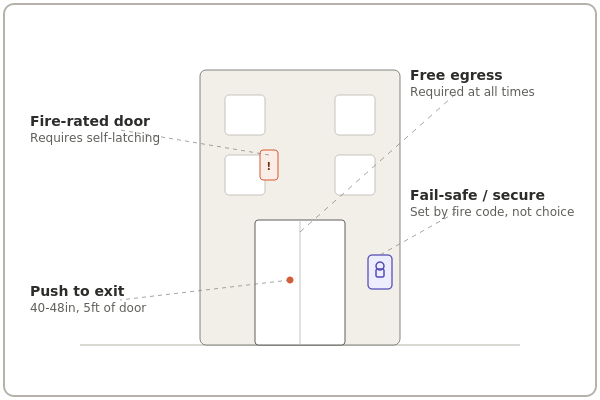
Georgia's fire and building codes adopted through the State Minimum Fire Safety Standards, which incorporate NFPA 101 (the Life Safety Code) and the International Fire Code require free egress from a building at essentially all times, with narrow exceptions. That single requirement dictates hardware choice far more than most access control sales conversations acknowledge. A magnetic lock installed on an exit door, for instance, is generally required to be fail-safe, because a mag lock has no independent mechanical override if it fails locked, occupants are trapped. An electric strike on a fire-rated door assembly, by contrast, must typically be fail-secure, because fire doors are required to remain self-latching, and a fail-safe configuration would compromise that.
This isn't a minor technicality. Getting it backwards on even one door is the kind of finding that stops a certificate of occupancy inspection cold, or turns into a liability problem well after the building is occupied.
Some properties retail spaces concerned about theft through emergency exits, data centers, pharmacies want a door that resists casual or opportunistic exit without fully sacrificing egress. Delayed egress hardware is the code-sanctioned way to do this: pushing the door triggers a 15-second delay before it releases, accompanied by a local alarm and required signage explaining how the door functions.
Delayed egress hardware isn't available to just any building, though. Under the Life Safety Code as adopted in Georgia, a delayed egress lock generally cannot be installed unless the building is protected by an automatic sprinkler system or an approved automatic smoke or heat detection system. A building without either of those protections in place simply isn't eligible for this option, regardless of how badly a tenant wants it which is worth knowing before a delayed-egress system gets specified into a project that turns out not to qualify.
For access-controlled doors using electromagnetic locking, Georgia's adopted egress code is specific about the manual override hardware: a clearly marked "PUSH TO EXIT" device must be mounted between 40 and 48 inches above the floor, within 5 feet of the secured door, and pressing it must cut power to the lock directly independent of the access control system's electronics keeping the door unlocked for at least 30 seconds. A sensor on the egress side is also required to detect an approaching occupant and unlock the door automatically. None of this is optional design flair; it's baseline code compliance for this lock type.
The practical implication: any smart access control platform that can't demonstrate this hardware behavior out of the box, or that requires custom engineering to achieve it, is adding both cost and inspection risk to a project that a compliant system would avoid entirely.
Once the code requirements are handled correctly, the actual value of moving from mechanical locks to a connected system becomes clear.
A lost card, a departing employee, a terminated contractor each used to mean a decision about whether to re-key. With a connected system, the credential is simply deactivated, instantly, without touching a single lock cylinder.
Every credential read is time-stamped and tied to a specific person, which matters both for after-the-fact investigations and for regulated industries healthcare facilities in particular often need to demonstrate exactly who accessed a given space and when.
Access can be limited by day, time, and zone a cleaning contractor might have access to common areas only between 6 and 8 p.m., without a separate physical key system to manage.
For owners or managers overseeing several buildings, a cloud-based platform allows permissions to be set, adjusted, and audited from a single dashboard rather than visiting each site.
| Credential Type |
Best Fit |
Trade-offs |
| Key fob / card |
Most commercial properties, cost-sensitive deployments |
Low cost, easy to issue, but can be lost or shared |
| Mobile credential |
Multi-tenant offices, properties prioritizing convenience |
Lower hardware cost per user; depends on tenant smartphone adoption |
| Biometric |
High-security interior zones, server rooms, pharmacies |
Higher cost, strongest identity assurance, raises privacy considerations for broad deployment |
| PIN code |
Low-traffic secondary doors, temporary access |
Cheapest option, but harder to tie to a specific individual than card or mobile credentials |
The right configuration depends heavily on what kind of building it's protecting:
- Small commercial properties generally do well with card or mobile credentials on primary entry points and a small number of interior doors, without needing the full complexity of zone-based scheduling.
- Multi-tenant office buildings typically need tiered access building-wide credentials for common areas, tenant-specific credentials for individual suites along with visitor management for guests, which is where compliance complexity (multiple fire-rated doors, varying egress requirements per tenant space) tends to concentrate.
- Healthcare and other regulated facilities usually require more granular logging and audit trails, along with careful attention to delayed egress rules in specialty areas like labs, which are typically assessed individually against code rather than treated the same as the rest of the building.
- Multi-site portfolios benefit most from cloud-based platforms, since managing permissions consistently across several on-premise systems becomes unwieldy fast.
- Has the vendor coordinated the hardware selection fail-safe versus fail-secure, delayed egress eligibility with your local fire marshal or authority having jurisdiction, or are they proposing a generic configuration without reviewing your specific doors?
- Does the proposed system meet the "Push to Exit" hardware requirements out of the box for any electromagnetic locks, or does it require custom engineering?
- Is your building currently protected by an automatic sprinkler or detection system, and if not, has delayed egress hardware been proposed anyway?
- How does the system integrate with existing video surveillance, visitor management, and building automation, rather than operating as an isolated point solution?
Smart access control is a genuine security and operational upgrade over mechanical locks, but the decision that matters most often isn't which credential type to choose it's whether the hardware configuration on each door actually satisfies Georgia's adopted fire and egress code. Getting that foundation right before evaluating features avoids the far more expensive problem of failing an inspection, or worse, installing hardware that compromises life safety on the doors meant to protect it.
Frequently asked questions
Fail-safe locks unlock automatically when power is lost, allowing free egress. Fail-secure locks remain locked when power is lost, typically still allowing exit via a mechanical release. Which type is required depends on the door's function and its role in the building's fire and egress plan.
Magnetic locks on exit doors are generally required to be fail-safe and paired with specific override hardware, including a "Push to Exit" device and an approaching-occupant sensor, since magnetic locks have no independent mechanical release. Requirements should be confirmed with your local fire marshal before installation.
No. Under the Life Safety Code as adopted in Georgia, delayed egress locks generally require the building to be protected by an automatic sprinkler system or an approved automatic smoke or heat detection system. Buildings without either are typically not eligible for this hardware.
With a connected access control system, a credential can typically be deactivated instantly and remotely, without needing to physically re-key any locks.
Most modern platforms are designed to integrate with video surveillance, visitor management, and building automation systems, though the level of integration varies by vendor. It's worth confirming compatibility with your existing systems before selecting a platform.
Your local fire marshal or authority having jurisdiction (AHJ) is the relevant authority for confirming that a proposed hardware configuration meets Georgia's adopted fire and egress code. A qualified access control vendor should be able to coordinate this review as part of the design process, not leave it to be discovered during a final inspection.
Related articles

 Smart Buildings