Smart Buildings

Smart Buildings in Georgia: The Complete Guide for Property Owners
Smart Buildings
Published by IOT Georgia Research & Editorial Team
- Start With the Question Behind the Question
- The Two Systems That Are Actually Legal Requirements, Not Just Upgrades
- Occupancy Sensors Are Frequently Code-Mandated, Not Just Efficient
- Access Control Hardware Choice Is Governed by Fire Code, Not Preference
- The System Where Georgia's Rate Structure Changes the Math
- The System Where a Rebate Program Changes the ROI Before Any Energy Is Saved
- Putting It Together: A Realistic Order of Operations
- What to Ask Any Smart Building Vendor Operating in Georgia
- The Bottom Line
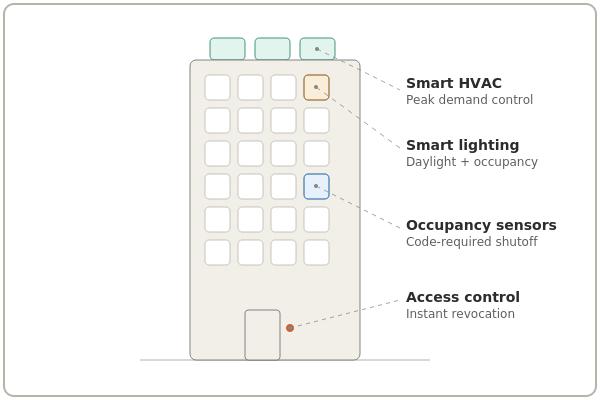
Search for "smart building guide" and most results describe the same five systems HVAC, lighting, access control, occupancy sensing, building management platforms in the abstract, as if they exist independent of where the building sits. They don't. In Georgia, three forces specifically shape which smart building investments actually pay off and which ones are legally required before a project can even open: Georgia Power's rate structure, the state's adopted fire and energy codes, and for a meaningful share of Atlanta's older office stock a live conversion market that changes the question entirely. This guide covers the systems, but more importantly, it covers the order in which a Georgia property owner should actually be thinking about them.
Start With the Question Behind the Question
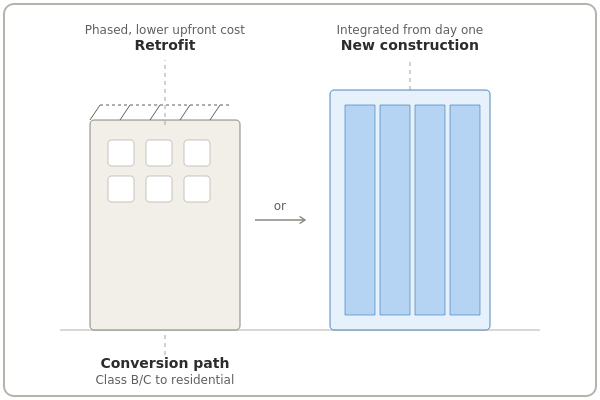
Before comparing HVAC vendors or lighting platforms, an owner of an older Georgia commercial property needs to answer something more fundamental: is this building actually staying in its current use? For Atlanta specifically, downtown office vacancy has hovered around 20 percent, and a substantial share of the city's aging Class B and C office stock buildings with narrower floor plates and simpler structural layouts is increasingly being evaluated for office-to-residential conversion rather than an office-focused smart building retrofit. Metro Atlanta's conversion pipeline has grown fast enough that the city now ranks among the top markets nationally for conversion activity.
This matters because it changes the order of operations. A building that's a strong conversion candidate shouldn't be the subject of an expensive office-focused smart building retrofit before that question is settled the systems a residential conversion needs (in-unit smart thermostats and locks, for example) differ meaningfully from what a commercial office tenant expects (building-wide access control, conference room systems, large-floor-plate occupancy zoning). Get the full comparison in Smart Building Retrofits vs. New Construction: What's Right for Your Facility, which walks through how to evaluate conversion viability before committing capital to either path.
The Two Systems That Are Actually Legal Requirements, Not Just Upgrades
Most smart building content treats every system as optional a menu of efficiency features an owner picks based on budget. Two of the core systems aren't optional in Georgia; they're compliance mechanisms with real consequences for a Certificate of Occupancy if specified incorrectly.
Occupancy Sensors Are Frequently Code-Mandated, Not Just Efficient
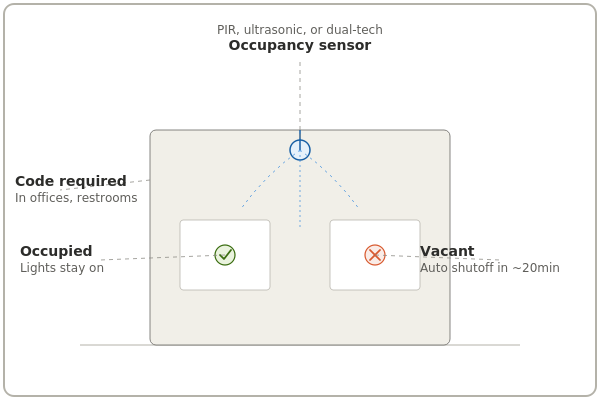
Georgia's adopted commercial energy code following the IECC, with ASHRAE/IES 90.1 as an alternative compliance path requires automatic lighting shutoff in nearly every commercial building, with occupancy or vacancy sensors specifically required in certain space types: private offices, classrooms, conference rooms, and restrooms among them. This isn't a menu option. A lighting control plan that doesn't meet these requirements can hold up final inspection. The full breakdown of which spaces require sensors, how sensor technology needs to match mounting height and space type, and what typically goes wrong in retrofits is covered in Occupancy Sensors Explained: How They Work and Where to Use Them.
Access Control Hardware Choice Is Governed by Fire Code, Not Preference
Similarly, the choice between fail-safe and fail-secure locking hardware isn't a security preference it's dictated by Georgia's adopted fire and egress code, which requires free egress from a building at essentially all times. A magnetic lock on an exit door generally must be fail-safe; an electric strike on a fire-rated door assembly generally must be fail-secure. Delayed egress hardware, a common request from tenants concerned about theft, is only permitted in buildings with automatic sprinklers or approved detection systems buildings without either simply aren't eligible, regardless of what a tenant wants. This is covered in detail in Access Control 101: Choosing the Right Smart Entry System for Your Property.
The practical implication for both of these systems: coordinate hardware and control decisions with a fire marshal or authority having jurisdiction before signing a vendor contract, not after a failed inspection forces a redesign.
The System Where Georgia's Rate Structure Changes the Math
HVAC is the highest-energy-cost system in most Georgia commercial buildings, and the reason isn't simply the state's long cooling season it's how Georgia Power calculates what a building pays for that cooling. Under the standard Power & Light commercial tariffs, a building's billing demand for the following months is set by a ratchet: 95 percent of the prior summer peak, or 60 percent of the prior winter peak, whichever is higher. In practice, one unusually hot afternoon, with every rooftop unit running at once, can set an elevated demand charge that persists for months.
This is the detail that separates a smart HVAC investment that actually moves the needle from one that only reduces average consumption. A system built around peak shaving and demand response pre-cooling ahead of Georgia Power's summer peak window, staggering rooftop units so they don't all ramp simultaneously targets the mechanism that actually drives the bill, not just the average kWh figure a generic energy-efficiency pitch focuses on. The mechanics of the demand ratchet, how it interacts with Georgia's climate, and what to ask an HVAC vendor before signing are covered in How Smart HVAC Systems Are Cutting Energy Costs in Georgia Office Buildings.
The System Where a Rebate Program Changes the ROI Before Any Energy Is Saved
Lighting is usually the easiest, fastest-payback entry point into smart building technology and in Georgia, that payback gets meaningfully faster before a single watt is saved, because of how Georgia Power's rebate programs are structured. The utility's Commercial Energy Efficiency Program specifically names lighting controls and sensors not just LED fixtures as an eligible Custom Savings category, and small businesses may qualify for the Small Commercial Direct Install program, which has historically covered a significant share of installation costs following a free assessment.
Separately, the federal Section 179D deduction can apply to qualifying lighting upgrades, stacking with utility-level incentives in many cases. A lighting project scoped from the start to qualify for these programs sees a fundamentally different ROI calculation than the same equipment installed without accounting for either. The full rebate mechanics, along with a more grounded way to estimate realistic payback, are in The ROI of Smart Lighting: What Building Owners Should Expect.
Putting It Together: A Realistic Order of Operations
For a Georgia property owner starting from scratch, the sequence that avoids the most expensive mistakes looks like this:
- If the building is older, underoccupied Class B/C office space in Atlanta: assess residential conversion viability first. This determines whether the rest of this list even applies in its current form.
- Confirm code requirements before selecting any hardware. Occupancy sensor requirements and access control fail-safe/fail-secure rules aren't negotiable design preferences get them right before a vendor conversation, not after an inspection flags them.
- Pull your Georgia Power interval data. Before scoping an HVAC project, EnergyDirect's 15-minute and hourly usage data will show exactly when your building's demand peaks have historically occurred the single most useful piece of information for a smart HVAC investment.
- Check rebate eligibility before finalizing a lighting project scope. Custom Savings and Small Commercial Direct Install both require pre-approval for certain project types, so this needs to happen early, not as an afterthought once equipment is already ordered.
- Choose an integrated platform, not isolated point solutions. A lighting system, HVAC controller, and access control platform that share occupancy data are worth more together than as separate, disconnected systems and since occupancy sensors are likely already required for code compliance, that data should be doing double duty across systems, not sitting in a single-purpose lighting controller.
What to Ask Any Smart Building Vendor Operating in Georgia
- Has the hardware configuration been reviewed against Georgia's adopted fire and energy code requirements for this specific building, not just a generic compliance claim?
- For HVAC: does the platform address Georgia Power's demand ratchet specifically, or only average energy consumption?
- For lighting: has the project been scoped to qualify for Georgia Power's Custom Savings, Small Commercial Direct Install, or the federal 179D deduction where applicable?
- Do the proposed systems share occupancy and usage data with each other, or will each system operate as an isolated silo?
The Bottom Line
Smart building technology in Georgia isn't a menu of generic upgrades it's a set of decisions shaped by specific local mechanics: a demand ratchet that rewards peak shaving over average savings, an energy and fire code that makes certain systems mandatory rather than optional, utility rebate programs that materially change project economics, and, for a real segment of Atlanta's office stock, a conversion market that changes the underlying question before any of the rest applies. Owners who work through these Georgia-specific factors before evaluating vendors consistently end up with better-performing systems, smoother inspections, and faster payback than owners who start with a generic smart building checklist.