Most articles about smart HVAC savings talk in generalities: sensors reduce waste, automation cuts costs, buildings get more efficient. All true, but none of it explains why the payback on a smart HVAC retrofit can look dramatically different for two office buildings sitting a mile apart in Atlanta. The answer usually isn't the equipment. It's the rate structure the building happens to be billed under, and specifically how Georgia Power calculates what's called billing demand.
Understanding that mechanism changes how a facilities manager should think about smart HVAC investment. It's not just "use less energy." It's "avoid the specific 30-minute window, once a summer, that sets your electricity cost for months afterward."
Georgia Power's commercial and industrial customers are billed under one of a few standard schedules Power & Light Medium (PLM) for buildings pulling 30-499 kW, and Power & Light Large (PLL) for anything above that. Both combine two charges: an energy charge for actual kWh consumed, and a demand charge based on the building's peak 30-minute draw during the billing period.
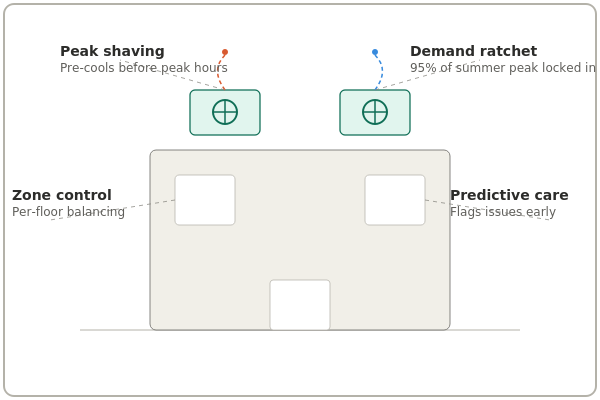
The part that catches most owners off guard is the demand ratchet. Under Georgia Power's standard commercial tariffs, a building's billing demand for the year is locked in at 95% of its highest summer peak, or 60% of its highest winter peak, whichever is greater. In practice, that means a single unusually hot afternoon one 30-minute stretch where every rooftop unit is running flat out can set an elevated demand charge that follows the building for months, even during periods when actual usage drops.
This is the part a generic energy-efficiency conversation misses. Reducing average consumption is good practice, but it doesn't touch the ratchet. The building that avoids the peak spike in the first place is the one that actually controls its year-round demand charge.
Georgia Power's summer peak period runs weekday afternoons from June through September, and it's during exactly this window that Georgia's climate makes HVAC load hardest to manage. Long, humid summers mean cooling systems aren't just fighting temperature they're fighting latent heat load from humidity, which keeps compressors running harder and longer than a comparable building would need in a drier climate.
For a mid-size Atlanta office building on a PLM or PLL schedule, that combination a demand ratchet plus a climate that pushes HVAC systems to their peak during exactly the hours the ratchet is calculated means cooling equipment isn't just the biggest energy line item. It's the single most consequential piece of equipment on the property when it comes to controlling the demand charge for the following twelve months.
Traditional HVAC runs on a schedule: a setpoint, a timer, and a technician who adjusts things manually when something feels off. A smart HVAC system adds sensors, connectivity, and control logic on top of the existing mechanical equipment, and the practical differences show up in a few specific ways.
Rather than treating every hour the same, a smart HVAC platform can identify a building's highest-risk demand windows and pre-cool the space before the peak period begins running compressors harder in the mid-morning, when electricity is cheaper and the ratchet risk is lower, so the building coasts through the 2-7 p.m. summer peak window on residual cooling rather than fighting the afternoon heat load directly. Some systems can also stagger multiple rooftop units so they don't all ramp to full output simultaneously, which is often what actually creates the single spike that sets the ratchet.
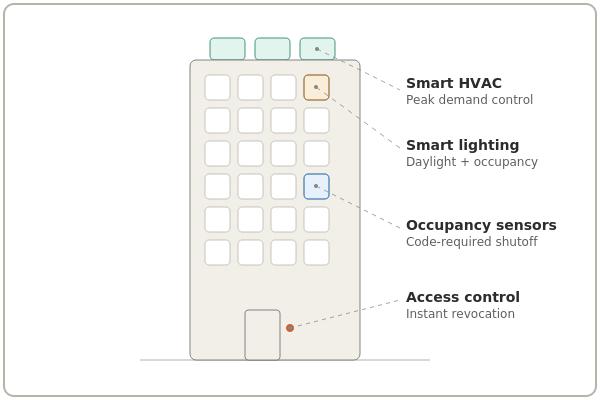
Conference rooms, break areas, and floors with hybrid-work vacancy are frequently conditioned on a fixed schedule regardless of whether anyone is using them. Tying HVAC output to real-time occupancy data often the same sensors used for smart lighting or access control means the system stops spending demand on empty space, which matters most during the exact afternoon hours when demand charges are calculated.
A system slowly losing efficiency a dirty coil, a refrigerant leak, a failing damper typically has to run longer and harder to hit the same setpoint. That inefficiency often goes unnoticed for weeks, quietly inflating both energy use and peak demand risk, until it either shows up as a bill increase or a full equipment failure during the hottest week of the summer. Smart systems that track performance drift over time can flag this before it becomes either.
Rather than conditioning an entire floor to a single setpoint, zone-level control lets different areas run at different levels based on actual demand. In a mixed-occupancy building some floors near capacity, others running light this reduces the odds of every unit hitting peak output during the same half-hour window.
Georgia Power also offers Real Time Pricing (RTP) tariffs for larger commercial and industrial customers typically those with 250 kW or more of load where energy is billed against hourly marginal-cost prices rather than a flat time-of-use schedule. Buildings on RTP that can shift or curtail load during high-price hours have historically seen meaningful bill reductions, and Georgia Power's own filings note extremely high enrollment among eligible large customers precisely because load-flexible buildings do well under it.
A smart HVAC system with demand-response capability is close to a prerequisite for taking real advantage of RTP: the tariff rewards buildings that can respond to hourly price signals automatically, not manually. For a large office building already considering an RTP switch, that's a strong argument for sequencing the smart HVAC investment first the automation is what makes the rate structure worth adopting in the first place.
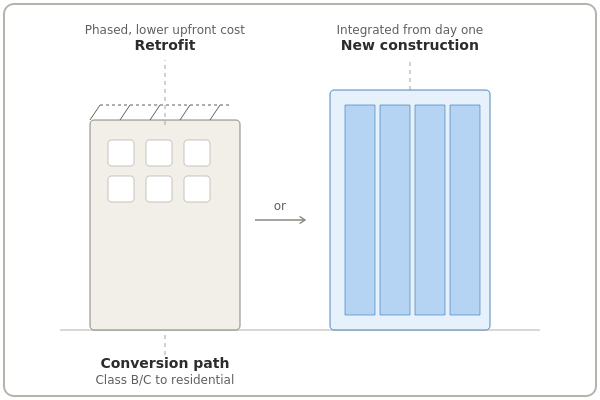
Smart HVAC controls can typically be layered onto existing mechanical equipment through retrofit kits rather than requiring full system replacement, provided the underlying equipment is in reasonable working order. A typical sequence looks like this:
- Pull interval data first. Georgia Power's EnergyDirect portal provides 15-minute and hourly interval usage for commercial accounts. Before investing in anything, a building should know exactly when its historical peaks have occurred this is the single most useful piece of data for scoping a smart HVAC project, and it's often sitting unused in an account most facilities teams have never logged into.
- Identify the ratchet-setting event. In most buildings, one or two specific afternoons per year are doing the damage. A smart HVAC vendor worth hiring should be able to show, using that interval data, exactly what those events looked like and what would have prevented them.
- Start with peak-risk zones. Rooftop units serving the largest floors, or units already flagged for maintenance, are usually the highest-value starting point not necessarily the whole building at once.
- Layer in occupancy and predictive maintenance. Once demand-response control is in place, occupancy sensors and maintenance monitoring add incremental savings without requiring a second major project.
Not every "smart HVAC" vendor is actually addressing the demand-charge problem. Before committing to a project, it's worth asking directly:
- Does the system integrate with Georgia Power's interval data, or does it rely only on on-site sensors with no visibility into actual billing demand?
- Can the platform identify and act on a demand-ratchet-setting event specifically, not just reduce average kWh?
- Is pre-cooling or load staggering part of the control logic, or is the system limited to occupancy-based scheduling?
- What happens during a Georgia Power demand response event or extreme heat advisory does the system have a defined response, or does it run business-as-usual?
A vendor who can't answer these clearly is likely selling a general building-automation package rather than something built around how Georgia's commercial rate structure actually works.
Smart HVAC does reduce energy consumption, and that's worth something on its own. But in Georgia, the bigger financial lever is the demand ratchet a single mechanism that turns one hot summer afternoon into months of elevated billing. A smart HVAC system that's specifically designed to manage peak demand, not just average usage, is solving the problem that actually shows up on a Georgia Power bill.
Frequently asked questions
Usually not. Most smart HVAC platforms add sensors and control logic to existing mechanical equipment through a retrofit, provided the equipment is in reasonable working condition. Full equipment replacement is typically only necessary if the underlying units are already near end of life.
A demand ratchet locks in a building's billing demand at a percentage of its highest recent peak under Georgia Power's standard commercial tariffs, 95% of the prior summer peak or 60% of the prior winter peak, whichever is higher. Because summer peaks are typically the higher of the two, a single hot afternoon can set an elevated charge that carries forward for months.
Georgia Power's EnergyDirect portal provides interval usage data for commercial accounts, including 15-minute and hourly granularity. Reviewing a building's historical peak events is typically the first step before scoping any smart HVAC project.
For larger buildings with load flexibility generally 250 kW or more Real Time Pricing can offer meaningful savings for buildings that can shift usage away from high-price hours. A smart HVAC system with demand-response capability is close to a requirement for taking advantage of RTP effectively, since the tariff rewards automated, hour-by-hour load response rather than manual adjustments.
Timelines vary by building size and scope, but a single-floor or single-system pilot can often be completed in a matter of weeks, while a full-building rollout across multiple rooftop units and zones typically takes longer and is often phased over several months.
In many cases, yes, though compatibility depends on the age and type of the existing control system. Buildings with legacy pneumatic controls or very old rooftop units sometimes require an intermediate hardware upgrade before smart controls can be layered on top this is worth confirming with a vendor during an initial site assessment rather than assuming compatibility.
Related articles

 Smart Buildings