 Manufacturing IoT

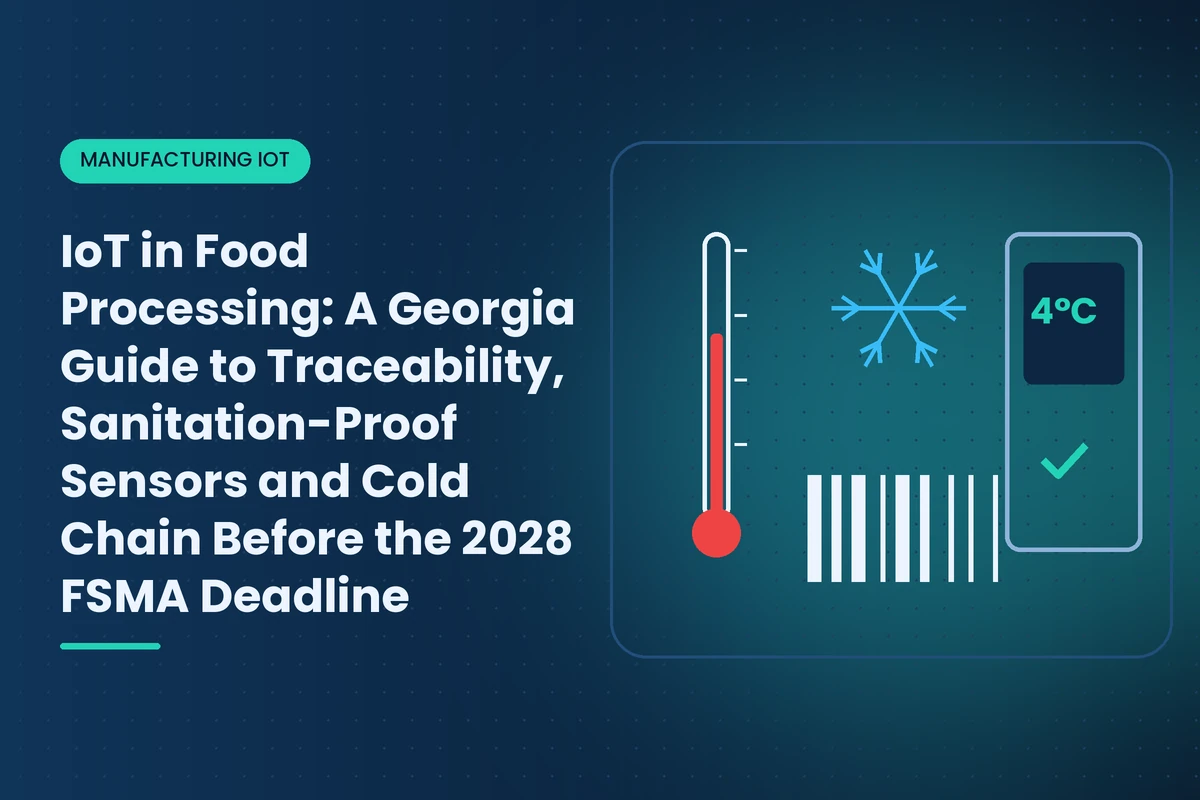
IoT in Food Processing: A Georgia Guide to Traceability, Sanitation-Proof Sensors and Cold Chain Before the 2028 FSMA Deadline
Manufacturing IoT
Published by IOT Georgia Research & Editorial Team
- Why Food Plants Need a Different IoT Playbook
- Where IoT Pays Back in Food Processing
- Understanding FSMA 204 in Plain Terms
- Choosing Sensors That Survive Sanitation
- Georgia Food Sectors and Their Priorities
- A Step-by-Step Plan for Georgia Processors
- An Illustrative Example
- Common Challenges
- Where Food Processing IoT Is Heading
Food processing is one of Georgia's quiet industrial giants. The state has led the nation in broiler production for decades, grows a large share of the country's peanuts and pecans, packs Vidalia onions and other produce, and hosts bakeries, beverage plants, snack makers and ingredient suppliers from the mountains to the coast. It also carries a hard lesson in food safety. The 2008 and 2009 salmonella outbreak traced to a peanut plant in Blakely was one of the events that pushed Congress to pass the Food Safety Modernization Act in 2011.
That history is relevant again. The FDA's Food Traceability Rule under Section 204 of the act will require detailed, shareable records for high-risk foods, and the compliance date is now July 20, 2028. Many retail and foodservice buyers are already asking suppliers for that data. IoT is one of the most practical ways to capture it without adding clipboards. This guide explains where connected sensors help Georgia food processors most, how to choose hardware that survives sanitation, and how to prepare for 2028 without overbuilding.
Why Food Plants Need a Different IoT Playbook
A food plant is not a machine shop with different products. Three things set it apart:
- Sanitation. Many areas are washed down daily with hot water, high pressure and chemicals. Devices that are not built for it fail fast, and devices that trap moisture can become contamination risks themselves.
- Temperature is a safety control. Cooking, chilling and cold storage temperatures are often critical control points in a food safety plan, so records must be complete and accurate.
- Traceability reaches outside the plant. Records must connect ingredients coming in and products going out, across suppliers, distributors and customers.
Where IoT Pays Back in Food Processing
| Application | What Is Monitored | Why It Matters |
|---|---|---|
| Critical control point logging | Cook, chill and holding temperatures | Automatic, tamper-evident records and instant alerts on deviations |
| Cold storage and freezer monitoring | Room and product temperature, door openings | Protects product and supports audits |
| Refrigeration equipment health | Compressor vibration, oil, pressures, evaporator performance | Prevents refrigeration loss and supports ammonia safety programs |
| Traceability events | Lot codes at receiving, transformation and shipping | Supports FSMA 204 key data elements and faster recalls |
| Environmental monitoring support | Room humidity, condensation, sanitation completion | Reduces conditions that allow pathogens to grow |
| Line performance | Machine state, throughput, stops | Recovers capacity on packaging and processing lines |
| Utilities | Water, steam, compressed air, energy | Controls major cost drivers in wet processing |
Understanding FSMA 204 in Plain Terms
The Food Traceability Rule applies to foods on the FDA's Food Traceability List, which includes items such as fresh-cut fruits and vegetables, leafy greens, shell eggs, certain cheeses, finfish and shellfish, and nut butters. Covered businesses must record key data elements at critical tracking events, such as receiving, transforming and shipping, assign traceability lot codes and be able to provide records to the FDA within 24 hours of a request.
The rule itself did not change when the date moved. The FDA extended compliance by 30 months to address readiness concerns, and Congress later directed that it not be enforced before July 20, 2028. Many large buyers are not waiting, so Georgia suppliers selling to national retailers should treat the date as a floor rather than a target.
IoT helps in two ways. Scanners and connected scales capture lot codes and quantities at each event without manual entry. Sensors add condition data, such as cooling curves and storage temperatures, that make those records more useful in an investigation. Even businesses whose products are not on the list often receive similar data requests from customers.
Choosing Sensors That Survive Sanitation
Hardware choice decides whether a food plant IoT project lasts. Look for:
- High ingress protection. Devices rated for high-pressure, high-temperature washdown, typically IP69K in direct spray zones.
- Food-safe materials. Stainless steel or approved plastics, with smooth surfaces and no crevices that trap debris.
- Chemical resistance. Housings, seals and cables that tolerate the plant's sanitizers and caustic cleaners.
- Hygienic mounting. Brackets and cable routing that can be cleaned and do not create harborage points.
- Temperature range. Freezers, blast chillers and ovens often exceed the ratings of general-purpose sensors and batteries.
Involve the sanitation and food safety teams before installing anything. A sensor mounted in the wrong place can create a finding at the next audit.
Georgia Food Sectors and Their Priorities
Poultry processing
Chilling, refrigeration and cold chain dominate. Plants monitor chiller water temperature, carcass and product temperatures, spiral freezer performance and large ammonia refrigeration systems, which fall under OSHA's Process Safety Management standard above threshold quantities. Condition monitoring on compressors supports the mechanical integrity requirements of that program. Our guide to predictive maintenance in Georgia's climate covers washdown-rated condition monitoring.
Peanuts and tree nuts
Shelling, roasting and nut butter plants in South Georgia focus on roaster temperature profiles, which are often validated kill steps for pathogens, along with storage humidity and temperature that affect aflatoxin risk and quality. Nut butters are on the Food Traceability List, so lot-level traceability is a priority.
Produce packing
Vidalia onion, vegetable and fruit packers deal with rapid cooling, storage conditions and short shelf lives. Many fresh produce items are on the traceability list, making receiving and shipping records critical.
Shell eggs
Georgia is also a significant egg producer, and shell eggs are on the Food Traceability List. Egg packing operations benefit from cooler temperature monitoring, which supports refrigeration requirements for eggs, along with lot capture at packing and shipping. Connected sensors in egg coolers and on delivery trucks create a continuous record from the packing plant to the customer.
Bakery, snack and beverage
Ovens, fryers and mixers benefit from process monitoring and energy tracking, while beverage plants focus on water, CIP cleaning cycles and filling line performance. Allergen changeover verification is a common priority in bakeries and snack plants.
A Step-by-Step Plan for Georgia Processors
- Map your traceability events. List every point where lots are received, created, combined or shipped. Identify which products are on the Food Traceability List or requested by customers.
- Automate critical control point records. Replace manual temperature logs on cook, chill and cold storage steps with connected sensors and alerts.
- Protect refrigeration. Add condition monitoring to compressors and alarm monitoring to coolers and freezers.
- Capture lot data at the source. Use scanners, label printers and connected scales at receiving, production and shipping.
- Connect records. Link sensor data to lot codes so a single search returns what happened to a lot and under what conditions.
- Run a mock recall. Test whether you can produce a complete traceability report within 24 hours, then fix the gaps.
- Expand to performance. Once safety and traceability are covered, add machine monitoring to packaging lines. See our guide to machine monitoring in Georgia factories.
An Illustrative Example
Imagine a mid-sized South Georgia plant that roasts peanuts and makes private-label peanut butter for regional grocers. Its roaster temperatures are logged on paper every 30 minutes, cold storage is checked twice a shift and lot records live in spreadsheets. A national retailer asks for FSMA 204-ready data as a condition of a new contract. The plant installs connected thermocouples on each roaster, wireless sensors in storage rooms and scanners at receiving, grinding and shipping. Within a quarter, roast profiles for every lot are stored automatically, a storage cooler that drifted warm overnight triggers an alert instead of a morning surprise, and a mock recall that once took two days is completed in under an hour. The retailer contract moves forward, and the quality team spends less time filling in forms and more time reviewing trends.
Common Challenges
- Wet environments and wireless. Stainless equipment and water absorb and reflect signals. Test coverage in production conditions, not in a dry plant on a weekend.
- Supplier data quality. Traceability depends on lot data from ingredient suppliers. Set clear requirements and help smaller suppliers meet them.
- Alarm overload. Door openings and defrost cycles can trigger nuisance alarms. Use delays and context-aware rules.
- Validation. Sensors used for food safety records must be calibrated and verified on a schedule.
- Workforce. Many plants run multilingual crews, so screens and alerts should be clear in the languages operators use.
Where Food Processing IoT Is Heading
Expect traceability data to become a standard commercial requirement rather than a regulatory project, with major buyers expecting electronic data exchange from suppliers of all sizes. Vision systems and AI will take on more inspection work, from foreign material detection to grading. Refrigeration, one of the largest energy users in food plants, will increasingly be optimized with connected controls. And as Georgia's new inland ports and cold storage capacity grow, links between plant data and cold chain logistics will tighten. Georgia AIM at Georgia Tech lists food production among its focus sectors, and the Georgia Manufacturing Extension Partnership supports food processors with technical help.
For related reading, see our look at supply chain IoT in Georgia and our guide to IoT asset tracking. To find food and manufacturing IoT partners, browse the IoT Georgia company directory or explore manufacturing IoT providers in Gainesville and Macon. Browse more of our Manufacturing IoT coverage.
Tags:
Related articles
Manufacturing IoT
 Manufacturing IoT
Robotics and IoT Are Changing Automotive Manufacturing in Georgia: What the Robot Fleet Needs to Run Well
 Manufacturing IoT
Hyundai's Georgia Metaplant: Inside the State's New Smart-Manufacturing Model
 Manufacturing IoT