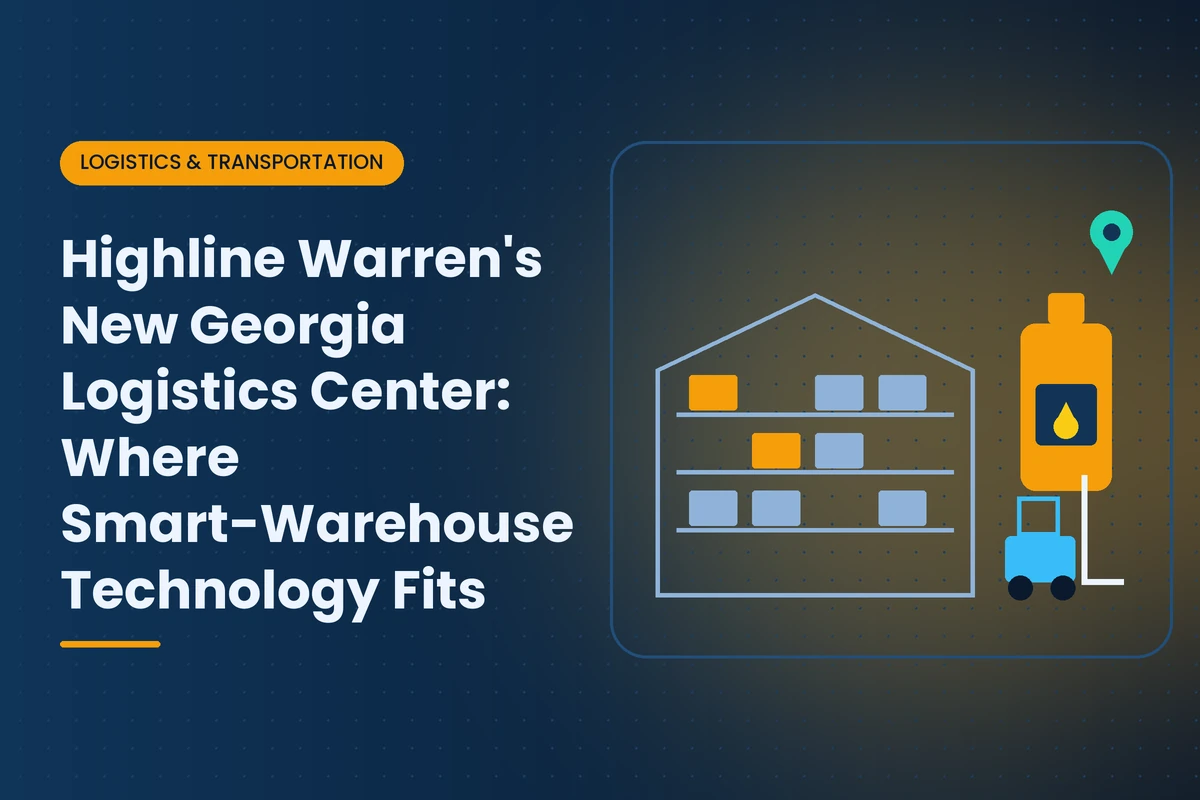
In July 2026, Governor Brian Kemp announced that Highline Warren, a Memphis-based manufacturer and distributor of automotive aftermarket and maintenance products, will invest $170 million in a new logistics and operations center in McDonough. The company plans to acquire and renovate an existing 1.1 million-square-foot facility in Henry County, create 160 jobs and begin operations in late 2026. Highline Warren says the site will help it reach 95 percent of the U.S. population within two days and give its network an East Coast port of entry.
The announcement said the facility will be outfitted with advanced infrastructure and technology, but the company has not published a detailed technology plan. This article is an analysis, not a description of announced systems. It looks at what Highline Warren's product mix and network goals imply for warehouse design, and where smart-warehouse technology typically fits in a facility like this. It is also a useful case study for any company opening or converting a large distribution center in Georgia.
| Item | Detail |
|---|
| Company | Highline Warren, headquartered in Memphis, Tennessee |
| Business | Vertically integrated manufacturer and distributor of maintenance and cleaning products for automotive, home, commercial and industrial markets |
| Scale | More than 1,700 employees and more than 10,000 customers |
| Location | McDonough, Henry County, on the I-75 corridor south of Atlanta |
| Facility | Existing 1.1 million-square-foot building to be acquired and renovated |
| Investment and jobs | $170 million over multiple years, 160 jobs |
| Timing | Operations expected to begin in late 2026 |
| Network goal | Two-day delivery to about 95 percent of the U.S. population |
Industry coverage describes the company's products as including motor oil and other automotive fluids, chemicals, wiper blades, filters and shop supplies, sold to major retailers and to automotive service businesses.
A distribution center's design follows its products. Several characteristics of automotive maintenance products shape where technology adds the most value.
Motor oil, fluids and cleaning chemicals are dense and heavy. Moving them by hand is physically demanding, and pallets are heavy for racking and floors. That points toward pallet-level automation, such as conveyors, pallet movers, autonomous forklifts and robotic palletizing, and toward ergonomic aids for case picking.
Some automotive chemicals and aerosols are flammable or otherwise regulated. Storing them requires appropriate racking, segregation, fire protection and spill response planning. IoT tools can support those requirements with leak and spill detection, temperature monitoring in storage areas and continuous monitoring of fire protection systems.
Maintenance products are bought often and in predictable patterns. Fast movers can be slotted near shipping, and velocity data from the warehouse management system helps keep slotting current as demand changes.
Retailers typically order full pallets or cases with strict labeling, appointment and shipping notice requirements. Service businesses may order smaller mixed quantities more often. Supporting both from one building usually means separate flows for pallet, case and smaller-unit picking.
| Area | Technology That Commonly Fits | Why It Matters Here |
|---|
| Inbound receiving | Dock door sensors, yard tracking, container and trailer visibility | Inbound containers from Savannah and plant replenishment arrive on tight schedules |
| Storage | Dense pallet storage, inventory scanning drones or vision counting | Large pallet volumes of heavy product benefit from accurate, dense storage |
| Case picking | Conveyors, pick-to-light or voice, ergonomic lift assists | Heavy cases make productivity and safety improvements valuable |
| Smaller orders | Autonomous mobile robots or goods-to-person systems | Shop supplies and mixed orders suit flexible automation |
| Outbound | Sortation, robotic palletizing, automated labeling | Retailer compliance and fast truck loading |
| Safety and compliance | Spill and leak sensors, environmental monitoring, fire system monitoring | Regulated chemicals and aerosols |
| Mobile equipment | Forklift telematics and pedestrian proximity systems | Heavy pallets and high traffic increase risk |
| Energy | Submetering, smart lighting, charging management | A 1.1 million-square-foot building has significant energy use |
Our guide to warehouse automation options in Georgia compares these systems in more detail.
Highline Warren chose to renovate an existing facility rather than build new. That is common in Georgia's large warehouse market and has clear advantages in speed and cost. It also brings specific technology considerations:
- Floor condition. Older or heavily used floors may need repair for autonomous vehicles and heavy pallet loads.
- Power capacity. Charging, conveyors and automation may require electrical upgrades.
- Wireless coverage. A 1.1 million-square-foot building needs careful wireless design, especially with dense racking and metal structures.
- Fire protection. New racking layouts and regulated materials can change sprinkler and storage requirements.
- Climate. Heat in summer affects workers, batteries, electronics and some products, so environmental monitoring is worth planning early.
The company has said the facility is designed to support future expansion, which suggests phasing. Building the data infrastructure, such as network coverage, equipment connectivity and a warehouse management system that can orchestrate automation, makes later phases easier.
Every company sequences projects differently, but large distribution centers opening in existing buildings often follow a similar pattern:
| Phase | Typical Focus |
|---|
| Before opening | Building repairs, racking, network and power upgrades, warehouse management system configuration |
| Launch | Core receiving, storage and shipping processes, forklift telematics, dock and yard visibility |
| Stabilization | Inventory accuracy, slotting by velocity, labor productivity tracking |
| Optimization | Targeted automation such as palletizing, conveyors or mobile robots where data shows the payoff |
| Expansion | Additional capacity, new channels or value-added services as the network grows |
Starting with strong data collection makes each later phase easier to justify and plan.
Opening a new hub in an existing network is not just a construction project. Inventory has to move from other facilities, customer assignments change, and service levels must hold during the transition. Data plays a central role:
- Accurate inventory counts before and after transfers.
- Clear visibility of inbound shipments from plants, suppliers and the Port of Savannah.
- Monitoring of order fill rates and delivery times by customer during cutover.
- Labor and productivity tracking as new staff ramp up.
- Equipment uptime data as systems are commissioned.
Our guide to tracking freight from Savannah to Atlanta covers inbound visibility on the corridor that will feed a site like this.
Whatever equipment a facility like this uses, its performance depends on the data systems that coordinate it. A warehouse management system tracks inventory and orders. A warehouse execution or control system, if automation is added, assigns work across people and machines. Yard management connects dock doors to arriving and departing trailers. Maintenance systems receive alerts from equipment sensors. For a company serving retailers with strict compliance rules and service businesses that need fast replenishment, the ability to see orders, inventory and equipment status in one place matters as much as any individual robot or conveyor.
Henry County sits on I-75 south of Atlanta, with access to I-675 and I-285 and a short drive to Hartsfield-Jackson. It is one of the core submarkets of metro Atlanta's industrial market, with access to parcel networks, regional trucking capacity and a large labor pool. Inbound freight from Savannah can arrive by truck along I-16 and I-75 or by rail to metro Atlanta ramps. For a company aiming at two-day delivery to most of the country, that combination of port access and outbound reach is the core advantage.
- Design around the product. Heavy, regulated or high-velocity goods each favor different systems.
- Assess existing buildings carefully. Renovation saves time, but floors, power, wireless and fire protection must support the plan.
- Phase automation. Build the data foundation first and add automation as volumes and processes stabilize.
- Plan the migration. Visibility into inventory, orders and inbound freight protects service during cutover.
- Train early. Georgia's technical colleges and Quick Start program can help prepare staff for new systems.
Large distribution center openings create demand for local integrators, electrical and network contractors, safety and fire protection firms, maintenance providers and IoT specialists. Projects in Henry County and along the I-75 corridor need partners who can work on tight timelines in large existing buildings and support systems after go-live. Providers with experience in heavy goods, regulated materials and retailer compliance are particularly well positioned.
The project also arrives as Henry County continues to attract large distribution operations, which affects competition for warehouse labor and the local supply of contractors and service providers. As the McDonough center moves toward its late 2026 opening, watch for details on its automation choices, how quickly it ramps to full operations and whether the company expands the site over time. More broadly, the project reflects a trend in Georgia logistics: companies are choosing the state for port access and national reach, then using technology to make very large buildings run efficiently with lean teams. For a deeper look at heat, labor and safety in Georgia warehouses, see our guide to smart warehouses in Georgia.
For related reading, see our guides to IoT asset tracking and Georgia's inland port network, and our article on smart lighting ROI. To find warehouse technology partners, browse the IoT Georgia company directory or explore logistics IoT providers in Atlanta and Macon. Browse more of our Logistics and Transportation coverage.
Frequently asked questions
Highline Warren plans to invest $170 million to acquire and renovate a 1.1 million-square-foot logistics and operations center in McDonough, Henry County, creating 160 jobs.
State and company announcements said operations are expected to begin in late 2026.
The company cited Georgia's workforce, infrastructure and connections to global supply chains. McDonough offers I-75 access, proximity to Atlanta and a route to the Port of Savannah, supporting two-day delivery to about 95 percent of the U.S. population.
Common fits include dock and yard visibility, dense pallet storage, conveyors and palletizing for heavy cases, AMRs for smaller orders, forklift telematics, spill and environmental monitoring and energy management.
The company said the facility will use advanced infrastructure and technology but has not published a detailed technology plan. This article analyzes where such technology typically fits.
Assess floor condition, electrical capacity, wireless coverage, fire protection and climate before choosing automation, and plan phased implementation and network migration carefully.
Related articles

 Logistics & Transportation