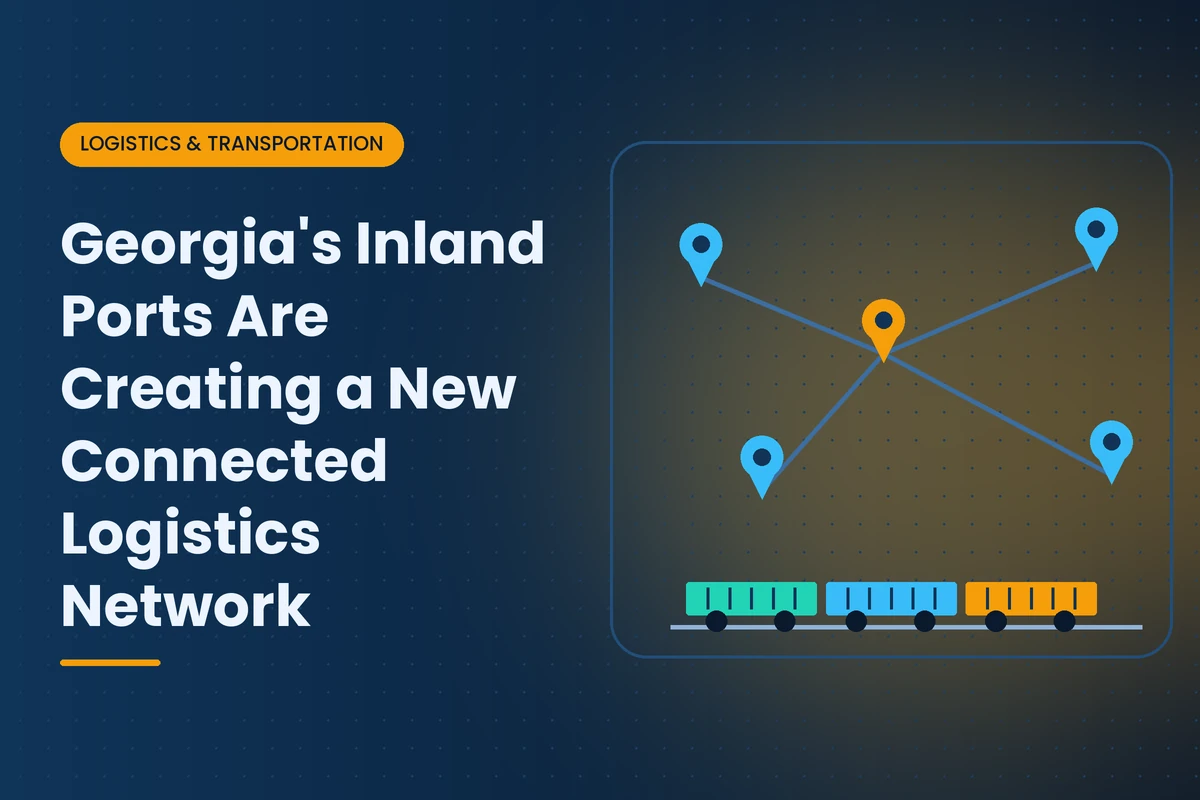
For most of its history, the Port of Savannah was a coastal gateway that cargo reached by truck. That is changing. With the Appalachian Regional Port in Crandall, the Bainbridge Terminal in Southwest Georgia and, since May 4, 2026, the Gainesville Inland Port in Hall County, the Georgia Ports Authority now operates a network of inland terminals that pull the port's reach hundreds of miles inland. Containers can ride rail from Savannah to within a short drive of manufacturers and distribution centers across North Georgia, then return loaded with exports.
A network like this works only if information moves as smoothly as the containers. Shippers need to know when a box will reach an inland terminal, when it is available, where empty containers are and how to book pickups and returns. This article looks at Georgia's inland ports as a connected logistics network: what each terminal does, where data and IoT tools make the difference, and how shippers can plan around a port that now has several front doors. For the bigger picture of handoffs across modes, see our article on IoT in Georgia logistics.
| Terminal | Location | Rail Partner | Main Role |
|---|
| Appalachian Regional Port | Crandall, Murray County | CSX | Containers for Northwest Georgia and the Chattanooga region |
| Gainesville Inland Port | Gainesville, Hall County | Norfolk Southern | Containers for Northeast Georgia manufacturers and distributors |
| Bainbridge Terminal | Bainbridge, Decatur County | Rail and barge | Bulk and breakbulk cargo such as fertilizers and agricultural products |
The Appalachian Regional Port opened in 2018 as a partnership among the state, Murray County, the GPA and CSX. It handled a record 49,319 containers in fiscal year 2026. The Gainesville Inland Port, formerly called the Blue Ridge Connector, is a $134 million facility on a 104-acre site with three 6,000-foot working tracks connected to Norfolk Southern. At full build-out it will have 18,000 feet of working track and capacity for 200,000 containers a year. GPA expects it to replace about 26,000 truck round trips in its first year and serve a market of around 330 manufacturers. Bainbridge, on the Apalachicola-Chattahoochee-Flint waterway, focuses on bulk cargo rather than containers.
All three connect back to Savannah, where the Mason Mega Rail Terminal handled 591,000 containers in 2025 and the GPA reports average vessel-to-rail dwell of under 20 hours.
When containers moved directly by truck from Savannah to a warehouse, there were two main handoffs: terminal to trucker and trucker to warehouse. Inland ports add steps. A container now goes from vessel to rail at Savannah, rides a train, arrives at an inland terminal, waits for pickup and finally travels a short distance by truck. Exports reverse the process. Each step creates a status update that someone needs.
The benefits are significant: shorter truck trips, less highway congestion, lower emissions and often lower cost. But shippers only capture those benefits if they can see what is happening. A container that sits unnoticed at an inland terminal for three extra days can wipe out the savings from avoiding a long truck haul.
| Information Need | Typical Source | Who Uses It |
|---|
| Container loaded on train at Savannah | Terminal and railroad events | Importers, drayage carriers |
| Estimated arrival at inland terminal | Rail tracking and schedules | Warehouse planners, carriers |
| Container available for pickup | Inland terminal system | Drayage dispatchers |
| Gate in and gate out | Gate cameras and transactions | Carriers, cargo owners |
| Empty container location and return options | Terminal and shipping line data | Exporters, carriers |
| Reefer power and temperature | Remote reefer monitoring | Food and cold chain shippers |
| Dwell time at each step | Combined event timeline | Logistics managers |
Most of these events already exist inside terminal, railroad and shipping line systems. The opportunity for shippers is to pull them into one timeline per container, either through a visibility platform or direct data feeds, and to set alerts on the milestones that matter.
Rail and terminal events tell you where a container is in the process. Trackers on the container or cargo add continuous location and condition data. For high-value goods, temperature-sensitive products or time-critical parts, that extra layer catches problems between official milestones.
Poultry and food processors are among the expected users of the Gainesville terminal. Frozen and chilled exports need unbroken cold chain from the plant through the inland terminal, along the rail line and onto the vessel. Remote monitoring of reefer power and temperature at each stage gives exporters evidence of proper handling and early warning of failures. Our guide to IoT in food processing covers the plant side.
Inland ports shorten truck trips, which means a drayage carrier can make more turns per day, but only if warehouse docks are ready. Linking container availability to dock appointment systems and yard tracking at the warehouse keeps short-haul moves efficient. See our guide to smart warehouses in Georgia.
Containers can be ready while chassis are not. Tracking chassis pools and equipment at inland terminals helps carriers avoid wasted trips.
One of the biggest efficiency gains from inland ports comes from matching imports and exports. When an importer near Gainesville empties a container, that box can be reloaded by a nearby exporter, such as a poultry, heavy equipment or forest products company, instead of traveling empty back to Savannah. Making that work requires shared information about empty container availability, shipping line rules and exporter bookings. Shippers and carriers that coordinate this data can reduce empty miles and costs for both sides.
- Compare total landed cost by route. For each lane, compare direct truck from Savannah with rail to an inland port plus short drayage, including dwell, storage and drayage rates.
- Set milestone alerts. Track loaded on rail, arrived inland, available and picked up. Alert on delays at each step.
- Coordinate drayage early. Line up local carriers who understand inland terminal procedures and appointment rules.
- Align dock schedules. Use expected availability times to plan labor and dock doors.
- Measure dwell. Review time spent at each step monthly and discuss outliers with partners.
- Explore match-back. Work with carriers and shipping lines to reuse import empties for exports where possible.
Imagine a hypothetical plastics manufacturer in Jackson County that imports resin and exports finished parts. It previously trucked containers to and from Savannah, roughly a 600-mile round trip. After the Gainesville Inland Port opened, it shifted part of its volume to rail. In the first month, savings were smaller than expected because containers sometimes waited days at the inland terminal before pickup. The company added rail and terminal events to its visibility platform, set alerts for availability, and agreed on standing pickup windows with a local drayage carrier. It also began reusing import empties for its own exports. Within a quarter, inland dwell fell, empty moves dropped and the rail route became consistently cheaper than trucking. The savings came from visibility as much as from the rail line itself.
Inland ports are changing how companies choose locations in Georgia. A factory or distribution center within a short drive of an inland terminal can reach Savannah's global shipping services without long truck hauls through Atlanta. When evaluating sites, companies should look at distance and drive time to the nearest inland terminal, the rail partner and service frequency, local drayage capacity, road access around the terminal and whether nearby shippers create match-back opportunities for containers. They should also confirm that the site has the connectivity needed to share data with terminals, carriers and customers from day one.
- Fragmented data. Terminals, railroads, shipping lines and carriers each hold part of the picture.
- Service frequency. Rail schedules are less flexible than trucks, so urgent cargo may still need direct trucking.
- Local road impacts. Communities near inland terminals see more local truck traffic, which affects routing and community relations.
- Learning curve. Shippers new to intermodal need time to adjust planning and contracts.
The GPA's long-term plans include more berth capacity in Savannah and further expansion of on-terminal rail, which will feed more volume into the inland network. Gainesville is expected to grow well beyond its first-year volume as more Northeast Georgia shippers adopt it, and the GPA has projected trade there could reach several times the size of the Appalachian Regional Port. Site selectors are already weighing proximity to inland terminals when choosing locations for factories and warehouses. Over time, Georgia's port will look less like a single coastal gateway and more like a statewide system, and the companies that connect their data to that system will get the most from it.
For related reading, see our look at Savannah port technology, our guide to tracking freight from Savannah to Atlanta and our article on supply chain IoT in Georgia. To find logistics technology partners, browse the IoT Georgia company directory or explore logistics IoT providers in Gainesville and Savannah. Browse more of our Logistics and Transportation coverage.
Frequently asked questions
The Georgia Ports Authority operates the Appalachian Regional Port in Crandall, the Gainesville Inland Port in Hall County, which opened May 4, 2026, and the Bainbridge Terminal in Southwest Georgia, which handles bulk cargo.
It connects to the Port of Savannah by Norfolk Southern rail. GPA expects it to replace about 26,000 truck round trips in its first year and reach 200,000 containers of annual capacity at full build-out.
Inland routes add handoffs between vessel, rail, inland terminal and truck. Without shared status data, containers can sit unnoticed and erase the savings of using rail.
It means reusing an emptied import container for a nearby export load instead of returning it empty to the seaport. It reduces empty miles and costs but requires shared container and booking data.
Yes. Exporters such as poultry processors can use inland rail, but they should monitor reefer power and temperature at each stage to protect the cold chain.
Compare total landed cost by lane, including drayage, dwell, storage and transit time, and track actual performance by milestone after switching routes.
Related articles

 Logistics & Transportation