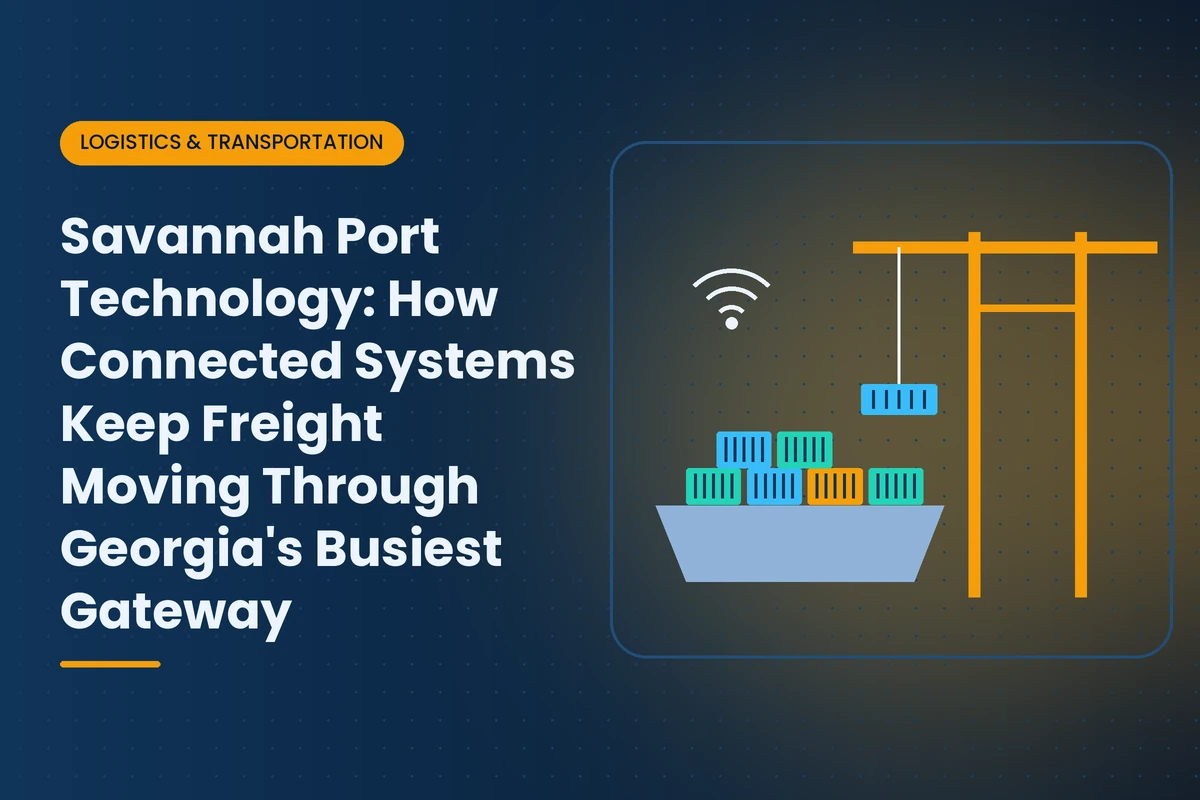
The Port of Savannah is one of the busiest container gateways in North America. According to the Georgia Ports Authority, it sees about 40 ship calls and 42 doublestack trains a week and roughly 16,000 truck gate moves a day. Garden City Terminal alone covers more than 1,500 acres, has 7.5 million TEUs of annual capacity and can handle vessels up to 20,000 TEUs. Keeping that volume moving depends on far more than cranes and pavement. It depends on connected systems that track every container, coordinate every move and share status with thousands of trucking companies, railroads, shipping lines and cargo owners.
This article looks at the technology layer inside the port: the systems that run gates, cranes, yards, rail and refrigerated cargo, how they connect, and what shippers and truckers can do with the data. For the wider logistics picture, see our article on IoT in Georgia logistics and our earlier look at IoT at the Port of Savannah.
| Measure | Figure |
|---|
| Containers handled, fiscal year 2026 | 5.67 million TEUs |
| Garden City Terminal annual capacity | 7.5 million TEUs |
| Weekly ship calls | About 40 |
| Weekly doublestack trains | 42 |
| Daily truck gate moves | About 16,000 |
| Mason Mega Rail Terminal | 85 acres, 18 working tracks |
| Ocean Terminal redevelopment | About 60 percent complete as of September 2026 |
At the center of any large container terminal is a terminal operating system that knows where every container is, what it contains, who owns it and where it needs to go next. It plans vessel loading and unloading, assigns yard positions, dispatches equipment and records each move. Every other system on the terminal feeds data into it or takes instructions from it.
With roughly 16,000 truck moves a day, gates are a constant pressure point. Modern terminal gates use cameras and optical character recognition to read container numbers, chassis and truck plates, weigh and inspect equipment, and match each truck to a pickup or drop-off transaction. The faster that check-in happens, the shorter the lines outside the terminal and the more turns truckers can make in a day.
Ship-to-shore cranes and yard cranes generate continuous data on moves, cycle times, faults and energy use. Equipment telemetry supports productivity tracking and predictive maintenance on assets whose failure can delay vessel operations. At Garden City Terminal West, the expansion that added 100 acres and space for 20,000 containers is served by 15 electric rubber-tire gantry cranes, which link energy use and equipment status more closely to the terminal's electrical systems.
The Mason Mega Rail Terminal is the largest on-terminal intermodal facility in North America, with 18 working tracks able to handle trains of 10,000 feet and rail lift capacity of 2 million TEUs a year. The Georgia Ports Authority reports an average of about 20 hours from vessel to rail. That speed depends on tight coordination between vessel discharge plans, yard moves and railcar loading, all tracked digitally so railroads and customers know when containers will depart.
Savannah handles large volumes of refrigerated exports and imports, including Georgia poultry and produce. Reefer containers must stay plugged in and at the correct temperature while on terminal. Remote reefer monitoring lets terminals and cargo owners see power status, set points and actual temperatures, and respond quickly to alarms. Our guide to IoT in food processing explains why those records matter to food shippers.
Much of the value of port technology reaches the people who use the port, not just those who operate it. Common data and tools include:
- Container availability. Status showing when an import container is discharged, released and ready for pickup.
- Truck appointments. Scheduling systems that spread gate traffic across the day and reduce waiting.
- Gate and turn times. Data showing how long truck visits take, helping carriers plan and price work.
- Vessel schedules and berth status. Updates on arrivals and departures that feed shippers' planning.
- Rail status. Information on when containers are loaded on trains and depart for inland destinations, including Georgia's inland ports in Chatsworth and Gainesville.
The shippers that benefit most pull this data automatically into their own transportation or visibility systems rather than checking websites manually.
Georgia's port technology story extends beyond Garden City Terminal. The Port of Brunswick is one of the country's busiest ports for vehicles and heavy equipment, where tracking individual units across large outdoor lots is the main technology challenge. Inland, the Appalachian Regional Port in Murray County and the Gainesville Inland Port, which opened in May 2026, connect to Savannah by rail. Each inland terminal extends the port's digital reach, because container status must follow cargo from the ship to the inland gate. For cargo owners in North Georgia and neighboring states, consistent data across these locations is what makes rail-plus-truck routings practical.
The Georgia Ports Authority is carrying out a multi-billion-dollar plan to expand capacity across Savannah and its inland network. Ocean Terminal is being rebuilt as a container facility. According to local reporting in September 2026, the $1.6 billion project was about 60 percent complete, with plans to open the terminal to larger ships by the end of 2028 and grow its annual capacity from about 200,000 TEUs to 1.75 million. The GPA has also said it plans to expand Mason Mega Rail further over time.
More capacity means more containers, trucks and trains to coordinate. Technology is what allows a larger port to run without proportionally longer waits. It also makes the port more dependent on reliable networks, accurate data and cybersecurity.
Ports are critical infrastructure, and cyber incidents at ports worldwide have shown how quickly operations can stop when terminal systems go down. In the United States, the Coast Guard finalized cybersecurity requirements for the maritime transportation system in 2025, adding expectations for cybersecurity plans, incident reporting and training. For terminal operators, carriers and logistics providers that connect to port systems, practical steps include segmenting operational networks, controlling remote access, maintaining incident response plans and testing manual fallback procedures so cargo can keep moving if systems are unavailable. Our article on industrial IoT security risks covers the fundamentals.
Imagine a regional drayage company based near Savannah with 60 trucks serving import warehouses along I-16 and in Effingham County. Its dispatchers used to check container availability manually and send drivers based on experience, leading to wasted trips and long waits. The company integrated port availability data and truck appointment information with its dispatch software and added telematics to its fleet. Dispatchers now see which containers are ready, book appointments in quieter windows and track each truck's turn time. Empty trips drop, drivers complete more moves per shift and customers receive more accurate delivery estimates. The underlying port systems did not change. The company simply connected to the data they already provide.
- Which port data feeds do you receive automatically, and how quickly do they update?
- Can you share container availability, appointment and gate times with us in a standard format?
- How do you monitor refrigerated containers while they are on terminal and in transit?
- What is your plan if port systems are unavailable during a cyber incident or storm?
- How do you measure and report turn times and dwell for our shipments?
Clear answers to these questions separate partners who simply move boxes from those who help you plan with data.
- Data access varies. Not every party can or will share data in compatible formats.
- Peak periods. Surges in volume strain gates, yards and rail, and data shows problems faster than it can fix them.
- Weather. Hurricanes and severe storms can close the port or disrupt operations, making contingency planning essential.
- Chassis and equipment availability. Freight can stall when chassis are not where they are needed, even if containers are ready.
- Skills. Terminal and logistics companies need people who can manage connected systems and use data well.
Expect deeper automation of gate processes, more electrified yard equipment, wider use of predictive analytics for vessel, yard and rail planning, and more real-time data shared with cargo owners. As Ocean Terminal comes online for larger ships and rail capacity grows, the port's ability to move more freight without proportionally more congestion will depend on how well these connected systems work together. For Georgia shippers, carriers and warehouses, the opportunity is to connect to that data, build it into daily planning and use it to make better decisions about routing, timing and inventory.
For related reading, see our guides to supply chain IoT in Georgia and smart warehouses in Georgia, and our fleet tracking primer. To find logistics technology partners, browse the IoT Georgia company directory or explore logistics IoT providers in Savannah. Browse more of our Logistics and Transportation coverage.
Frequently asked questions
The Georgia Ports Authority reports about 40 ship calls and 42 doublestack trains a week and roughly 16,000 truck gate moves a day. The port handled 5.67 million TEUs in fiscal year 2026.
A terminal operating system tracks every container and move, supported by smart gates, crane and yard equipment telemetry, rail coordination systems and reefer monitoring.
It is an 85-acre on-terminal rail facility at Garden City Terminal with 18 working tracks and 2 million TEUs of annual rail lift capacity. GPA reports about 20 hours from vessel to rail.
Truckers can use container availability, appointment systems and turn time data to avoid wasted trips, book quieter windows and complete more moves per shift.
Local reporting in September 2026 said the $1.6 billion Ocean Terminal project was about 60 percent complete, with plans to open the terminal to larger ships by the end of 2028.
Ports are critical infrastructure, and cyber incidents can halt terminal operations. The Coast Guard finalized maritime cybersecurity requirements in 2025 covering plans, incident reporting and training.
Related articles

 Logistics & Transportation