The Port of Savannah's Garden City Terminal is the largest single-operator container terminal in North America, running 36 high-speed ship-to-shore cranes and processing roughly 14,000 truck gate moves a day between 4 a.m. and 6 p.m. Every one of those moves depends on systems that cannot afford to wait on a round trip to a distant cloud server: a rubber-tired gantry crane positioning a container within centimeters of its target slot, an OCR gate system reading a truck and container ID in the fraction of a second it takes the vehicle to roll through, a terminal operating system tracking exactly where thousands of containers sit in a stacking yard at any given moment. This is what edge computing actually solves, and it's a much more concrete answer than the usual "process data closer to the source" explanation most articles settle for.
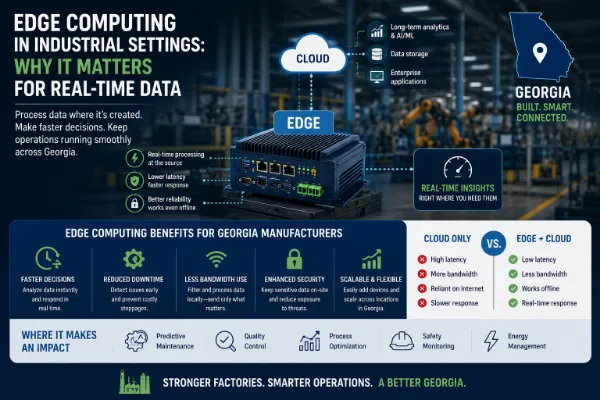
Edge computing means processing data physically close to where it's generated on-site hardware at a plant, terminal, or facility rather than sending raw data to a centralized cloud data center for processing and waiting for a response. The "edge" refers to the boundary of the network closest to the data source: a sensor, a camera, a piece of equipment.
This is different from a pure cloud architecture, where sensor data is transmitted off-site for processing and the results are sent back. It's also different from traditional on-premise SCADA, which processes data locally but typically for closed-loop control only, without the broader analytics capability cloud and edge platforms are built to provide. Edge computing sits between these two models: local processing power, but built with the same analytics and connectivity capabilities as a cloud platform, running at the site rather than remotely.
Most edge computing content mentions latency in passing and moves on to talk about bandwidth savings. At a facility like Garden City Terminal, latency isn't a secondary concern it's the entire reason edge processing is necessary rather than optional.
Consider what's actually happening when an automated stacking crane places a container: the crane's positioning system needs to process real-time sensor input and adjust crane movement continuously, correcting for sway, wind, and precise alignment, often dozens of times per second. A round trip to a cloud data center even a fast one, even with excellent connectivity introduces a delay that a real-time positioning system simply cannot tolerate. The physics of network round-trip time don't change based on how good your internet connection is; sending data hundreds of miles to a data center and back adds unavoidable delay that a millisecond-sensitive control loop can't absorb.
The same logic applies to the terminal's OCR gate systems, which need to read a container ID, truck ID, and chassis number and make a real-time decision open the gate, flag for inspection, route to a specific yard location in the few seconds it takes a truck to pass through, across roughly 7,000 truck moves a day. Processing that recognition locally, at the gate, rather than sending each image to the cloud and waiting for a response, is what makes that gate throughput possible at all.
A useful way to think about the layers in a modern industrial environment:
| Layer | What It Handles | Typical Response Time |
|---|
| Local control (PLC/SCADA) | Direct equipment control starting/stopping motors, valve positions | Milliseconds |
| Edge computing | Real-time analytics, image processing, positioning systems, immediate decision-making close to the equipment | Milliseconds to low seconds |
| Cloud computing | Historical analysis, cross-site comparison, machine learning model training, enterprise reporting | Seconds to minutes |
Edge computing doesn't replace either layer it fills the gap between them. A crane's core positioning control still runs on local, real-time control hardware. Long-term trend analysis across every crane at the terminal still runs in the cloud, where there's no latency requirement and far more computing power available for complex analysis. Edge computing handles the layer in between: processing that needs to happen faster than a cloud round-trip allows, but that's more complex than a simple PLC control loop can handle like real-time OCR, computer-vision-based positioning correction, or immediate anomaly flagging.
Latency is the primary driver, but connectivity reliability and bandwidth cost are close behind, particularly relevant for a facility the scale of Garden City Terminal, which spans 1,345 acres. Sending continuous, high-resolution camera and sensor data from every crane and gate across a facility that size to a cloud data center, for every single event, would require enormous sustained bandwidth and would fail entirely during any network outage.
Edge computing addresses this by processing the bulk of raw data locally and sending only the results, summaries, or flagged exceptions to the cloud not every frame of camera footage, but the OCR result; not every raw sensor reading, but the flagged anomaly. This dramatically reduces the bandwidth required and means the facility's most critical, real-time functions keep operating even if a connection to the broader cloud platform is temporarily disrupted, since the local edge systems don't depend on that connection to make immediate decisions.
Automated stacking cranes and rubber-tired gantry cranes use local edge processing to interpret sensor and camera data in real time, correcting position continuously rather than sending data off-site and waiting for guidance.
OCR gate systems process container, chassis, and truck identification locally, making immediate routing and access decisions without a network round-trip, which is what allows a high-throughput gate to keep pace with real truck traffic volumes.
Rather than streaming every sensor reading to the cloud for analysis, edge devices can run lightweight models locally that flag anomalies as they happen an unusual vibration pattern, an out-of-range temperature sending only the flagged event to the broader platform rather than the full raw data stream.
Because critical processing happens locally, core operations can continue functioning even during a temporary loss of connection to a centralized cloud platform, with data queued and synchronized once connectivity is restored, rather than the facility's real-time operations depending entirely on an uninterrupted internet connection.
Not every industrial application needs edge processing, and it's worth being direct about that. If a use case can tolerate a delay of several seconds or more monthly energy consumption reporting, long-term maintenance trend analysis, cross-facility performance comparisons cloud processing is usually simpler, cheaper, and easier to maintain than deploying and managing additional edge hardware. Edge computing earns its added complexity specifically in applications where latency, bandwidth, or connectivity reliability create a real operational constraint, not as a default architecture choice for every sensor deployment.
- Does the application require a response faster than a cloud round-trip can reliably provide? If yes real-time positioning, immediate safety response, high-speed image recognition that's a strong edge computing candidate.
- Would sending raw data to the cloud create an unreasonable bandwidth burden? High-resolution video or high-frequency sensor streams from many devices across a large facility often make more sense processed locally, with only summarized results sent onward.
- Does the application need to keep functioning during a connectivity outage? If a temporary loss of internet connectivity would be operationally unacceptable for a given function, that function likely belongs at the edge rather than depending entirely on the cloud.
- If none of the above apply, cloud processing is probably the simpler, more maintainable choice, and edge hardware would add cost and complexity without a corresponding operational benefit.
Edge computing matters in industrial settings not as a general best practice, but because specific applications genuinely can't function on cloud latency alone. The Port of Savannah's container terminal operations make this concrete: crane positioning, OCR gate processing, and real-time terminal tracking at the scale Garden City Terminal operates depend on processing happening at the site, not hundreds of miles away. The right framework isn't "edge versus cloud" it's identifying which specific functions in your operation actually have a latency, bandwidth, or connectivity requirement that only local processing can meet, and building the architecture around that distinction rather than applying one computing model uniformly across an entire facility.
Frequently asked questions
SCADA handles direct, closed-loop equipment control at millisecond speed but with limited analytics capability. Edge computing sits above that layer, handling more complex real-time processing like image recognition or positioning correction that requires more computing power than a PLC provides, while still avoiding the latency of a full cloud round-trip.
The physical distance data has to travel to a cloud data center and back introduces network latency that a millisecond-sensitive control loop, like continuous crane position correction, can't tolerate, regardless of how fast the underlying internet connection is.
No. Edge and cloud typically work together edge handles real-time, latency-sensitive processing on-site, while cloud platforms handle historical analysis, cross-site comparisons, and complex analytics that don't have a real-time requirement and benefit from greater computing scale.
Because critical real-time processing happens locally rather than depending on a live cloud connection, core operations can continue functioning during a temporary connectivity loss, with data synchronized to the cloud platform once the connection is restored.
No, though the case for it is often clearest at scale. Any facility with a genuine latency, bandwidth, or connectivity-reliability requirement for a specific application regardless of overall facility size can benefit from edge processing for that application specifically.
Ruggedized industrial computers or gateway devices installed on-site, often positioned close to the equipment or process they're supporting near a crane, at a gate, or on a production line rather than in a centralized server room, so processing happens as close to the data source as possible.
Related articles

 Industrial IoT (IIoT)