Most hospital asset tracking content leads with a generic industry statistic about nurses losing time searching for equipment and moves straight to product features. That skips the part that actually matters: what happens when equipment-finding delays occur at a hospital operating at or beyond capacity. Grady Memorial Hospital, Atlanta's only Level I trauma center since Wellstar Atlanta Medical Center closed in 2022, handles roughly 13,000 to 14,000 trauma activations a year across nearly 1,000 licensed beds, and absorbed a significant volume increase almost overnight when AMC shut down, adding roughly 200 beds in the following months to keep pace. In an environment already operating under that kind of sustained volume pressure, the minutes a nurse or tech spends searching for a specific infusion pump or portable monitor aren't just an efficiency nuisance they're minutes pulled directly from an already stretched capacity margin.
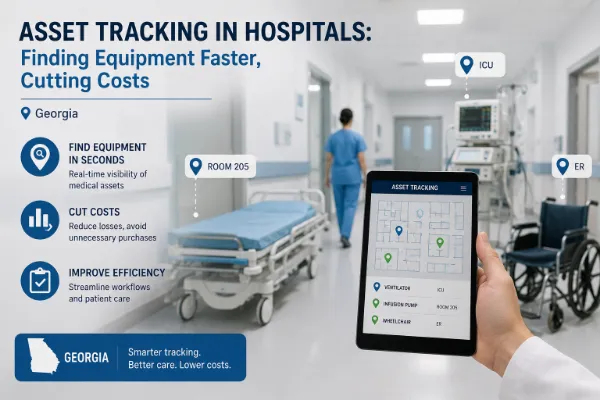
Hospital asset tracking, often implemented as a Real-Time Location System (RTLS), uses tags attached to mobile medical equipment combined with a network of sensors throughout a facility to track that equipment's location continuously. A few underlying technologies are commonly used, often in combination:
- RFID (Radio Frequency Identification) passive or active tags that transmit an identifier to fixed readers positioned throughout a facility, providing room-level or zone-level location accuracy.
- Bluetooth Low Energy (BLE) beacons increasingly common for indoor tracking, offering better accuracy than basic RFID in many deployments while consuming less power than earlier active RFID tags.
- Wi-Fi-based tracking using a facility's existing wireless network infrastructure to triangulate tagged asset locations, which can reduce the need for a separate dedicated sensor network.
- Ultra-wideband (UWB) the highest-precision option, capable of near real-time, sub-meter location accuracy, typically reserved for high-value equipment or workflows where exact positioning matters, such as tracking equipment within a specific bay in a busy emergency department.
The tag itself is only useful when paired with a software platform that staff can search typically from a computer, a mobile device, or a dashboard at a nursing station to see a piece of equipment's current or last-known location without physically walking the floor to look for it.
Equipment search time is a documented, industry-wide problem: clinical staff routinely report spending meaningful portions of a shift locating mobile equipment infusion pumps, wheelchairs, portable monitors, specialty beds that should be readily available but isn't where it's expected to be. This happens for a predictable set of reasons: equipment gets moved between departments and isn't returned, gets stored in an atypical location during a busy shift, or ends up in a different unit entirely after being borrowed during a patient transfer.
At a facility handling Grady's trauma volume, this dynamic compounds. A trauma activation requires immediate access to a defined set of equipment, often across multiple departments simultaneously as a patient moves from the emergency department to imaging to the OR to a step-down unit. Every handoff is a point where equipment can be misplaced, and every minute spent searching during a high-acuity case has a materially different cost than the same minute spent searching during a quiet shift on a lower-volume floor.
The most direct benefit is time: staff spend less time physically searching for equipment and more time on direct patient care, which matters both for care quality and for staff workload in an environment already operating under volume pressure.
Hospitals frequently own more mobile equipment than they actually need, specifically because equipment is hard to locate when needed, leading departments to hoard or over-purchase rather than share a facility-wide pool efficiently. Accurate, real-time visibility into where equipment actually is and whether it's in use allows a hospital to right-size its equipment inventory rather than over-purchasing to compensate for poor visibility.
Equipment that goes missing for an extended period, or is never recovered at all, is a real and recurring cost for hospitals, sometimes requiring an emergency rental to cover the gap until a replacement is sourced or the original item is found. Asset tracking directly reduces both the loss rate and the time equipment spends "lost" before being located.
For equipment requiring cleaning or maintenance between uses, location tracking can help staff identify which units have already been through that cycle and are ready for reuse, versus which are still in a dirty or maintenance queue, reducing both search time and the risk of using equipment that hasn't been properly processed.
For a trauma center handling the volume Grady manages, asset tracking implementation tends to prioritize differently than it would at a smaller, lower-acuity facility:
- Trauma bay and OR equipment gets the highest-precision tracking (often UWB), since exact positioning within a busy, fast-moving care area matters more than in a general medical floor.
- High-turnover portable equipment infusion pumps, portable monitors, ventilators is prioritized for tracking before lower-turnover fixed assets, since these are the items most likely to migrate across departments during a busy shift.
- Integration with patient flow systems becomes more valuable at high volume, since knowing where equipment is only helps if it's paired with visibility into where patients are moving and what equipment their next step will require.
It's worth being direct about the limits. Asset tracking tells staff where equipment is it doesn't solve an underlying equipment shortage, and it doesn't replace the staffing and process changes a facility under sustained volume pressure may still need. A hospital that's genuinely short on infusion pumps for its patient volume will still be short on infusion pumps with perfect location visibility; tracking just makes it clear faster, rather than solving the underlying capacity problem. Asset tracking is a visibility and efficiency tool, not a substitute for adequate equipment inventory or staffing levels.
- Start with the equipment categories causing the most disruption, not every mobile asset in the building. High-turnover, frequently searched-for equipment types are usually the clearest starting point and the fastest to show measurable value.
- Match tracking technology to the precision actually needed. A general medical floor may do fine with room-level RFID or BLE accuracy; a trauma bay or OR may justify the added cost of UWB precision.
- Plan for the software and workflow integration, not just the tags. A tracking system that staff don't know how to search, or that isn't integrated into existing workflows, produces far less value than the hardware alone would suggest.
- Measure baseline search time and equipment loss rates before implementation, so the actual impact can be assessed against a real starting point rather than an assumed one.
Asset tracking reduces search time, improves equipment utilization, and cuts loss and rental costs at any hospital, but the value compounds at a facility operating under sustained volume pressure. For a hospital like Grady, now carrying the trauma volume of two major Atlanta facilities after Wellstar Atlanta Medical Center's closure, every minute of equipment search time removed from a high-acuity case is a minute returned to an already stretched capacity margin making asset tracking less of an efficiency upgrade and more of a direct contributor to how much clinical capacity a facility can actually sustain.
This article discusses healthcare technology and operations for general informational purposes and is not medical advice.
Frequently asked questions
Common approaches include RFID, Bluetooth Low Energy (BLE) beacons, Wi-Fi-based triangulation using existing wireless infrastructure, and ultra-wideband (UWB) for the highest-precision, near real-time location tracking, often used in combination depending on the precision needed in different areas of a facility.
It often does, indirectly. When equipment location is hard to determine, departments tend to hoard or over-purchase equipment to compensate. Accurate, real-time visibility allows more efficient sharing of a facility-wide equipment pool, which can reduce the need for redundant purchasing.
At facilities handling high trauma volumes, equipment frequently moves across multiple departments during a single case, and time spent searching during a high-acuity situation carries a materially higher cost than the same delay during routine, lower-volume care.
No. Asset tracking improves visibility into where existing equipment is located, but it doesn't create additional equipment. A facility with a genuine shortage relative to its patient volume will still need to address that shortage directly, independent of tracking technology.
High-turnover, frequently searched-for mobile equipment infusion pumps, portable monitors, wheelchairs, and specialty beds are typically prioritized first, since these categories tend to migrate across departments most often and show measurable value fastest.
No. UWB offers the highest precision but at a higher cost than RFID, BLE, or Wi-Fi-based tracking. It's generally reserved for high-acuity, fast-moving areas like trauma bays and operating rooms, where exact positioning matters more than in general medical floors.
Related articles

 Healthcare IoT