For a general introduction to how remote patient monitoring devices and workflows function, see our Remote Patient Monitoring in Georgia guide. This piece is aimed at a narrower, more urgent situation: a rural Georgia health system that has just absorbed patients from a closed hospital, or is bracing for one of the 22 currently at-risk facilities to shut down, and needs a practical sequence for standing up a monitoring program fast, not a general technology overview.
When Hancock Memorial Hospital closed in 2001, more than 9,000 residents of Hancock County lost their closest hospital overnight. It was an early warning of a pattern that has since become routine across rural Georgia. The Georgia Hospital Association counts 18 rural hospitals that have closed since 2013, and as of this year, 22 more are considered at risk of shutting down. The health systems left absorbing those patients rarely have the luxury of a slow, exploratory technology rollout. They need a plan they can execute in months, not years.
In September 2026, the state finished distributing $218.8 million in federal rural health funding, including $93 million earmarked specifically for telehealth, workforce training, and new technology at 87 rural hospitals. That funding decision reflects a broader shift already underway across Georgia's health systems: when a physical hospital is no longer a realistic option for a community, remote patient monitoring built on the internet of things has become the most practical way to keep chronic patients safely connected to care.
Remote patient monitoring is a national trend, but it carries particular weight in Georgia because of how sharply the state's healthcare access has bifurcated. Metro Atlanta has some of the Southeast's most advanced hospital systems, while dozens of rural counties have no hospital at all. The Georgia Partnership for TeleHealth already provides more than 200,000 telehealth encounters annually across the state, and health systems like Tanner Health in Carrollton have built remote patient monitoring directly into their telemedicine platforms, integrating in-home monitoring devices with electronic health records so a rural patient's vitals flow to a care team in real time rather than being checked only during periodic in-person visits.
Health systems that have done this well tend to move through a similar sequence rather than trying to deploy everything at once. The device and platform fundamentals are covered in the guide linked above; this is the implementation order that actually works under time pressure.
Immediately after a closure or during a wind-down period, identify the patients most likely to generate an avoidable emergency visit without intervention: congestive heart failure, diabetes, and COPD patients with a recent hospitalization or ER visit on record. This group, not the full affected population, is where a monitoring program needs to start, since trying to onboard everyone simultaneously overwhelms a care team with no existing remote monitoring workflow.
Before ordering a single connected device, confirm actual cellular and broadband coverage at each patient's home address, not just the county average. Rural broadband access remains uneven across Georgia, and a monitoring program that ships devices before confirming connectivity will discover its failure rate only after patients are already enrolled. Where coverage is confirmed weak, plan for cellular-connected devices rather than Wi-Fi-dependent ones as the default.
Older rural patients, who make up a significant share of those affected by hospital closures, need in-person or phone-based onboarding support, not a device mailed with a instruction pamphlet. Programs that pair a community health worker or home health visit with initial setup consistently see higher long-term adherence than those relying on patient self-setup. This is also the window to confirm billing codes and prior authorization requirements with Georgia Medicaid or the relevant managed care organization, so the program is reimbursement-ready before scaling past the initial patient cohort.
Connected blood pressure cuffs, pulse oximeters, glucose monitors, and weight scales transmitting to a care team dashboard, appropriate for the chronic disease population identified in the first 30 days.
For patients who would otherwise require inpatient admission, larger Georgia health systems, including Emory, participate in the CMS Acute Hospital Care at Home waiver program, delivering hospital-level care at home through continuous remote monitoring and a dedicated care team. This is a heavier lift operationally than standard RPM and is generally not the right starting point for a health system building its first program after a closure, but it becomes relevant as the program matures.
For the acute events a closed hospital can no longer handle locally, connected monitoring equipment can give a rural clinic or ambulance crew real-time data access to specialists at a regional hub. This is typically a second-phase addition once the chronic disease monitoring program is stable, rather than a day-one priority.
| Challenge From Hospital Closures |
How Remote Patient Monitoring Addresses It |
| No local hospital for routine chronic disease follow-up |
Continuous vital sign and glucose data lets care teams intervene before a condition worsens into an emergency |
| Long travel distances to the nearest specialist |
Telehealth encounters, now exceeding 200,000 annually through the Georgia Partnership for TeleHealth alone, reduce the need for long-distance travel |
| Limited local emergency capacity |
Rural tele-emergency services connect local providers to specialists in real time during acute events |
| Physician shortage in rural counties |
Remote monitoring extends the reach of a smaller number of physicians and care teams across a wider patient population |
Consider a 68-year-old patient with congestive heart failure living in a South Georgia county where the local hospital closed several years ago. Under the old model, this patient would see a cardiologist roughly every three months at a regional medical center more than an hour away, with any weight gain or breathing changes between visits going unnoticed until they became severe enough to require an emergency room visit at that same distant facility. With a connected weight scale, blood pressure cuff, and pulse oximeter now in the home, daily readings flow automatically to a remote monitoring nurse at the regional health system. When the patient's weight climbs two pounds over two days, a classic early warning sign of fluid retention, the care team adjusts medication by phone before the situation escalates, avoiding both the emergency trip and a likely hospital admission. This is the exact mechanism behind the growing evidence that remote monitoring reduces avoidable hospitalizations, and it matters more in a rural Georgia county with no local hospital than it would in a market with an emergency department ten minutes away.
Rural broadband access remains uneven across Georgia, and remote patient monitoring devices depend on reliable connectivity to transmit data. Some health systems have addressed this by pairing technology rollouts with broadband infrastructure investment at the same clinic or community level, since one without the other limits the program's reach.
Georgia has multiple health information exchanges, and while some are capable of near real-time data sharing, not every electronic health record system integrates smoothly with every remote monitoring platform. Health systems report that accessing real-time data on specific patients and achieving system interoperability remain primary operational challenges.
Georgia Medicaid covers remote patient monitoring through standard CMS billing codes, sometimes with prior authorization depending on the specific managed care plan, and Medicare telehealth policy continues to evolve. Health systems building rural monitoring programs need to track these reimbursement rules closely, since a policy reversion could affect which services remain billable for rural, non-mental-health telehealth encounters.
Older rural patients, who make up a significant share of the population most affected by hospital closures, sometimes need additional support onboarding to connected devices. Programs that pair a community health worker or home visit with the initial device setup tend to see higher long-term adherence than those that simply mail equipment to a patient's home.
- Federal funding tied explicitly to rural technology. The recent $93 million allocation to 87 rural Georgia hospitals for telehealth, workforce training, and new technology signals that remote monitoring infrastructure will continue to receive dedicated federal support, at least in the near term.
- Expansion of hospital-at-home models. As more Georgia health systems participate in programs like CMS's Acute Hospital Care at Home waiver, expect the definition of what can safely be treated outside a traditional hospital building to keep expanding.
- Cybersecurity investment specific to rural hospitals. Part of the recent federal funding is explicitly earmarked for rural hospital cybersecurity, reflecting growing recognition that connected medical devices in smaller, resource-constrained facilities need the same security rigor as those in large urban health systems.
- Integration with surgical robotics and workforce retention tools. The same funding modernizing rural telehealth capacity is also being directed toward surgical robotics and workforce retention technology, suggesting rural Georgia's technology upgrade is being planned as a connected system rather than a single point solution.
- Triage to the chronic disease population most likely to generate an avoidable emergency visit before enrolling anyone else.
- Verify connectivity at the individual address level before shipping devices, not just at the county level.
- Confirm current CMS and Georgia Medicaid billing codes before scaling past the initial cohort.
- Build a human onboarding step into the program design from day one rather than treating it as an afterthought.
- Apply for available federal and state rural health technology funding, since Georgia has committed substantial recent funding specifically to this category.
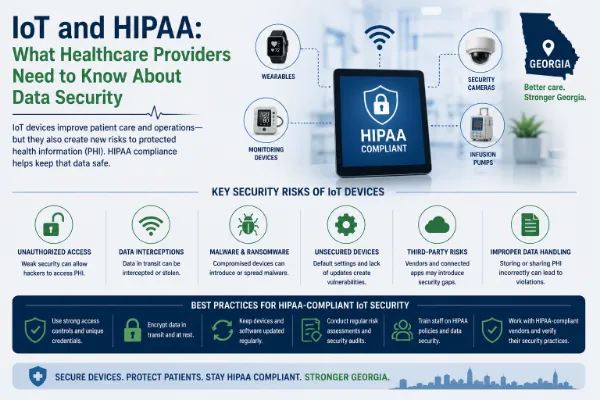
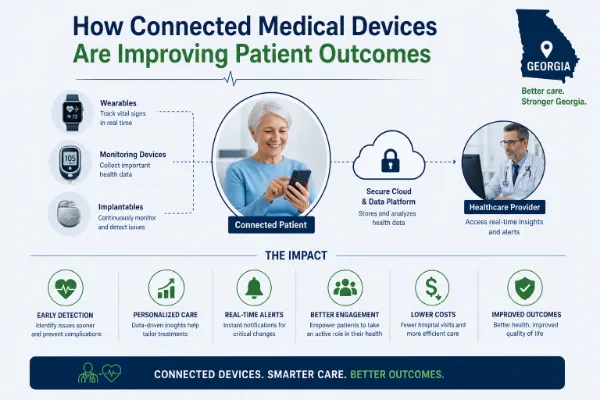
Health systems exploring this space can go deeper with our dedicated guide to remote patient monitoring in Georgia, which covers device selection and workflow in more technical detail, alongside connected medical devices and patient outcomes and IoT and HIPAA data security requirements for the compliance side of a rollout. The Healthcare IoT category and Augusta Healthcare IoT directory track related developments across the state.
Rural hospital closures are not slowing down in Georgia, and no single policy intervention is likely to reverse the underlying economics driving them. Remote patient monitoring will not replace the emergency department Hancock County lost or the ones at risk in the 22 hospitals the Georgia Hospital Association is currently watching. But for the chronic disease management that drives much of rural healthcare demand, it has become the most realistic tool available for keeping patients safely connected to care in communities where the hospital simply is not coming back.
Frequently asked questions
The Georgia Hospital Association has documented 18 rural hospital closures since 2013, and as of 2026, 22 additional rural hospitals are considered at risk of closing.
Chronic conditions that benefit from continuous trend data, such as congestive heart failure, diabetes, and chronic obstructive pulmonary disease, are typically the strongest candidates, since early warning signs like weight gain or oxygen saturation changes can be caught between visits rather than only during infrequent in-person appointments.
Yes, Georgia Medicaid covers remote patient monitoring through standard CMS billing codes for initial setup, device supply, and monthly treatment management, though coverage details and prior authorization requirements can vary by managed care organization.
Uneven broadband and cellular connectivity remains one of the most consistent barriers, since remote monitoring devices depend on reliable data transmission, and rural coverage gaps can silently limit how well a program actually functions once deployed.
No. Remote monitoring is designed to catch early warning signs and reduce avoidable hospitalizations and travel for routine chronic disease management, but it cannot replace the acute, in-person emergency and trauma care a physical hospital provides.
Yes. Georgia has committed the full $218.8 million awarded to the state for the first year of a federal rural health program, including $93 million specifically directed toward telehealth, workforce training, cybersecurity, and other technology at 87 rural hospitals.
Related articles


 Healthcare IoT