Most explanations of remote patient monitoring lead with convenience patients checking vitals from home instead of driving to a clinic. In Georgia, that framing undersells what's actually driving adoption. According to Chartis Group's 2026 rural health analysis, 25 Georgia rural hospitals are currently considered vulnerable to closure, the fourth-highest count of any state in the country, and Georgia is one of only ten states that hasn't expanded Medicaid under the Affordable Care Act a policy status strongly correlated with weaker rural hospital financial performance nationally. For a meaningful number of Georgia communities, remote patient monitoring isn't a convenience upgrade. It's becoming one of the few remaining ways to maintain any clinical oversight for patients in areas where the nearest hospital may not be there in a few years, or already isn't.
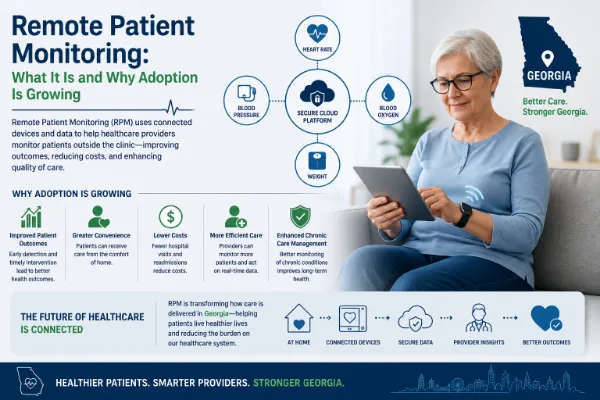
Remote patient monitoring (RPM) uses connected medical devices to collect a patient's health data outside a clinical setting typically at home and transmit it to a healthcare provider for review, without requiring an in-person visit. Common RPM devices include:
- Connected blood pressure cuffs that transmit readings automatically via cellular or Wi-Fi connection, rather than requiring a patient to manually log and report numbers.
- Continuous glucose monitors that track blood sugar levels throughout the day and flag concerning trends in real time, rather than relying on periodic finger-stick checks.
- Pulse oximeters that monitor blood oxygen levels, commonly used for patients managing chronic respiratory conditions.
- Connected scales used to track weight trends in heart failure management, where sudden weight gain can be an early indicator of fluid retention requiring intervention.
- Cardiac monitoring devices, including wearable ECG patches that track heart rhythm over extended periods, far longer than a single in-office EKG could capture.
The device itself is only half the system. RPM programs pair these devices with a monitoring platform that aggregates the data, flags readings outside a patient's established parameters, and routes those flags to a clinical team typically a nurse or care coordinator who reviews the data and escalates to a physician when a reading warrants it.
Georgia has lost inpatient care access in 11 communities since 2010, a figure that ties the state for third-highest nationally alongside Kansas, Mississippi, Missouri, and Oklahoma, according to Chartis's tracking. As of the 2026 analysis, roughly a third of Georgia's rural hospitals are classified as vulnerable to closure, and the state's non-expansion Medicaid status continues to correlate with weaker rural hospital operating margins compared to expansion states nationally.
In this environment, remote patient monitoring serves a function beyond convenience: it extends a provider's ability to track a patient's condition even when the nearest hospital or specialist is an hour or more away, or when a local facility has stopped offering a particular service line entirely. A cardiologist covering a large rural service area, for example, can maintain meaningful oversight of a heart failure patient's weight and vitals between visits, catching a concerning trend early enough to intervene before it becomes an emergency department visit which matters more, not less, in a community where the nearest emergency department may be considerably farther away than it was a decade ago.
Rural access is a significant driver in Georgia specifically, but RPM adoption has grown for several converging reasons nationally that apply here as well:
Medicare established specific billing codes for remote patient monitoring services, covering device setup, data transmission, and the clinical time spent reviewing monitoring data. This gave healthcare organizations a clearer, more sustainable revenue model for RPM programs than existed in the technology's earlier years, when reimbursement pathways were less established.
Temporary telehealth waivers implemented during the COVID-19 public health emergency removing geographic restrictions and allowing a patient's home to serve as an originating site for telehealth services changed how broadly RPM and related telehealth services could be delivered. Some of these flexibilities have since become permanent for certain service categories, while others remain subject to ongoing policy decisions, which is worth understanding as a factor that continues to shape program design.
Conditions like hypertension, diabetes, and heart failure require ongoing trend monitoring rather than single-point-in-time measurements, which is exactly what RPM is built to provide. A single blood pressure reading in a clinic captures one moment; a week of connected daily readings captures a pattern, which is generally more clinically useful for managing a chronic condition.
Early RPM devices often required patients to manually sync data via Bluetooth to a smartphone app, creating a real adoption barrier for less tech-comfortable patients. Newer devices increasingly transmit data automatically over cellular networks, removing that step and reducing the technical burden on patients, particularly older patients managing chronic conditions who are often the population RPM programs are most trying to reach.
A typical RPM program follows a consistent structure regardless of the specific condition being managed:
- Patient enrollment and device setup typically initiated after a hospital discharge, a new chronic disease diagnosis, or as part of ongoing chronic care management for an existing patient.
- Baseline parameter setting establishing what readings are normal for that specific patient, since target ranges vary by individual and condition, and a threshold that's genuinely concerning for one patient may be unremarkable for another.
- Ongoing data transmission and review the device transmits readings automatically, and a care team member reviews the data on a defined schedule, with the platform flagging any readings outside the established parameters for more immediate attention.
- Escalation when needed a concerning trend or an out-of-range reading triggers outreach to the patient, ranging from a follow-up call to an instruction to seek in-person or emergency care, depending on severity.
It's worth being direct about the limits, particularly in a rural access context. Remote patient monitoring extends oversight between visits and can catch developing problems earlier it doesn't replace the need for in-person care entirely, and it doesn't solve every access barrier a rural hospital closure creates. A patient who needs emergency surgery, a specialist procedure, or inpatient admission still needs a facility capable of providing that care, and RPM has no ability to close that specific gap. It's also dependent on reliable connectivity, which is not universally available across rural Georgia, and on a patient's ability and willingness to consistently use the device program design has to account for both of those constraints rather than assuming universal, frictionless adoption.
- Start with the conditions where trend data matters most hypertension, diabetes, and heart failure management are the most established, best-reimbursed use cases, and a reasonable starting point for organizations new to RPM.
- Confirm current reimbursement requirements before scaling a program, since billing requirements for RPM services include specific data collection and clinical review time thresholds that need to be met and documented.
- Design for the connectivity reality of your patient population, particularly in rural service areas where cellular coverage may be inconsistent a program relying entirely on home Wi-Fi will exclude patients who don't have it.
- Build the clinical response workflow before enrolling patients, not after a monitoring program only creates value if there's a defined process for reviewing data and acting on concerning readings in a timely way.
Remote patient monitoring adoption is growing nationally for a mix of reimbursement, technology, and chronic care management reasons, but in Georgia, it's also increasingly functioning as a partial response to a genuine access crisis: a state with one of the highest counts of rural hospitals vulnerable to closure in the country, and a Medicaid policy environment that hasn't helped rural hospital finances the way expansion has in other states. RPM won't replace the access a closed hospital provided, but for the chronic conditions it's built to manage, it's one of the more practical tools available for maintaining clinical oversight in communities where that oversight is becoming harder to deliver in person.
This article discusses healthcare technology trends and is intended for general informational purposes. It is not medical advice. Individuals with health concerns should consult a qualified healthcare provider.
Frequently asked questions
Hypertension, diabetes, and heart failure are among the most established use cases, since these conditions benefit from ongoing trend monitoring rather than single-point-in-time measurements taken during occasional office visits.
Medicare has established specific billing codes covering RPM device setup, data transmission, and clinical review time, though coverage details and requirements can change. Healthcare organizations should confirm current requirements directly rather than relying on general information when designing a billing workflow.
Georgia has one of the highest counts of rural hospitals considered vulnerable to closure nationally, and has lost inpatient care access in multiple communities since 2010. RPM helps extend clinical oversight for patients in areas where in-person access to hospitals and specialists has become more limited.
No. RPM extends monitoring and can catch developing issues earlier, but it doesn't provide emergency care, surgery, or inpatient treatment. Patients who need those services still require access to a facility capable of providing them.
Monitoring platforms flag readings outside a patient's established parameters for clinical team review, and the response depends on severity ranging from a follow-up phone call to guidance to seek in-person or emergency care.
Many newer RPM devices transmit data over cellular networks rather than requiring home Wi-Fi, which reduces but doesn't eliminate this barrier. Connectivity reliability still varies across rural areas and is an important factor in program design.
Related articles

 Healthcare IoT