Search "healthcare IoT guide" and most results describe the same generic categories remote monitoring, connected devices, asset tracking, security without much sense of why any of it matters more in one place than another. Georgia's healthcare landscape makes that abstraction hard to sustain. The state has one of the highest counts of rural hospitals vulnerable to closure in the country, is home to the largest joint biomedical engineering research program in the U.S., runs its only Level I trauma center at sustained capacity following a major hospital closure, and has reported a sharply accelerating pace of healthcare data breaches concentrated in third-party vendor relationships. Healthcare IoT adoption in Georgia isn't happening in a vacuum it's responding directly to these specific, documented pressures. This guide covers the technology, but more importantly, it covers why the stakes look different here than the generic version of this conversation assumes.
Georgia has 25 rural hospitals currently considered vulnerable to closure, the fourth-highest count nationally, and has lost inpatient care access in 11 communities since 2010 a toll tied for third-highest among states. Georgia is also one of only ten states that hasn't expanded Medicaid, a policy status correlated nationally with weaker rural hospital financial performance. In this environment, remote patient monitoring isn't a convenience feature layered onto an otherwise stable healthcare system. For a meaningful number of Georgia communities, it's becoming one of the few practical ways to maintain clinical oversight for patients whose nearest hospital may not be there in a few years, or already isn't. The full mechanics of how RPM works and why this matters specifically in Georgia are covered in Remote Patient Monitoring: What It Is and Why Adoption Is Growing.
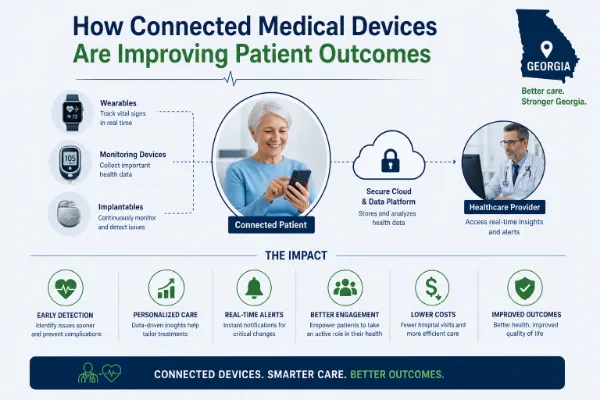
A less obvious but genuinely important fact: Georgia is also a research and development hub for the connected medical devices this guide covers. The Wallace H. Coulter Department of Biomedical Engineering, a joint program between Georgia Tech and Emory University, is the largest biomedical engineering department in the country, running a dedicated translational research pipeline that pairs engineers with practicing clinicians to move device concepts from lab prototypes into commercially validated, patient-facing products work often piloted at partner institutions like Children's Healthcare of Atlanta. For Georgia healthcare providers, this means more direct local access to emerging device technology and the engineering talent needed to implement it well than providers in states without comparable research infrastructure. The mechanisms by which connected devices actually improve clinical outcomes, and how this research pipeline works, are covered in How Connected Medical Devices Are Improving Patient Outcomes.
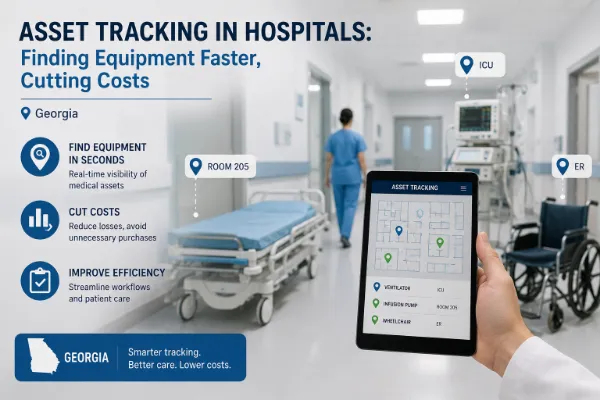
Grady Memorial Hospital has been Atlanta's only Level I trauma center since Wellstar Atlanta Medical Center closed in 2022, and now handles roughly 13,000 to 14,000 trauma activations a year across nearly 1,000 licensed beds volume it absorbed largely in a single transition, adding roughly 200 beds to keep pace. In an environment already operating under this kind of sustained pressure, the minutes clinical staff spend searching for a misplaced infusion pump or portable monitor aren't simply an inefficiency; they're minutes pulled directly from an already stretched capacity margin. Hospital asset tracking, using RFID, BLE, Wi-Fi, or ultra-wideband location systems, addresses this directly by giving staff real-time visibility into where mobile equipment actually is. The technology breakdown and implementation framework, including how prioritization differs at a high-acuity facility, is covered in Asset Tracking in Hospitals: Finding Equipment Faster, Cutting Costs.
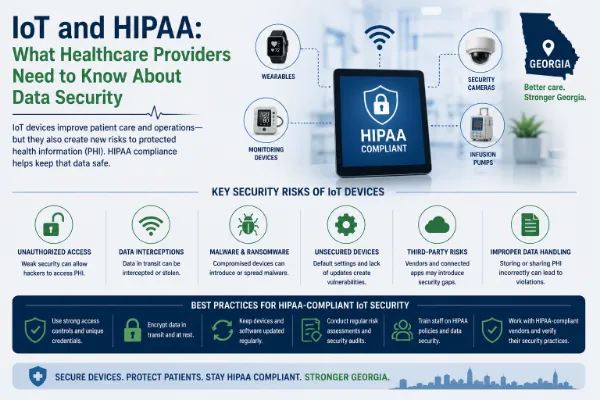
Georgia healthcare organizations have reported 219 data breaches to HHS since 2010, affecting 38 million cumulative records, with the pace accelerating from roughly 9 breaches a year in the late 2010s to 21 a year more recently. The detail most relevant to IoT adoption specifically: business associates and health plans, not hospitals themselves, account for 87 percent of exposed records while representing a smaller share of reported incidents. Since most connected medical device platforms, remote monitoring services, and asset-tracking systems involve exactly this kind of third-party vendor relationship, the vendor management and Business Associate Agreement diligence applied before deploying any IoT platform matters as much as the device's underlying security. This is especially true for smaller and rural providers, where breach rates run more than three times higher per capita than metro Atlanta, often alongside thinner internal IT security capacity. The full risk breakdown and a practical compliance framework are in IoT and HIPAA: What Healthcare Providers Need to Know About Data Security.
For a Georgia healthcare provider evaluating IoT adoption, the sequence that reflects the state's actual pressures looks like this:
- If you're a rural or safety-net provider, start with the access problem RPM can help address. Given Georgia's rural hospital vulnerability, remote monitoring for chronic conditions is often the highest-leverage starting point, both clinically and for sustaining some form of oversight where in-person access is shrinking.
- Evaluate connected device vendors with an eye toward validated, clinically-developed technology, and take advantage of Georgia's research ecosystem where relevant proximity to institutions like Coulter BME means more local expertise is available than in most states.
- If you're a high-volume facility, treat asset visibility as a capacity lever, not just an efficiency project. Prioritize tracking for the equipment categories causing the most disruption during your highest-acuity workflows.
- Before signing with any IoT or connected device vendor, apply real due diligence to the Business Associate Agreement, not a rubber stamp ask about the vendor's security program, breach history, and subcontractor relationships, given how concentrated Georgia's healthcare breach exposure is in exactly this layer.
- Build your risk analysis and incident response plan around every connected device generating ePHI, not just traditional IT systems, and reassess vendor security posture periodically rather than only at initial contract signing.
- Is your platform designed with rural connectivity constraints in mind, or does it assume consistent broadband access that not every Georgia community has?
- Can you provide evidence of clinical validation or research partnership behind this device, not just a commercial pitch?
- What level of location precision does your asset tracking solution provide, and is it appropriate for high-acuity areas like trauma bays and ORs specifically?
- Will you sign a Business Associate Agreement, and can you document your security program, breach history, and subcontractor relationships in detail?
Healthcare IoT in Georgia is shaped by a specific set of pressures that a generic national guide won't capture: a rural hospital access crisis driving real urgency behind remote monitoring, a world-class local research pipeline building the next generation of connected devices, a trauma system operating at sustained capacity where equipment visibility has real clinical stakes, and a healthcare breach landscape increasingly concentrated in the third-party vendor relationships that most IoT platforms depend on. Providers who scope their IoT strategy around these actual, documented Georgia conditions, rather than a generic best-practices checklist, are better positioned to get real clinical and operational value out of this technology rather than just adding another dashboard nobody has time to watch.
This article discusses healthcare technology trends and general compliance considerations for informational purposes. It is not medical or legal advice. Healthcare organizations should consult qualified clinical, legal, and compliance professionals for guidance specific to their situation.
Frequently asked questions
It depends on the provider type. Rural and safety-net providers often see the most value starting with remote patient monitoring, given Georgia's rural hospital access challenges. High-volume, high-acuity facilities often see faster returns from asset tracking, where equipment visibility directly affects capacity.
Georgia has one of the highest counts of rural hospitals vulnerable to closure nationally. Remote patient monitoring and telehealth-adjacent IoT technology are increasingly functioning as partial responses to that access gap, extending clinical oversight into communities where in-person care is becoming harder to access.
Yes. The Wallace H. Coulter Department of Biomedical Engineering, a joint Georgia Tech and Emory University program, is the largest biomedical engineering department in the country and runs a translational research pipeline actively developing and commercializing connected medical devices, often in partnership with Georgia clinical institutions.
Third-party vendor and business associate relationships. Georgia's own breach data shows that business associates and health plans, not hospitals, account for the large majority of exposed healthcare records, which directly implicates the vendor relationships most IoT and connected device platforms depend on.
The specific use case varies by provider type. Rural providers tend to see the most value from remote monitoring and telehealth-adjacent technology; large, high-volume facilities tend to see the most value from asset tracking and connected device integration supporting capacity and throughput.
Yes, more so than larger systems in some respects. Rural Georgia providers face healthcare data breach rates more than three times higher per capita than metro Atlanta, often with smaller internal IT security teams, making vendor security diligence especially important when internal capacity to compensate for a less secure platform may be limited.
Related articles

 Healthcare IoT