Most IoT-and-HIPAA content treats this as an abstract compliance checklist. The actual numbers for Georgia make it considerably more concrete. Healthcare organizations operating in the state have reported 219 data breaches to the HHS Office for Civil Rights since 2010, affecting a cumulative 38 million individual records and the pace has accelerated sharply, rising from an average of 9 breaches a year between 2015 and 2019 to 21 a year between 2021 and 2025, according to a 2026 analysis by Atlanta-based MIS Solutions. Perhaps the most relevant detail for anyone evaluating connected medical devices specifically: business associates and health plans, not hospitals themselves, are behind 87 percent of exposed records, while accounting for only 37 percent of reported incidents. That distinction matters enormously for IoT, because most connected medical devices and monitoring platforms involve exactly this kind of third-party vendor relationship.
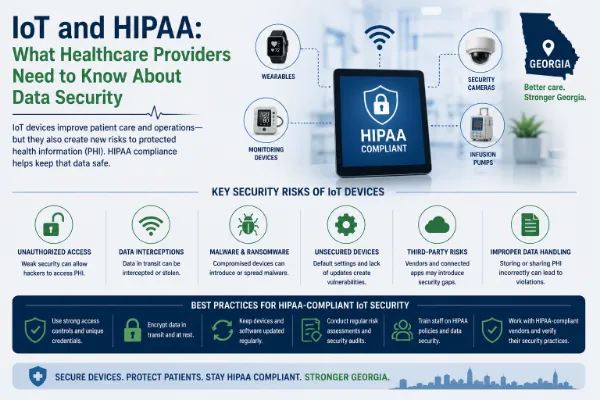
HIPAA's Security Rule requires covered entities and their business associates to implement administrative, physical, and technical safeguards protecting electronic protected health information (ePHI). Connected medical devices complicate this in ways that traditional, non-networked equipment didn't:
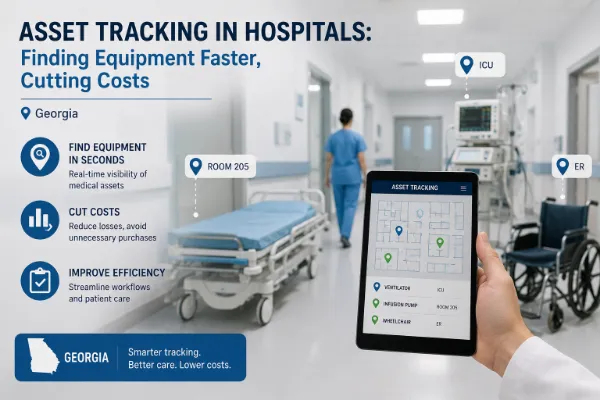
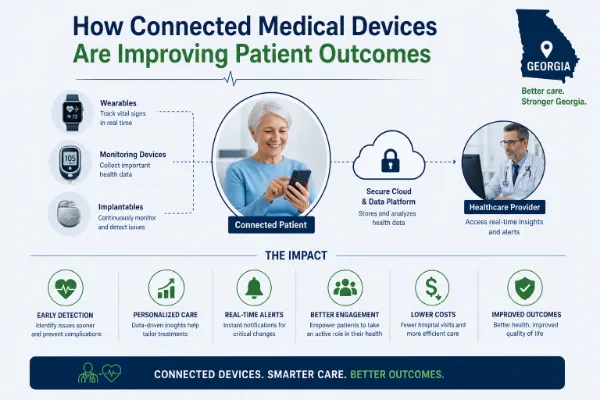
- Every connected device is a potential entry and exit point for ePHI. A remote patient monitoring device, a connected infusion pump, or a hospital asset-tracking tag that transmits any patient-identifiable data is handling ePHI, whether or not it was originally designed with healthcare-grade security in mind.
- Most IoT platforms involve a business associate relationship. When a hospital or provider uses a third-party platform to manage remote monitoring data, device connectivity, or cloud storage of device-generated patient data, that vendor is generally a business associate under HIPAA, requiring a signed Business Associate Agreement (BAA) and creating a shared compliance obligation.
- Device vendors vary widely in security maturity. Unlike hospital IT systems built with healthcare compliance as a baseline requirement, some medical device manufacturers, particularly newer or smaller companies entering the connected health space, may not have mature security practices matched to healthcare-grade regulatory expectations.
This is precisely why the Georgia data reflects what it does: when 87 percent of exposed records trace back to business associates and vendors rather than hospitals directly, it signals that the weakest point in the healthcare data security chain is increasingly the third-party technology layer exactly where most IoT and connected device platforms sit.
HIPAA doesn't specify exact technical requirements for every device category, but it does require reasonable and appropriate safeguards based on a documented risk analysis. For connected medical devices, the practices that consistently show up in stronger compliance programs include:
Any ePHI transmitted from a connected device a remote monitoring reading, an asset location, a device usage log should be encrypted during transmission and while stored, whether on the device itself, on a gateway, or in a cloud platform.
Devices deployed with default manufacturer credentials that are never changed represent one of the most common and most preventable security gaps across connected industrial and medical equipment alike. Every device and platform accessing ePHI should require unique, managed credentials rather than a shared default.
Not every staff member or vendor representative needs access to every patient's device data. Role-based access controls, limiting who can view or modify device data to those with a legitimate clinical or operational need, reduce the exposure if any single credential is compromised.
HIPAA requires the ability to track who accessed ePHI and when. Connected device platforms need audit logging built in, not added as an afterthought, since retroactively reconstructing access history after an incident is far harder than logging it from the start.
Given that business associates account for the large majority of exposed records in Georgia's healthcare breach data, the due diligence a provider applies before signing a Business Associate Agreement with an IoT device vendor deserves real scrutiny, not a rubber stamp. Questions worth asking before deploying any connected device platform handling ePHI:
- Does the vendor have a documented security program, and can they provide evidence of it, rather than just a contractual promise?
- How does the vendor handle a security incident, and what are the contractual notification timelines if a breach occurs on their end?
- Where is data stored, and does that storage location and the vendor's subcontractors also fall under appropriate BAA coverage?
- Has the vendor had prior reported breaches or OCR enforcement actions, and if so, what changed as a result?
A vendor's technology can be clinically excellent and still represent an unacceptable compliance risk if their security practices and contractual protections don't hold up these are separate evaluations, and both matter.
The same Georgia breach analysis found that rural counties are hit harder than metro Atlanta on a per-capita basis, with a breach rate more than three times higher outside the metro area. This connects to a broader pattern already reshaping rural Georgia healthcare: as rural hospitals face financial pressure and, in some cases, closure risk, remaining rural providers increasingly rely on connected devices and telehealth platforms to extend care the same technology this article is about often with smaller IT and security teams than a large metro health system can support. A rural hospital in Bainbridge, Georgia experienced exactly this kind of event in November 2024, when a ransomware attack disrupted its EMR system, email, and website, ultimately affecting more than 120,000 individuals' protected health information. Smaller providers evaluating IoT and connected device adoption should factor this reality into vendor selection, favoring platforms with strong built-in security over relying entirely on internal IT capacity to compensate for a less secure device or platform.
- Include every connected device generating or transmitting ePHI in your HIPAA risk analysis, not just traditional IT systems. This includes remote monitoring devices, connected infusion pumps, and asset-tracking platforms.
- Verify BAA coverage for every vendor in the data path, including any subcontractors or cloud infrastructure providers the primary vendor relies on, since the compliance chain extends through the full vendor relationship, not just the primary contract.
- Require encryption, unique authentication, and audit logging as baseline requirements in any vendor evaluation, rather than treating these as optional upgrades.
- Build an incident response plan that specifically addresses a connected device or vendor platform compromise, including notification timelines and how patient care continues if a device platform needs to be taken offline.
- Reassess vendor security posture periodically, not just at initial contract signing, since a vendor's security maturity and incident history can change over the life of a multi-year agreement.
IoT and HIPAA compliance isn't primarily a technology problem it's a vendor management problem, and Georgia's own breach data makes that point directly: the large majority of exposed healthcare records trace back to business associates, not hospitals themselves. For providers adopting connected medical devices, remote monitoring platforms, or hospital asset tracking, the security of the underlying technology matters, but the contractual and operational diligence applied to every vendor in that data path matters just as much, and is often the gap that turns a manageable technology risk into an actual breach.
This article provides general information about HIPAA and IoT security considerations and is not legal advice. Healthcare organizations should consult qualified legal counsel and compliance professionals for guidance specific to their situation.
Frequently asked questions
The device itself isn't PHI, but data it generates or transmits that can be tied to an identifiable patient readings, usage logs, location data in a clinical context generally qualifies as electronic protected health information (ePHI) and is subject to HIPAA's Security Rule requirements.
In most cases, yes. If a vendor's platform creates, receives, maintains, or transmits ePHI on behalf of a covered entity, they generally qualify as a business associate under HIPAA and require a signed BAA before deployment.
According to a 2026 analysis of HHS-reported breaches, business associates and health plans account for 87 percent of exposed records in Georgia's healthcare sector while representing a smaller share of reported incidents, suggesting that when third-party vendor breaches occur, they tend to affect a disproportionately large number of individuals.
Encryption of data in transit and at rest, unique authentication rather than shared default credentials, role-based access controls, and built-in audit logging are baseline expectations for a device or platform handling ePHI.
Data shows rural Georgia counties experience healthcare data breaches at a rate more than three times higher per capita than metro Atlanta, and rural providers often operate with smaller IT and security teams, making vendor security diligence particularly important when adopting connected device technology.
The response should follow the incident response plan established with that vendor relationship, including reviewing the Business Associate Agreement's breach notification terms, assessing the scope of affected patient data, and meeting HIPAA's breach notification timeline requirements to affected individuals and HHS as applicable.
Related articles

 Healthcare IoT