Most articles about connected medical devices treat Georgia purely as a place where this technology gets used. That misses half the picture. The Wallace H. Coulter Department of Biomedical Engineering a joint program between Georgia Tech and Emory University, and the largest biomedical engineering department in the country with more than 1,400 students and 70 faculty runs a dedicated translational research pipeline specifically designed to take connected medical device concepts out of the lab and into commercial, patient-facing products. Georgia isn't just adopting this technology. A meaningful share of it is being invented here, tested here, and often deployed first at hospitals like Children's Healthcare of Atlanta, one of the department's key clinical research partners.
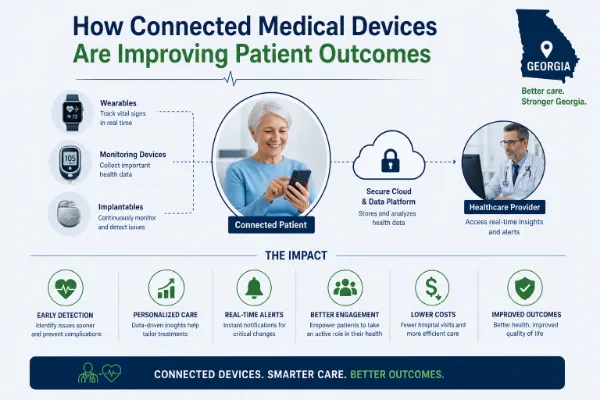
A connected medical device combines a sensor or diagnostic function with data transmission typically wireless that sends readings to a clinician, a monitoring platform, or another connected device, often in real time. This spans a wide range of device categories:
- Wearable monitors continuous glucose monitors, cardiac rhythm patches, and activity trackers used for clinical purposes rather than general fitness.
- Implantable devices pacemakers, defibrillators, and neurostimulators that transmit performance and physiological data to a clinical team without requiring an in-person device check for every data point.
- Closed-loop systems devices like automated insulin delivery systems, which don't just monitor a condition but actively respond to it, adjusting insulin dosing in real time based on continuous glucose readings without requiring a manual patient decision for every adjustment.
- Smart infusion pumps hospital-based devices that track and log medication delivery, flagging dosing errors or deviations from a prescribed regimen before they reach the patient.
- Connected diagnostic tools point-of-care devices that transmit test results directly into a patient's electronic health record, reducing the manual transcription errors that can occur when results are recorded by hand.
The mechanism by which connected devices improve outcomes isn't uniform across categories, but a few patterns show up repeatedly across the research coming out of programs like Coulter BME and similar translational efforts nationally.
A traditional clinical measurement a blood pressure reading at an office visit, a single lab draw captures one moment. A connected device capturing data continuously or at frequent intervals captures a trend, which is often clinically more useful for detecting a developing problem before it becomes acute. This is the same principle underlying remote patient monitoring, but it applies equally to in-hospital and implantable devices, not just home-based monitoring programs.
Conditions requiring frequent, precise adjustments type 1 diabetes management being the clearest example place a significant cognitive and behavioral burden on patients when management is fully manual. Automated insulin delivery systems, which combine continuous glucose monitoring with an insulin pump that adjusts dosing algorithmically, reduce how often a patient has to make a real-time treatment decision, and research in this space has generally shown improved time-in-range glucose control compared to manual management for many patients, alongside a reduced burden of constant decision-making.
A cardiac rhythm device that transmits an irregular heartbeat event to a clinical team automatically, rather than waiting for a patient to notice symptoms and schedule an appointment, shortens the time between when a problem develops and when a clinician becomes aware of it. For arrhythmias in particular, this kind of early detection window matters clinically, since some rhythm abnormalities are intermittent and easy to miss during a routine, brief in-office visit.
Smart infusion pumps and connected medication administration systems can flag a dosing order that falls outside a safe range before it's administered, catching a category of preventable error that manual processes are more prone to, particularly in high-volume hospital settings where staff are managing multiple patients simultaneously.
Connected medical devices face a challenge that's different from most consumer IoT products: the path from a working prototype to a commercially available, clinically validated device is long, expensive, and heavily regulated. This is precisely the gap the Coulter Translational Research Partnership Program is designed to address providing seed funding to Georgia Tech and Emory research teams working on projects with defined commercial potential and a clearly identified clinical need, pairing engineers and scientists directly with practicing physicians throughout development.
Recent funded projects illustrate the range this covers: a pediatric rehabilitation device, a cardiac drug-delivery catheter, and a diagnostic kit for detecting anemia are among the kinds of connected and diagnostic technologies that have moved through this pipeline. The direct pairing of engineering teams with clinicians throughout the process is a structural advantage a device designed with clinical input from the start is generally more likely to solve an actual care-delivery problem than one designed in isolation and adapted for clinical use afterward.
For hospitals and clinics evaluating connected medical device adoption, Georgia's research ecosystem offers a practical advantage: proximity to institutions actively developing and validating this technology, along with a regional pool of biomedical engineering talent supporting both device development and clinical implementation. This doesn't mean every provider needs to partner directly with a research institution, but it does mean Georgia providers have more direct local access to emerging device technology, and to the engineering and clinical expertise needed to implement it well, than providers in states without a comparable biomedical research infrastructure.
This proximity also shows up in workforce terms. Biomedical engineers trained through programs like Coulter BME often go on to work in device development, clinical engineering, and hospital technology implementation roles across the state, meaning Georgia health systems have a somewhat deeper regional talent pool for the biomedical and clinical engineering roles that connected device programs increasingly require staff who understand both the technical and clinical sides of a device deployment, not just one or the other. For smaller hospitals and clinics without in-house biomedical engineering staff, this regional talent base also supports a broader ecosystem of device vendors, integrators, and consultants who can help implement connected device programs without requiring the provider to build that expertise from scratch internally.
- Identify where continuous data would change a clinical decision, not just where it would be interesting to have more data. The clearest value comes from conditions where a trend materially changes treatment timing or dosing, not from monitoring for its own sake.
- Confirm the device's data integration path into existing clinical workflows. A connected device that generates data nobody reviews in a timely way doesn't improve outcomes it just adds a data stream. The clinical response process needs to be built alongside the device deployment, not after.
- Understand the regulatory and validation status of any device being evaluated, particularly for newer categories like closed-loop systems, where the specific algorithm and its validation history matter as much as the underlying hardware.
- Consider the patient population's ability to use the device consistently, since a device's clinical benefit depends on sustained, correct use, not just its technical capability.
Connected medical devices improve patient outcomes primarily by replacing sparse, point-in-time clinical snapshots with continuous data, by automating response for conditions that otherwise require constant manual management, and by catching problems arrhythmias, dosing errors, developing complications earlier than a traditional care model would. Georgia's position as home to the country's largest joint biomedical engineering program, with a dedicated translational pipeline turning lab research into clinically validated devices, means the state isn't just a market for this technology. It's genuinely part of where it gets built.
This article discusses healthcare technology trends and research for general informational purposes and is not medical advice. Individuals with health concerns or questions about specific medical devices should consult a qualified healthcare provider.
Frequently asked questions
A connected medical device transmits data wirelessly to a clinician, monitoring platform, or another device, often in real time, rather than requiring manual recording or an in-person check to retrieve the data.
These systems combine continuous data collection (such as glucose monitoring) with an algorithm that automatically adjusts treatment delivery (such as insulin dosing) based on that data, reducing how often a patient needs to make a manual, real-time treatment decision.
It's a joint department between Georgia Tech and Emory University, the largest biomedical engineering program in the country, running translational research programs that pair engineers and scientists directly with clinicians to develop and commercialize new medical technologies, including connected devices.
Smart infusion pumps and connected medication administration systems can flag dosing orders that fall outside a safe range before administration, which can help catch a category of preventable error, particularly in busy hospital settings.
Connected medical devices are subject to relevant medical device regulatory review, and newer categories like closed-loop automated systems involve additional scrutiny of the underlying algorithm's safety and validation, not just the physical device hardware.
No. The clinical benefit depends on consistent, correct use by the patient and a defined clinical workflow for reviewing and acting on the data the device generates. A device alone, without that surrounding process, doesn't reliably improve outcomes on its own.
Related articles

 Healthcare IoT