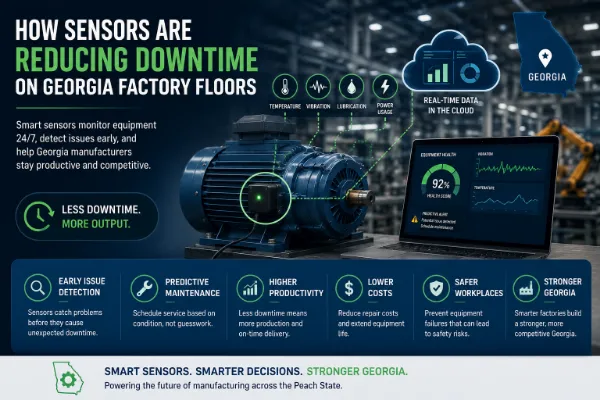
"Factory floor" means something different depending on where in Georgia you're standing. At Lockheed Martin's 8-million-square-foot Marietta facility, it means the longest continuously running military aircraft production line in history, building the C-130J Super Hercules since 1955 alongside F-35 center wing assemblies. In Gainesville, it means one of the country's highest-density concentrations of poultry processing plants, running cold-chain refrigeration and high-speed conveyor lines around the clock. These are fundamentally different manufacturing environments, and the sensor strategies that reduce downtime in each look different as a result which is exactly why a generic "install sensors, reduce downtime" article misses what actually matters on the ground in this state.
Lockheed Martin's Marietta site is not a high-volume line in the automotive sense it's a low-volume, high-mix manufacturing environment building complex, highly regulated aircraft assemblies, with more than 2,700 C-130s delivered to over 70 operators worldwide over the program's history. Downtime in this kind of environment doesn't look like a stopped conveyor belt. It looks like a torque tool that drifts out of calibration during a fastening sequence on a wing assembly, or a riveting machine whose positioning accuracy degrades slightly problems that, in aerospace manufacturing, can trigger a full quality investigation and rework cycle far more costly than the equipment issue itself.
In this environment, sensor deployment focuses less on predicting a catastrophic equipment failure and more on continuously verifying process parameters in real time:
- Torque and force sensors on fastening equipment, verifying every fastener meets spec at the moment it's installed, rather than relying on downstream inspection to catch a problem after the fact.
- Positional accuracy sensors on automated drilling and riveting equipment, flagging drift before it produces an out-of-tolerance hole that requires an engineering disposition.
- Environmental sensors in composite layup and paint areas, where temperature and humidity directly affect material cure quality, and a drift outside spec can mean scrapping an expensive composite part rather than simply losing production time.
The downtime being prevented here isn't just a stopped machine it's the cascading cost of a nonconformance investigation on a defense program, where a single undetected process deviation can delay delivery on a contract with strict government milestones. Sensor-based process verification catches these deviations at the moment they occur, rather than after a part has already moved several stations down the line.
Gainesville's poultry processing industry operates on an entirely different logic: extremely high line speeds, continuous refrigeration requirements, and equipment that runs in cold, wet conditions that accelerate mechanical wear compared to a dry manufacturing environment. A conveyor or refrigeration failure here doesn't just stop production for facilities running perishable product through a continuous cold chain, an unplanned refrigeration outage risks the product itself, not just the equipment.
Sensor deployment in this environment typically centers on:
- Refrigeration system monitoring temperature sensors throughout cold storage and processing areas, flagging drift before it becomes a compliance or product-safety issue, and vibration/current sensors on compressors to catch developing mechanical problems before a full refrigeration failure.
- Conveyor and line-speed sensors detecting jams, misalignment, or motor strain on high-speed processing lines where even a brief unplanned stop disrupts a continuous, tightly timed process.
- Gas detection sensors a category that carries particular weight in this industry following the January 2021 incident at a Gainesville poultry plant, where a liquid nitrogen leak in a freezer room led to six worker deaths. Federal investigators found the facility had lacked adequate training and monitoring for the hazard. Since then, gas detection sensors monitoring for oxygen displacement in refrigerant-heavy confined spaces have become a more prominent part of both safety and equipment-monitoring strategies in cold-chain food processing facilities, serving a dual purpose: protecting workers and providing early warning of a refrigeration system leak before it becomes a larger mechanical failure.
This is a case where downtime reduction and safety monitoring aren't separate investments a sensor network built to catch a developing refrigeration leak serves both purposes simultaneously, and in this industry specifically, that overlap deserves to be treated as a single integrated priority rather than two competing budget lines.
Georgia's growing automotive and advanced manufacturing corridor anchored by Kia Georgia in West Point and the Hyundai Motor Group Metaplant in Bryan County, alongside a fast-growing base of Tier 1 and Tier 2 suppliers runs on tightly balanced, just-in-time production lines where every station's output feeds directly into the next. Sensor priorities here differ again: the goal is less about individual process verification and more about protecting the overall line rate, since a slowdown at any single station ripples through the entire balanced line.
- Vibration and thermal sensors on stamping presses, welding robots, and conveyor drive motors the equipment types most likely to cause a full line stop if they fail unexpectedly.
- Cycle-time monitoring tracking whether each station is holding its designed takt time, since a station running even slightly slow than its target cycle time can create a bottleneck long before it fully fails.
- Predictive alerts tied to shift scheduling flagging developing equipment issues in time for maintenance teams to address them during a planned changeover or shift break, rather than mid-run.
Despite how differently these three environments deploy sensors, they share an underlying pattern worth pulling out explicitly: in each case, the sensor is valuable only because of what it's connected to. A torque sensor on a Lockheed Martin fastening tool matters because it feeds a quality verification system tied to aerospace compliance requirements. A temperature sensor in a Gainesville cold-storage room matters because it feeds both a food-safety monitoring system and a refrigeration-maintenance alert system. A vibration sensor on an automotive stamping press matters because it feeds a predictive maintenance platform tied to line-rate protection.
The lesson for any Georgia manufacturer evaluating sensor investment, regardless of industry, is that the sensor hardware itself is the cheap, commoditized part of the project. The harder and more valuable work is deciding what system that sensor data needs to feed, who needs to see the alert, and what action is supposed to happen when a threshold is crossed. A facility that installs sensors without building out that downstream response chain typically sees far less downtime reduction than the sensor specifications alone would suggest.
- Low-volume, high-mix, quality-critical manufacturing (aerospace, defense, precision components): prioritize in-process verification sensors over failure-prediction sensors the goal is catching a deviation before it becomes a nonconformance, not just before a machine breaks.
- Continuous-process, perishable-product manufacturing (food and beverage processing): prioritize sensors that serve dual safety and reliability purposes, particularly around refrigeration, confined spaces, and gas hazards, and budget them as a combined priority rather than separately.
- High-volume, line-balanced manufacturing (automotive, general assembly): prioritize sensors on the specific equipment types most likely to cause a full line stop, and tie alerts to shift and changeover scheduling so maintenance can act without disrupting an active run.
Georgia's manufacturing base is genuinely diverse aerospace in Marietta, food processing in Gainesville, automotive and advanced manufacturing across the I-85 corridor and coastal Georgia and the sensor strategy that reduces downtime in one of these environments doesn't transfer directly to another. What does transfer is the underlying principle: sensor data only reduces downtime when it's connected to a system and a team positioned to act on it before a developing issue becomes an unplanned stop, a quality escape, or, in the highest-stakes cases, a safety incident.
Frequently asked questions
The underlying sensor technologies (vibration, temperature, torque, gas detection) are similar across industries, but which ones matter most, and what they're connected to, varies significantly based on the manufacturing environment aerospace process verification looks very different from food-processing cold-chain monitoring or automotive line-rate protection.
In low-volume, high-mix, highly regulated manufacturing like aerospace, a process deviation that goes undetected can trigger a costly quality investigation and rework cycle, which is often more disruptive than the underlying equipment issue itself. Catching the deviation in real time, at the moment it occurs, is generally more valuable than predicting an eventual equipment failure.
Gas detection sensors monitor for hazards like oxygen displacement in refrigerant-heavy confined spaces, serving both a worker-safety function and an equipment-monitoring function, since a developing refrigeration leak can be caught by the same sensor network protecting workers from the underlying hazard.
Installing sensor hardware without building the downstream system to act on the data deciding who receives an alert, what system it feeds, and what response is expected when a threshold is crossed. Sensors without a defined response chain typically produce far less downtime reduction than expected.
Automotive assembly lines are typically balanced so each station's output feeds directly into the next. A slowdown or failure at a single station can bottleneck the entire line, so sensor priorities focus on the equipment most likely to cause a full line stop, with alerts timed to fit within planned shift changes when possible.
The scale of investment should match the facility's size and risk profile, but the underlying framework applies broadly: identify what a deviation or failure would actually cost in your specific environment, and prioritize sensors on the equipment and processes where that cost is highest, rather than deploying sensors uniformly across every machine.
Related articles

 Industrial IoT (IIoT)