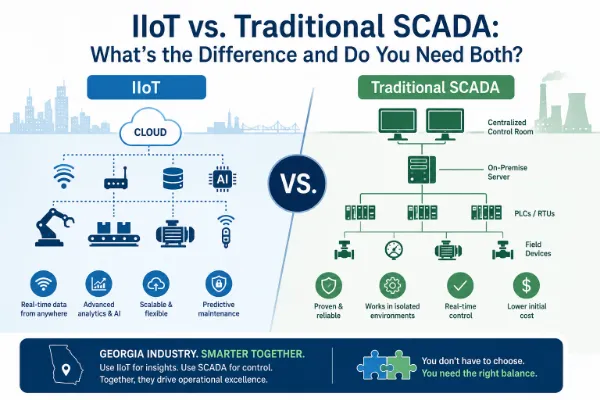
Most "IIoT vs. SCADA" content frames this as a choice between an old technology and a new one, as if a plant manager is picking a side. That's not how it plays out on an actual factory floor, and it's especially not how it plays out in Georgia's carpet manufacturing region around Dalton, where roughly 85 percent of U.S. carpet production happens and companies like Shaw Industries and Mohawk Industries run extrusion, tufting, and dye-house lines that have been under SCADA control for decades. In that kind of environment, the real question was never "SCADA or IIoT." It's "how do you layer IIoT on top of SCADA systems that are already running critical production, without breaking either one."
Supervisory Control and Data Acquisition (SCADA) systems have run industrial processes since the 1970s and remain the backbone of real-time control in most manufacturing plants. A SCADA system typically consists of:
- PLCs (programmable logic controllers) the hardware directly controlling equipment: starting and stopping motors, adjusting valve positions, sequencing a tufting machine's needle bars.
- HMIs (human-machine interfaces) the screens operators use to monitor and adjust processes in real time from the plant floor.
- A supervisory layer software that aggregates data from multiple PLCs across a line or plant, giving a centralized view and allowing coordinated control.
Critically, SCADA is built for closed-loop, real-time control: a temperature sensor on a dye house vat feeds back to a PLC that adjusts a heating element within milliseconds, with no cloud round-trip and no dependency on an internet connection. This is by design. A carpet dye line running a precise heat and chemical process can't wait on a network request to a remote server to make a control decision the control loop has to be local, deterministic, and fast.
Industrial IoT platforms are not built to replace that real-time control loop. They're built to do something SCADA was never designed for: pull data out of the plant floor, combine it with data from other lines, other plants, and other systems (ERP, quality data, maintenance records), and apply analytics that a local PLC has neither the data scope nor the computing power to perform.
- Cross-line and cross-plant visibility. A SCADA system is typically scoped to a single line or plant. An IIoT platform can pull data from every extrusion line across every Dalton-area facility a company operates and compare performance, something no single SCADA system was built to do.
- Predictive analytics. SCADA tells an operator what a machine is doing right now. IIoT platforms apply historical pattern analysis to predict what a machine is likely to do in the coming days or weeks the foundation of predictive maintenance.
- Enterprise integration. IIoT platforms are generally built to connect production data with business systems tying machine performance to order fulfillment, quality metrics, or energy costs in ways a plant-floor SCADA system typically doesn't attempt.
- Cloud-based storage and computing. Where SCADA historians typically retain a rolling window of recent data locally, IIoT platforms often retain and analyze years of historical data at a scale local plant hardware isn't built to store or process.
Industrial control architecture is often described using the Purdue Enterprise Reference Architecture, a layered model separating plant-floor control from business systems:
| Level | What Lives There | System Type |
|---|
| Level 0-1 | Sensors, actuators, PLCs directly controlling equipment | SCADA / control system |
| Level 2 | HMIs, local supervisory control | SCADA / control system |
| Level 3 | Plant-wide operations management, historians | SCADA / MES, increasingly IIoT-connected |
| Level 4-5 | Enterprise business systems, ERP, cloud analytics | IIoT platforms, business systems |
SCADA lives primarily at Levels 0 through 2, where real-time, deterministic control is non-negotiable. IIoT platforms live primarily at Levels 3 through 5, where the priority shifts from millisecond control to data aggregation, analytics, and enterprise visibility. This is the real answer to "do you need both": SCADA and IIoT solve different problems at different layers of the same operation, and a mature industrial environment typically needs both simultaneously, not one instead of the other.
A greenfield facility being designed today can plan IIoT connectivity into the architecture from day one. Most of Georgia's manufacturing base carpet mills that have been running continuous production for decades, along with the state's broader automotive and industrial manufacturing sector is brownfield: SCADA systems that have been in place for years, controlling processes that can't tolerate downtime for a rearchitecture project.
In this environment, IIoT deployment isn't a replacement project. It's an overlay project: connecting to existing PLCs and historians to extract data without disrupting the control loops already running production. This typically happens through one of a few approaches:
- Protocol gateways that translate SCADA protocols (Modbus, DNP3, proprietary PLC protocols) into IIoT-friendly formats (MQTT, OPC-UA) without touching the underlying control logic.
- Read-only data taps that pull data out of the SCADA historian or network for analytics purposes, with no write-back path into the control system a deliberate design choice that limits the risk of an IIoT platform ever interfering with real-time control.
- Edge devices installed alongside existing sensors to capture additional data (vibration, acoustic signatures) the original SCADA system was never designed to collect, feeding that data to the IIoT platform independently of the control loop.
SCADA networks were historically designed with the assumption that they'd remain isolated air-gapped or nearly so from corporate IT networks and the internet. That assumption is precisely what IIoT connectivity breaks, since the entire value proposition of IIoT depends on getting plant-floor data out to systems that live outside that isolated network.
This isn't a reason to avoid IIoT, but it is a reason to treat the OT/IT connection point as the most security-critical part of any IIoT deployment layered onto existing SCADA infrastructure. A few principles matter more here than generic cybersecurity advice:
- One-way data flow where possible. A read-only gateway that can pull data out but has no path to push commands back into the control network dramatically limits what an attacker could do even if the IIoT layer were compromised.
- Network segmentation between OT and IT. The IIoT platform and its cloud connectivity should sit on a segmented network zone, not directly bridged into the same network as PLCs and HMIs.
- Legacy equipment can't always be patched. Some PLCs running Dalton-area production lines may be old enough that firmware updates aren't available or feasible without a full hardware replacement meaning the security strategy has to rely more heavily on network-level controls than on hardening the endpoint itself.
- If the question is about real-time control stopping a machine, adjusting a process variable within milliseconds that's a SCADA question, and IIoT platforms generally shouldn't be in that control loop at all.
- If the question is about visibility, prediction, or cross-line/cross-plant comparison that's an IIoT question, and it should be layered on top of, not instead of, the existing SCADA system.
- If existing SCADA infrastructure is aging but still functionally reliable, a read-only IIoT overlay is usually lower-risk and lower-cost than a full control-system replacement, and can be implemented without disrupting production.
- If SCADA infrastructure is failing or unsupported, that's a separate control-system modernization project, and it's worth sequencing that before or alongside an IIoT rollout rather than layering new analytics on top of infrastructure already due for replacement.
For most established Georgia manufacturers particularly the carpet and flooring industry concentrated around Dalton, where decades-old SCADA-controlled lines are still running daily production the real question isn't SCADA versus IIoT. It's how to connect IIoT analytics to existing SCADA systems without disrupting the real-time control those systems were built to provide, while treating the OT/IT connection point as the place that deserves the most careful security design.
Frequently asked questions
No. SCADA handles real-time, closed-loop control of equipment, which IIoT platforms are not designed to do. IIoT typically operates as a layer on top of SCADA, pulling data out for analytics, predictive maintenance, and cross-plant visibility rather than replacing the control function.
In most cases, yes, through protocol gateways that translate industrial protocols like Modbus or DNP3 into IIoT-friendly formats, or through read-only data taps that pull information from a SCADA historian without touching the control logic itself.
It can be, but the connection point requires deliberate security design one-way data flow where possible, network segmentation between OT and IT, and awareness that legacy PLCs may not support modern security patching. Treating this connection as the highest-risk part of the deployment is important rather than an afterthought.
A historian is typically a component within or connected to a SCADA system that logs process data over time. SCADA historians usually retain a rolling window of recent data locally, while IIoT platforms often retain and analyze much longer historical periods at cloud scale.
IIoT value scales with the complexity of what you're trying to see across a single-line operation may get less benefit from cross-plant analytics than a company running multiple facilities. However, even a single-plant operation can benefit from predictive maintenance and historical trend analysis that a SCADA system alone doesn't provide.
Timelines vary significantly based on the age and documentation of existing control systems, but a read-only data overlay project is generally faster and lower-risk than a full control-system replacement, since it doesn't require disrupting the production line's existing control logic during implementation.
Related articles

 Industrial IoT (IIoT)