Most predictive maintenance content leads with a generic downtime statistic and moves on. That undersells the actual stakes for Georgia specifically. The state now hosts one of the most tightly coupled automotive and EV manufacturing ecosystems in the country Kia Georgia's West Point plant, producing roughly 350,000 vehicles a year, and the $7.59 billion Hyundai Motor Group Metaplant America in Bryan County, designed to build up to 500,000 vehicles annually across ten models. Both operate on just-in-time supply chains with dozens of Tier 1 and Tier 2 suppliers built directly into or near the manufacturing campus. In that kind of network, an unplanned failure at a single supplier doesn't just stop one line it can starve every downstream station relying on that part, and automotive downtime costs run as high as $2.3 million per hour industry-wide. Predictive maintenance isn't a nice-to-have efficiency upgrade in this environment. It's the difference between a contained equipment issue and a cascading, multi-supplier production crisis.
Predictive maintenance uses sensor data, connectivity, and analytics to estimate when a piece of equipment is likely to fail, so repairs happen before a breakdown rather than after one. It sits between two older approaches that most plants still rely on to some degree:
- Reactive maintenance fixing equipment after it fails. Cheapest to plan for, most expensive when it actually happens, since failures rarely occur on a convenient schedule.
- Preventive maintenance servicing equipment on a fixed schedule (every 500 hours, every quarter) regardless of its actual condition. Reduces surprise failures but wastes labor and parts on equipment that didn't need service yet, and still misses failures that occur between scheduled checks.
- Predictive maintenance using real-time condition data (vibration, temperature, current draw, acoustic signatures) to service equipment based on its actual, current state, catching developing problems in the window between "still fine" and "about to fail."
Most predictive maintenance content treats every factory as an isolated cost center: your downtime costs you money, full stop. That framing misses how modern automotive manufacturing actually works. Kia's West Point facility alone has spurred an estimated 14,000 plant and supplier jobs across a network of Tier 1 suppliers concentrated along the I-85 corridor. HMGMA's Bryan County megasite is even more tightly integrated the campus includes affiliate plants for Hyundai Mobis, Hyundai Glovis, Hyundai Transys, Hyundai Steel, and Hyundai Material directly on-site, with another 22 suppliers operating nearby, feeding the assembly line on a continuous basis using dedicated hydrogen fuel-cell trucks running daily supply routes.
In a supply chain built this way, equipment failure risk isn't contained to the plant where it happens. A stamping press failure at a Tier 1 supplier feeding cockpit modules or chassis components doesn't just cost that supplier lost output it can halt the OEM's assembly line within hours, since just-in-time delivery means there's little buffer inventory absorbing the gap. This is exactly the dynamic that drives automotive downtime costs into the millions per hour: the cost isn't the broken machine, it's every downstream station that goes idle waiting on the part it made.
For a supplier operating inside or near one of Georgia's automotive megasites, predictive maintenance isn't primarily about protecting your own uptime. It's about protecting your position in a supply chain where a repeated failure to deliver on schedule is the kind of reliability problem that gets a supplier's contract reconsidered.
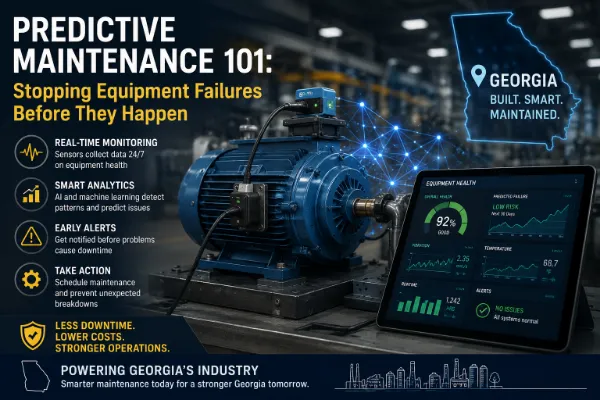
Vibration sensors, thermal sensors, acoustic sensors, and current/power monitors are attached to critical equipment motors, pumps, gearboxes, stamping presses, robotic welders continuously capturing data on how the equipment is actually performing, not just whether it's currently running.
Before a system can flag an anomaly, it needs to know what "normal" looks like for that specific piece of equipment. Early data collection establishes a baseline signature for each machine, since normal vibration or thermal patterns vary by equipment type, age, and operating conditions there's no universal threshold that works across every machine on a floor.
Once a baseline exists, the system flags deviations a bearing starting to show irregular vibration, a motor drawing more current than its normal operating range, a gearbox running hotter than its established pattern. These deviations often appear weeks before a failure would otherwise become apparent to a technician doing a routine visual inspection.
Based on the type and severity of the anomaly, the system estimates a likely failure window and can automatically generate a maintenance work order, prioritized against other pending maintenance tasks so the most time-sensitive issues get addressed first, rather than in the order they were noticed.
Not every piece of equipment needs the same level of sensor investment. A practical starting point for a Georgia manufacturing or supplier facility:
- Equipment tied directly to a customer delivery schedule. If a machine's failure would directly delay a shipment to an OEM assembly line, it's a priority candidate regardless of the equipment's individual replacement cost.
- Equipment with a history of unplanned failures. Past failure patterns are often the best predictor of where the next one will occur, and where sensor investment will show the fastest measurable return.
- Equipment with long lead times for replacement parts. A failure that can be fixed same-day with parts on hand is a very different risk than one requiring a part with a multi-week lead time the latter deserves earlier warning, not just any warning.
- Single points of failure. Equipment with no redundant backup on the line represents the highest downtime risk per failure event, since there's no way to keep production moving while it's repaired.
It's worth being direct about the limits. Predictive maintenance reduces the frequency and severity of unplanned failures, but it doesn't eliminate them entirely, and it introduces its own operational requirements:
- It requires a baseline period. New sensor deployments typically need weeks to months of normal operation data before the system can reliably distinguish a real anomaly from normal equipment variation.
- It requires someone to act on the alerts. A predictive maintenance system that flags a developing bearing failure is only useful if maintenance staff have the bandwidth and spare-parts availability to act on the warning before it becomes an unplanned stop otherwise it's just an early notification of the same outcome.
- It doesn't replace root-cause analysis. A machine that keeps showing the same failure pattern repeatedly may have an underlying design, installation, or operating condition problem that predictive monitoring alone won't fix it'll just keep flagging the same recurring issue earlier each time.
For a Georgia manufacturer or automotive supplier evaluating predictive maintenance for the first time, a reasonable sequence looks like this:
- Identify equipment where failure has the highest downstream cost not necessarily the most expensive machine, but the one whose failure would most directly delay a customer shipment or halt a connected line.
- Start with a pilot on a small number of machines rather than a plant-wide rollout, to validate that the sensor data and alerting actually produce useful, actionable warnings before committing to a larger deployment.
- Build the baseline period into the project timeline from the start, rather than expecting immediate predictive accuracy from day one.
- Confirm maintenance staff capacity to respond to alerts before scaling a system generating warnings nobody has time to act on doesn't reduce downtime, it just adds another dashboard.
Predictive maintenance matters everywhere manufacturing happens, but it matters differently in Georgia's automotive and EV manufacturing corridor, where suppliers operate inside tightly coupled, just-in-time networks feeding facilities like Kia Georgia and the Hyundai Metaplant. In that environment, an unplanned equipment failure isn't a contained cost it's a risk to a supplier's standing in a supply chain with very little slack built in. Treating predictive maintenance as supply-chain risk management, not just an internal efficiency project, is the framing that actually matches how the stakes work in this specific industry and this specific state.
Frequently asked questions
Preventive maintenance services equipment on a fixed schedule regardless of its actual condition. Predictive maintenance uses real-time sensor data to service equipment based on its current condition, catching developing problems that a fixed schedule might miss between service intervals, while also avoiding unnecessary service on equipment that's still performing normally.
Most systems need a baseline period typically weeks to months, depending on equipment type and operating cycles to establish what normal performance looks like before they can reliably distinguish genuine anomalies from routine variation.
Georgia's automotive manufacturing ecosystem, anchored by Kia Georgia and the Hyundai Motor Group Metaplant, relies on just-in-time delivery from a tightly coupled network of Tier 1 and Tier 2 suppliers. An unplanned equipment failure at a supplier can cascade into delayed deliveries and idle downstream production, given the limited buffer inventory in this kind of supply chain.
No. A practical starting point focuses on equipment tied directly to customer delivery schedules, equipment with a history of failures, equipment with long replacement lead times, and single points of failure with no backup on the line.
No. It reduces the frequency and severity of unplanned failures by providing earlier warning, but it depends on maintenance staff having the capacity to act on alerts and doesn't replace root-cause analysis for equipment with recurring failure patterns.
Common sensor types include vibration sensors, thermal/temperature sensors, acoustic sensors, and current or power draw monitors, often used in combination since different failure modes show up in different signal types.
Related articles

 Industrial IoT (IIoT)