Most explanations of GPS auto-steer focus on the obvious benefit: straighter rows, less operator fatigue. In Georgia, the technology's clearest economic case actually comes from a much more specific mechanic tied to one of the state's signature crops. A 2010-11 University of Georgia study led by researcher George Vellidis, testing auto-steer on a 180-acre peanut operation in south Georgia, found that GPS guidance significantly reduced digging losses when inverting peanuts the harvest step where peanuts are lifted from the ground and flipped to dry before picking. Miss the row alignment by even a few inches during that pass, and peanuts get left in the ground rather than harvested. That single mechanic, more than the general precision argument, is what turned auto-steer from a hard sell into what UGA's Calvin Perry now describes as something "nearly every farmer" in the region has adopted.
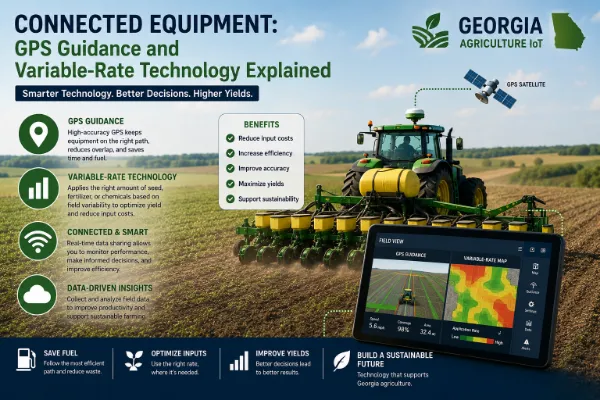
Auto-steer systems use GPS positioning, typically corrected for higher precision than a standard consumer GPS signal, to automatically guide a tractor or implement along a precise path across a field, with accuracy commonly within an inch or two depending on the correction signal used. Rather than a driver manually steering to maintain straight, evenly spaced passes across a field a task that gets harder to do precisely over long hours and large acreage the system holds the line automatically, freeing the operator to focus on implement performance and monitoring rather than steering.
At a price approaching $25,000 per vehicle when the technology was newer, Perry and other UGA researchers initially expected slow, limited adoption. What actually happened, in Perry's own words, was that farmers found it delivered a payback within a single season in many cases not from one single benefit, but from several compounding at once:
- Reduced digging losses in peanut harvest precise row alignment during the inverting pass keeps peanuts from being missed or damaged, directly protecting yield on a crop where Georgia growers hold a nationally significant share of production.
- Reduced overlap in spraying and tillage manual driving inevitably produces some overlap between passes, wasting inputs (fuel, chemical, seed) on ground that's already been covered. Auto-steer minimizes this overlap across an entire season of field operations.
- Extended usable hours auto-steer reduces the fatigue-driven precision loss that comes with long field days, supporting more consistent accuracy during extended planting or harvest windows when time pressure is highest.
As Perry put it, unlike variable-rate irrigation which only pays off on the specific pivot system it's installed on a tractor-mounted auto-steer system gets used across every acre a farm operates, every pass, every season. That difference in utilization is a big part of why auto-steer adoption outpaced VRI adoption across Georgia row-crop operations, even though both technologies came out of the same UGA research pipeline.
Variable-rate technology (VRT) uses field data soil maps, yield history, real-time sensor readings to adjust the rate of an input (seed, fertilizer, pesticide, water) automatically as equipment moves across a field, rather than applying a single uniform rate across the entire area. This connects directly to GPS guidance, since precise positioning is what allows the system to know exactly where in the field it is and apply the correct rate for that specific zone.
Different zones within a field often have different optimal plant populations based on soil type and water-holding capacity. Variable-rate planters adjust seeding density automatically as they cross zone boundaries, rather than planting a single uniform rate that's a compromise across the whole field.
Soil fertility varies meaningfully within a single field. Variable-rate fertilizer application, guided by soil sampling grids and yield maps, applies more fertilizer where the soil needs it and less where it doesn't, rather than a blanket rate that over-applies in some zones and under-applies in others.
Similarly, variable-rate sprayers can adjust chemical application rates based on real-time sensor data about plant density or pest pressure, reducing both waste and the environmental and cost impact of over-application.
Adam McLendon, a fifth-generation farmer in Calhoun County managing 8,500 acres of corn, cotton, peanuts, and pecans, illustrates what a fully connected operation looks like in practice. McLendon reviews tractor fuel-use logs, irrigation system performance data, and satellite imagery of his fields each morning, using that combined picture to prioritize where labor and attention go that day a workflow he's described as spending the first 45 minutes of every day using technology to manage the farm more efficiently. McLendon's operation also participates directly in UGA research, allotting acreage each year for the university to test emerging precision agriculture technology before deciding what to adopt commercially a pattern that reflects how much of Georgia's precision ag technology stack has been developed in direct partnership with working farms rather than purely in a research lab.
Precision agriculture adoption in Georgia tracks closely with the state's highest-value row crops: cotton, peanuts, and corn represent well over a billion dollars in combined annual farm gate value, and these are exactly the crops where UGA's precision ag research auto-steer, variable-rate irrigation, yield monitoring has concentrated. This isn't a coincidence: the economic case for investing in GPS guidance and variable-rate equipment scales with the value of what's being grown and the acreage it's applied across, which is why adoption has been fastest among the row-crop operations where Georgia has the deepest agricultural investment and research infrastructure already in place.
UGA's Tifton campus recently opened a dedicated Integrative Precision Agriculture Research, Education and Demonstration Laboratory, supported in part by federal funding, aimed at giving growers direct, hands-on access to emerging technology autonomous field equipment, drone-based crop scanning, AI-assisted yield prediction within walking distance of actual working agricultural plots. This continues the same pattern that made auto-steer and VRI successful in Georgia: technology tested and refined in direct partnership with the state's row-crop growers before being positioned for broader commercial adoption.
- Start with GPS guidance before variable-rate systems if budget requires a sequence, since auto-steer's utilization across every acre and every pass generally gives it the fastest, broadest payback of any single precision ag investment.
- Prioritize variable-rate investments where field variability is documented, not assumed soil sampling and yield mapping data should justify a variable-rate investment before committing to the equipment, since the technology's value depends entirely on real within-field variation existing to act on.
- Factor in crop-specific mechanics, not just general precision benefits the peanut digging-loss example shows how a technology's real payback can come from a very specific operational detail unique to a particular crop, not just generic efficiency.
- Take advantage of UGA's research and demonstration infrastructure before committing to unproven equipment, since Georgia's extension and research network specifically exists to help growers evaluate what to adopt commercially, informed by testing already done on working farms.
GPS guidance and variable-rate technology in Georgia weren't adopted because of a generic precision agriculture pitch they were adopted because UGA research, conducted directly on working farms, demonstrated specific, crop-relevant paybacks: reduced peanut digging losses, reduced input overlap, and a utilization pattern that made auto-steer pay for itself faster than almost any other single farm technology investment. For Georgia's cotton, peanut, and corn growers specifically, this combination of proven local research and direct farmer partnership is why adoption reached "nearly every farmer" territory faster than the technology's initial price tag would have suggested.
Frequently asked questions
Accuracy depends on the correction signal used, but many modern systems achieve precision within an inch or two, which is precise enough to significantly reduce overlap and misalignment compared to manual steering over long field passes.
According to UGA researcher Calvin Perry, auto-steer gets used across every acre a farm operates on every pass, while variable-rate irrigation only benefits the specific center-pivot system it's installed on, giving auto-steer a broader utilization base and faster overall payback.
UGA research found that precise row alignment during the peanut-inverting pass, the step where peanuts are lifted from the ground and flipped to dry, significantly reduces digging losses compared to manual steering, directly protecting harvestable yield.
Variable-rate technology automatically adjusts the rate of an input, such as seed, fertilizer, or pesticide, based on field data as equipment moves across different zones. It depends on precise GPS positioning to know exactly where in the field it is and apply the correct rate for that specific location.
Cotton, peanuts, and corn are Georgia's highest-value row crops and represent the crops where UGA's precision agriculture research and farmer adoption have concentrated most heavily, given the strong economic case at scale for these operations.
UGA's Tifton campus operates a dedicated precision agriculture research and demonstration facility, and many of the university's research partnerships happen directly on working farms, giving growers access to real-world testing and results before committing to a technology purchase.
Related articles

 Agriculture IoT