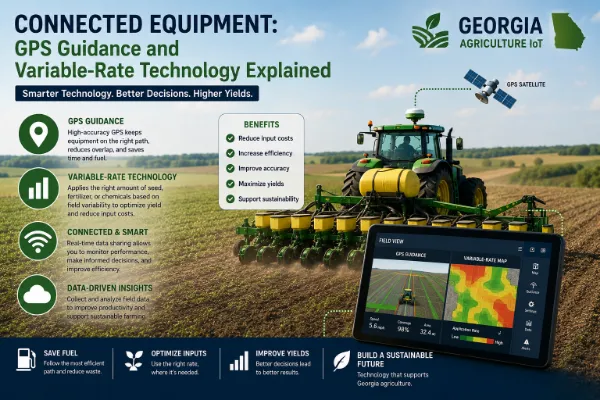
A recurring line shows up across UGA Extension's county-level agriculture blogs, and it's worth leading with because it's the most honest starting point for this topic: "Most of you are collecting data that you never use." That's not a criticism of any individual farmer it's a genuinely common pattern across Georgia agriculture as soil sensors, weather stations, GPS-guided equipment, and yield monitors have all become more accessible in recent years. The hardware side of farm data collection has gotten easy. The part that's still genuinely hard, and where most of the real value gets lost, is turning that raw sensor output into an actual decision.
Every piece of connected equipment covered elsewhere in this guide soil moisture sensors, weather stations, GPS-guided tractors, yield monitors generates data as a byproduct of doing its primary job. A soil moisture sensor's primary function is to inform an irrigation decision, but it also logs a continuous stream of readings. A GPS-guided planter's primary function is precise seed placement, but it also generates a detailed as-planted map. None of that secondary data does anything on its own. It requires deliberate collection, storage, and review to become useful, and that's the step that gets skipped most often, particularly on operations where the person running the equipment doesn't have dedicated time set aside for data review.
Before worrying about software or dashboards, it's worth getting the underlying data collection right, since bad input data produces bad decisions regardless of how sophisticated the analysis tools are. UGA research on soil sampling including a foundational study on a 67-acre field in Tift County is direct on this point: the technologies that have elevated precision agriculture cannot offset poor data collection and soil-testing technique. Inaccurate soil property data leads directly to improper management decisions, no matter how good the variable-rate equipment applying those recommendations is. A few fundamentals worth getting right early:
- Sampling grid size matters. UGA guidance on grid-based soil sampling for the southeastern U.S. specifically addresses how to choose a sampling grid size that accurately reflects real spatial nutrient variability within a field, since a grid that's too coarse misses real variation and a grid that's needlessly fine wastes money on unnecessary sampling.
- Consistent methodology across time matters more than any single reading. A soil test or yield map is most useful compared against the same field's data from previous seasons, which requires consistent sampling method and timing year over year, not just an accurate one-time snapshot.
- Know which lab or method produced a given result. Different soil-test laboratories can produce different results and different recommended application rates for the same physical sample, so consistency in where and how testing is done matters for comparing data over time.
UGA's Extension Precision Ag and Irrigation program maintains an ongoing review of ag data management software options, since the landscape includes everything from simple spreadsheet-based tracking to full commercial platforms tied to specific equipment brands. A reasonable way to think about where to start:
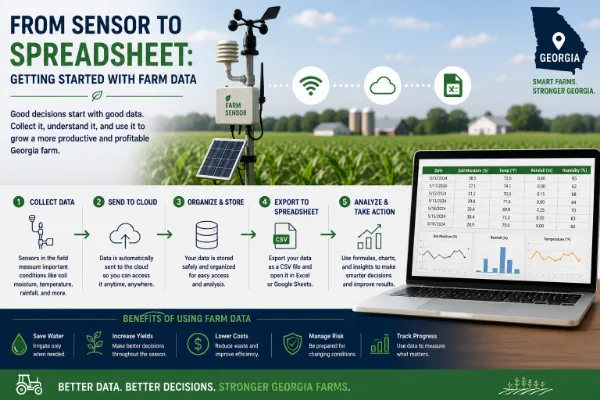
For a smaller operation or a farmer just starting to formalize data collection, a well-organized spreadsheet tracking field-level soil test results, input application rates, weather conditions, and yield by field and season is a legitimate and often underrated starting point. It requires no subscription cost, no proprietary data format, and gives a farmer complete control over structure and access, at the cost of requiring manual data entry and offering none of the automated visualization a dedicated platform provides.
Most major equipment brands offer a data platform tied to their own hardware automatically pulling data from GPS guidance systems, yield monitors, and variable-rate equipment into a centralized dashboard. These are often the path of least resistance if a farm's equipment is largely from one manufacturer, but can create a data silo problem for operations running mixed equipment from multiple brands, since not every platform exports data in a format another platform can easily import.
A growing category of software is designed specifically to aggregate data across multiple equipment brands and sensor types into one platform, addressing the silo problem equipment-specific platforms create. This is generally the right fit for larger, more technologically diverse operations, though it typically comes with a subscription cost that needs to be weighed against the operation's scale.
Collecting clean, well-organized data is only useful if it feeds an actual seasonal decision cycle. A practical structure looks like:
- Pre-season review the previous season's yield maps and soil test results to inform variable-rate seeding and fertilizer plans for the coming season.
- In-season combine soil moisture sensor readings, weather station data, and visual scouting to make real-time irrigation and pest management decisions.
- Harvest capture yield monitor data by field zone, comparing results against the season's input decisions to evaluate what worked and what didn't.
- Post-season consolidate the season's full data picture (inputs, weather, yield) into whatever system is being used, specifically to inform next year's plan rather than letting the data sit unreviewed until the next season starts.
The post-season step is the one most commonly skipped, and it's also the step where the "collecting data you never use" problem shows up most directly without a deliberate year-end review, a season's worth of sensor data effectively goes to waste, regardless of how good the underlying collection was.
Georgia farmers have a genuinely deep, hands-on set of resources for this specific problem, not just generic software recommendations:
- UGA's Institute for Integrative Precision Agriculture, established in 2022, is dedicated specifically to developing and applying precision agriculture technologies, including data management, directly on Georgia farms.
- The UGA Grand Farm site in Perry now hosts public field days including events held alongside the Georgia National Fair specifically designed to let growers see this technology and data workflow in action rather than evaluating it from a product brochure alone.
- UGA's Extension Precision Ag and Irrigation blog publishes ongoing, practical guidance on data management software options, harvest technology, and machinery systems, maintained specifically for Georgia growers and county extension agents.
- Audit what data you're already generating but not reviewing most operations already have more usable data sitting in existing equipment than they realize.
- Fix data quality fundamentals first, particularly soil sampling grid consistency, before investing in more sensors or software.
- Choose a data management approach that matches your operation's equipment mix spreadsheet, single-manufacturer platform, or independent aggregation software rather than defaulting to whatever your equipment dealer offers by default.
- Build a deliberate post-season review into your calendar, since this is the step most likely to get skipped and the one that turns a season's data into next year's better decision.
- Use UGA's Grand Farm field days and Extension resources to see real workflows in action before committing to a specific software platform or sensor investment.
The hardware for collecting farm data soil sensors, weather stations, GPS-guided equipment, yield monitors has become widely accessible across Georgia agriculture. The gap that actually determines whether that investment pays off isn't more sensors; it's the deliberate, consistent process of turning raw readings into a reviewed, actionable decision each season. Getting the data quality fundamentals right, choosing a management approach that fits your specific operation, and building in the post-season review that's most often skipped will do more for most Georgia farms than any single additional piece of hardware.
Frequently asked questions
No. A well-organized spreadsheet tracking field-level soil tests, input rates, and yield by season is a legitimate starting point, particularly for smaller operations, and costs nothing beyond the time required for consistent data entry.
A sampling grid that's too coarse can miss real nutrient variability within a field, leading to inaccurate variable-rate application recommendations, while a grid that's too fine wastes money on unnecessary sampling. UGA research provides specific guidance for choosing an appropriate grid size for southeastern soil conditions.
Collecting data without a deliberate process for reviewing and acting on it, particularly skipping a post-season review that connects the year's data back to next season's planning decisions.
If most of your equipment comes from a single manufacturer, their platform is often the simplest starting point. For operations running mixed equipment brands, an independent data management platform designed to aggregate across brands can avoid the data silo problem manufacturer-specific platforms create.
UGA's Grand Farm site in Perry, Georgia hosts public field days, including events held alongside the Georgia National Fair, giving growers hands-on exposure to these technologies and workflows rather than evaluating them from marketing materials alone.
At minimum, a structured post-season review comparing the year's yield results against input decisions and weather conditions is recommended, since this is the step that turns a season's raw data into an informed plan for the following year.
Related articles

 Agriculture IoT