For a broader look at the soil sensor and controller hardware behind precision irrigation, see our Precision Irrigation and Soil Sensors for Georgia Farms guide. This piece is narrower and more urgent: it's written specifically for growers in the Apalachicola-Chattahoochee-Flint river basin who need to document irrigation efficiency to secure a new well permit or defend an existing allocation, not a general introduction to the technology.
Southwest Georgia sits on top of one of the most contested water resources in the country. For more than three decades, Georgia, Florida, and Alabama have argued over how much water can be pulled from the Apalachicola-Chattahoochee-Flint river basin before it damages downstream ecosystems and Florida's oyster fisheries. That fight reached the U.S. Supreme Court, which ruled in Georgia's favor in 2021, but the state has kept a cautious hand on the tap ever since. A decade-long moratorium on new agricultural wells in the Flint River Basin only began to lift in 2025, and it came back with strings attached: new permits require significantly higher irrigation efficiency than farmers have historically needed to demonstrate.
For the peanut, cotton, and pecan growers who depend on that basin, efficiency is no longer a nice-to-have. It is the price of admission for pumping water at all. That shift is quietly turning South Georgia into one of the more advanced precision irrigation regions in the country, not because farmers chose it first, but because regulation forced the issue.
The Flint River Basin covers 27 counties in southwest Georgia and supports an agricultural economy that generates hundreds of millions of dollars in farmgate income tied directly to irrigation. Row crops, vegetables, and orchard operations here depend on center-pivot systems that draw from the Floridan Aquifer or directly from streams feeding the Flint. When drought hit in 2011 and 2012, stream flows dropped to historic lows, triggering a moratorium on new or expanded withdrawals that lasted until 2025.
When Georgia's Environmental Protection Division finally reopened the door to new permits, it attached a condition that changes the economics of irrigation. Mobile and solid-set sprinkler systems now must demonstrate a minimum efficiency threshold, and new permits require an even higher standard, measured as the percentage of withdrawn water that actually reaches the root zone rather than evaporating, drifting, or running off. Proving that efficiency, and defending it during a drought-driven audit, is exactly the kind of continuous measurement problem that sensor networks solve well and paper logs do not.
The hardware side, soil probes, variable-rate controllers, and remote shutoff, is covered in the precision irrigation guide linked above. The compliance-specific piece growers in the basin need to get right is the documentation itself. EPD's efficiency standard is measured as the percentage of withdrawn water that reaches the crop's root zone, which means a farmer's record needs to connect three data points, not just one: total volume withdrawn at the well, application rate and pattern at the pivot, and a defensible estimate of what actually reached the root zone versus what was lost to evaporation, wind drift, or runoff.
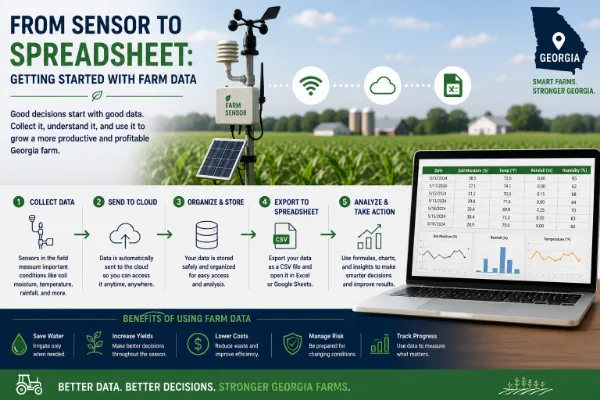
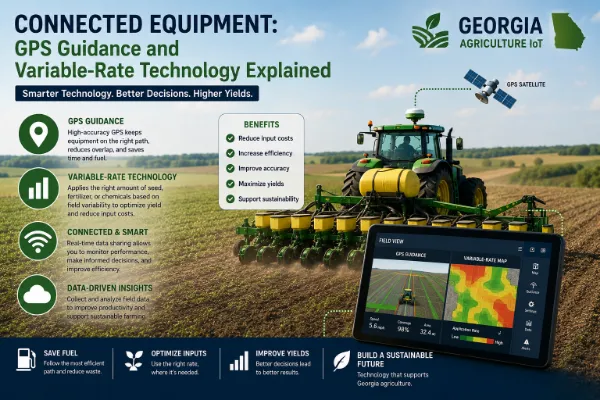
Flow sensors at the wellhead establish the baseline withdrawal figure that anchors the entire efficiency calculation. Variable-rate pivot controllers with GPS logging then document exactly how that water was distributed across the field, zone by zone, rather than assuming uniform application. Soil moisture probes at multiple depths provide the evidence that water applied is actually reaching and remaining in the root zone rather than running off a compacted area or draining past the root zone on sandy soil. Together, these three data streams are what turns a farm's efficiency claim from an estimate into a documented, auditable figure.
EPD's review process favors applicants who can show at least one full growing season of continuous data rather than a partial season or a projection. Farmers should also be prepared to show how their system handles the mobile and solid-set sprinkler efficiency threshold that applies even to existing systems, since a new permit application can prompt scrutiny of a farm's broader irrigation footprint, not just the specific well being requested.
If EPD issues a severe drought declaration, farms with documented efficiency records are in a materially stronger position to argue for continued access or participate in drought-related incentive bidding than those relying on estimates. The record needed here is the same one built for permit applications, continuous, time-stamped, and tied to specific fields and wells, but the practical difference is timing: an audit can be triggered with little notice, so the record needs to already exist rather than being assembled after the fact.
The math here is different from most industrial IoT return-on-investment conversations, because for many farms in the basin, the alternative to adopting sensors is not "keep doing what we're doing." It is losing access to the well permit altogether, or being capped at a lower irrigated acreage than the operation can otherwise support.
| Driver |
Why It Matters in the Flint Basin |
| Permit compliance |
New agricultural withdrawal permits carry a high efficiency requirement that is difficult to demonstrate without continuous measurement |
| Drought exposure |
A future severe drought declaration can trigger reduced allocations; farms with documented high efficiency are better positioned to argue for continued access |
| Input cost savings |
Precision irrigation reduces pumping energy costs and, when paired with fertigation, reduces fertilizer waste from over-application and runoff |
| Yield protection |
Sensor-driven scheduling avoids both under-watering during heat stress and over-watering that can promote disease in peanuts and other row crops |
Picture a 1,200-acre peanut and cotton operation in Mitchell or Baker County that has relied on the Floridan Aquifer for two generations. Under the old moratorium, the farm's irrigated acreage was frozen and any equipment failure or drought year simply meant reduced yield. After the 2025 permit changes opened a path to expand irrigated acreage, the operation invested in soil moisture probes across its most water-stressed fields, retrofitted two center pivots with variable-rate controllers, and added flow sensors at each wellhead. The immediate goal was not dramatic water savings for its own sake. It was building a defensible efficiency record that would support a new permit application and protect the farm if a drought declaration triggered a review of existing allocations. The secondary benefit, reduced pumping costs and more consistent yields on the sandier portions of the fields, made the investment pay for itself well before the compliance benefit ever came into play.
Cellular coverage thins out quickly outside the basin's small towns, which is why many precision agriculture deployments in this region lean on LoRaWAN or other low-power wide-area networks rather than assuming a cell signal will reach every corner of a large field.
Center-pivot systems installed decades ago were not built with digital control in mind. Retrofitting variable-rate nozzles and GPS controllers is workable but requires working with irrigation dealers experienced in this specific upgrade path rather than a generic agriculture IoT vendor.
The EPD's efficiency standard is specific about what counts as water reaching the root zone. Farmers new to sensor-based systems sometimes need help translating raw flow and moisture data into the reporting format regulators expect, which is where local agricultural extension services and irrigation consultants add real value beyond the hardware itself.
Soil moisture networks and variable-rate retrofits carry real upfront costs, and smaller family farms in the basin do not always have the balance sheet to self-fund a full-field deployment in one season. Phased rollouts, starting with the fields under the most water stress, tend to be the more realistic path.
- Satellite and drone imagery paired with ground sensors. Multispectral imagery is increasingly used to flag crop stress across a whole farm, directing where to install ground-truth soil sensors rather than instrumenting every acre equally.
- AI-driven irrigation scheduling. Rather than farmers manually interpreting sensor dashboards, newer platforms are starting to recommend exact irrigation timing and volume, factoring in weather forecasts alongside current soil conditions.
- Aquifer-level monitoring tied to regional data. As EPD continues to study the interaction between surface water and groundwater in the basin, on-farm sensor data is increasingly feeding into the same monitoring networks regulators use, giving growers more of a voice in how future allocation decisions get made.
- Drought-swap infrastructure. Some operations are pairing sensor-driven efficiency with wells that can draw from a different aquifer during declared drought periods, reducing the risk that a single restriction shuts down an entire season.
- Install wellhead flow sensors first, since the withdrawal figure anchors every other efficiency calculation EPD will review.
- Add soil moisture probes and variable-rate controllers on the specific fields tied to the permit application or most likely to be audited, not the whole farm at once.
- Log at least one full growing season of continuous data before submitting a new or expanded permit application.
- Work with an irrigation dealer or extension agent who has specifically helped other Flint Basin growers through the EPD efficiency documentation process, not a general precision-ag vendor.
- Keep the record current year-round, not just before an application deadline, since a drought declaration and resulting audit can happen with little notice.
For farm operators weighing this investment, Precision Irrigation and Soil Sensors for Georgia Farms covers the underlying sensor and controller hardware in more depth, while on-farm weather station basics and turning sensor data into usable farm records address the reporting side of building a defensible efficiency record. The full Agriculture IoT category tracks related developments across the state.
The Flint River Basin's water wars did not end with the 2021 Supreme Court ruling. They shifted into a quieter, more technical phase where efficiency data has become the currency that determines who gets to keep irrigating. For Georgia's peanut, cotton, and pecan growers, IoT-based precision irrigation is no longer primarily about squeezing out marginal yield gains. It is the practical tool that lets a farm prove it deserves the water it is asking for.
Frequently asked questions
New agricultural withdrawal permits in the basin require a high percentage of withdrawn water to reach the crop's root zone, a stricter standard than what applied to existing mobile and solid-set sprinkler systems before the moratorium changes took effect. Farmers should confirm the current specific thresholds with the Georgia Environmental Protection Division, since these standards are subject to ongoing review.
Most existing center-pivot systems can be retrofitted with variable-rate nozzle controllers, GPS guidance, and soil moisture integration rather than requiring full replacement. This is the more common and cost-effective path for established operations in the basin.
Both. Variable-rate application and moisture-based scheduling genuinely reduce over-watering compared with calendar-based irrigation, while the same sensor network produces the documentation needed to demonstrate compliance with EPD efficiency standards.
Low-power wide-area networks such as LoRaWAN are commonly used where cellular coverage is unreliable across large field areas, since they are designed for long-range, low-bandwidth sensor data rather than requiring a strong cell signal at every sensor location.
A documented efficiency record generally strengthens a farm's position during drought-related reviews, since the state's drought response framework has historically included incentive programs for farms that can demonstrate reduced or highly efficient water use compared with baseline irrigation practices.
Smaller operations can adopt precision irrigation incrementally, starting with soil moisture sensors on their most water-stressed or highest-value fields rather than instrumenting an entire farm at once, which keeps upfront costs manageable while still building toward the documentation regulators increasingly expect.
Related articles


 Agriculture IoT