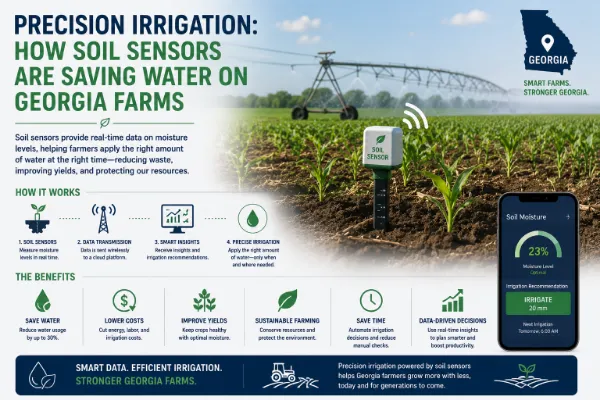
Most precision irrigation content treats soil moisture sensors as a generic efficiency upgrade. In southwest Georgia, they're closer to a regulatory necessity. In July 2012, Georgia's Environmental Protection Division suspended new agricultural water withdrawal permits across a large region of the Lower Flint River Basin, covering both groundwater from the Upper Floridan Aquifer and surface water rights. That suspension has been reviewed annually ever since and remains in effect indefinitely in parts of the region. For farmers in this area 27 counties that together generate more than $2 billion in farm revenue annually getting more crop per gallon isn't optional. It's the only way to grow within a fixed water allocation that isn't expanding.
The Lower Flint River Basin is unusually heavily irrigated for the Southeast center pivot systems dot the landscape across corn, cotton, and peanut fields in a way that's more typical of the arid West than the humid South. That combination of high irrigation density and a hard regulatory ceiling on new water withdrawals made the region a natural proving ground for precision irrigation research, and the University of Georgia's Stripling Irrigation Research Park in Camilla has spent years developing and testing technology specifically for this environment.
A soil moisture sensor is an electronic device installed in the root zone of a field, typically reporting real-time data on how much water is actually available to the plant at a given depth. UGA research deployments in the Flint River Basin have installed sensors at multiple depths commonly 20, 40, and 60 centimeters continuously relaying soil moisture and temperature conditions back to a central system, since water availability at the surface can look very different from conditions deeper in the root zone where most water uptake actually happens.
This matters because traditional irrigation scheduling watering on a fixed calendar or when a field simply looks dry has no way to account for that depth variation, or for how much water is genuinely still available before a crop experiences stress. A sensor-based system replaces guesswork with an actual measurement of the specific field's specific soil at the specific depth that matters for the crop being grown.
Variable-rate irrigation (VRI) converts a standard center pivot system into a zone-controlled precision water delivery system, applying different amounts of water to different parts of a field rather than a single uniform rate across the entire pivot circle. This matters because most fields aren't uniform soil type, drainage, and water-holding capacity vary meaningfully within a single field, meaning a uniform irrigation rate inevitably over-waters some zones and under-waters others.
UGA researchers, led by Calvin Perry at the Stripling Irrigation Research Park, developed VRI technology specifically for this region in partnership with the Flint River Soil and Water Conservation District and USDA's Natural Resources Conservation Service. The technology has since become an approved conservation practice eligible for financial assistance through the USDA's Environmental Quality Incentives Program, meaning farmers adopting VRI in Georgia can often access cost-share support rather than bearing the full capital cost alone.
The more advanced version of this system, known as Dynamic VRI, combines soil moisture sensor networks with VRI zone control into a single automated system using real-time field data to apply the right amount of water, in the right location, at the right time, without requiring a farmer to manually interpret sensor data and adjust the irrigation system by hand. UGA's research testing this approach, dividing fields into parallel strips comparing Dynamic VRI against a farmer's standard irrigation scheduling, found water use efficiency improvements of up to 40 percent alongside yield increases of 5 to 10 percent compared to traditional irrigation methods.
A precision irrigation system that only saved water while reducing yield would be a hard sell for most farmers, regardless of the regulatory pressure. The fact that UGA's Dynamic VRI research showed a yield increase alongside the water savings changes the economics significantly: this isn't a tradeoff between conservation and profitability, it's a case where more precise water delivery avoiding both under-watering during critical growth stages and over-watering that can promote disease or nutrient leaching improves both outcomes simultaneously.
This isn't purely a research-park concept. UGA Extension's Agricultural Water Efficiency Team (AgWET), a partnership of 16 UGA faculty, Flint River Soil and Water Conservation District staff, extension agents, crop consultants, and more than 50 participating farmers, has driven real, measurable adoption across south Georgia. According to UGA CAES impact reporting, soil moisture sensor sales among Georgia distributors increased by more than 300 percent following extension education efforts, with over 100 sensors installed across roughly thirty cotton and peanut fields in one recent multi-year program alone.
Sensor hardware alone doesn't tell a farmer what to do it needs to be paired with a decision tool. Georgia farmers have access to a few UGA-developed or UGA-supported options:
- Irrigator Pro an irrigation scheduling tool built specifically for peanut, cotton, and corn producers, generating recommendations based on real-time soil moisture data, crop growth stage, and soil type.
- Smart Irrigation apps a joint UGA and University of Florida project offering crop-specific smartphone apps (currently covering cotton, soybean, citrus, strawberry, and avocado, with corn, peach, and blueberry in development), each generating irrigation recommendations tailored to that crop's specific water needs and growth phenology.
These tools are what actually make sensor data actionable on a day-to-day basis translating a raw soil moisture reading into a specific "irrigate now" or "wait" recommendation, rather than requiring a farmer to interpret the data manually.
- Start with soil moisture sensors on your highest-value or most water-stressed fields, rather than instrumenting an entire operation at once. This is also the entry point UGA's own extension programs have used most successfully.
- Pair sensor data with a scheduling tool like Irrigator Pro or the relevant Smart Irrigation app for your crop, rather than treating raw sensor readings as something to interpret without guidance.
- Evaluate VRI retrofit costs against EQIP cost-share eligibility before assuming the capital cost is prohibitive USDA financial assistance is specifically available for this conservation practice in Georgia.
- Connect with UGA Extension or the Flint River Soil and Water Conservation District directly if you're in the Lower Flint Basin region specifically, since AgWET and related programs provide direct, farmer-facing technical support rather than requiring a farmer to evaluate this technology alone.
While the regulatory pressure driving adoption is most acute in southwest Georgia, the underlying technology and water-savings case applies broadly across the state's row-crop regions. Any Georgia farm managing irrigated cotton, peanuts, corn, or soybeans faces some version of the same tradeoff between water cost, yield, and long-term water availability, even outside the specific permitting suspension area making the research and tools developed in the Flint Basin broadly relevant to precision irrigation adoption statewide.
Precision irrigation in Georgia isn't a hypothetical efficiency upgrade it's a technology stack developed and proven specifically in response to a real regulatory constraint on water availability in one of the state's most agriculturally important regions. With UGA research showing up to 40 percent water use efficiency gains and a 5 to 10 percent yield increase from Dynamic VRI, soil moisture sensor sales already up more than 300 percent following extension outreach, and USDA cost-share support available for VRI adoption, the case for Georgia farmers to evaluate this technology is backed by more direct, in-state evidence than almost any other precision agriculture application.
Frequently asked questions
Since 2012, Georgia's Environmental Protection Division has suspended new agricultural water withdrawal permits across a large area of the Lower Flint River Basin, affecting both groundwater and surface water rights. This creates a hard ceiling on water availability, making water-use efficiency essential for farmers looking to maintain or grow production within that constraint.
UGA research deployments commonly use multiple depths, such as 20, 40, and 60 centimeters, since water availability and root uptake patterns vary by depth and a single shallow reading doesn't capture the full picture relevant to crop water stress.
UGA research on Dynamic VRI, which combines soil moisture sensors with zone-based irrigation control, found water use efficiency improvements of up to 40 percent alongside yield increases of 5 to 10 percent compared to traditional irrigation methods, based on multi-year field trials in the Flint River Basin.
Yes. VRI is an approved conservation practice through the USDA's Environmental Quality Incentives Program (EQIP), meaning eligible Georgia farmers can often access cost-share funding rather than bearing the full retrofit cost independently.
Georgia farmers have access to UGA-developed tools like Irrigator Pro, built for peanut, cotton, and corn scheduling, and the Smart Irrigation smartphone app series developed jointly by UGA and the University of Florida, covering several major crops with more in development.
No. While the regulatory pressure is most direct in the Lower Flint River Basin, the underlying water-cost and yield benefits of precision irrigation apply to irrigated row-crop farms across Georgia, and the tools and research developed in the Flint Basin are broadly applicable statewide.
Related articles

 Agriculture IoT