Public infrastructure is the foundation of every community, from roads and bridges to water systems, streetlights, parks, and public buildings. As Georgia's cities continue to grow, maintaining these assets has become increasingly complex. Rather than relying solely on scheduled inspections or citizen reports, many municipalities are turning to Internet of Things (IoT) sensors to monitor infrastructure in real time.
Connected sensors provide city officials with continuous data about the condition and performance of public assets. This allows maintenance teams to identify problems earlier, prioritize repairs, reduce operating costs, and improve the reliability of essential services. Instead of reacting after failures occur, cities can make smarter, data-driven decisions that extend the lifespan of critical infrastructure.
IoT sensors are connected devices that collect and transmit information about physical conditions such as movement, temperature, vibration, pressure, water flow, air quality, energy usage, and occupancy. Installed throughout public infrastructure, these sensors provide municipalities with valuable insights into how city assets are performing.
By combining sensor data with cloud platforms and analytics software, local governments can monitor infrastructure remotely and respond more quickly to emerging issues.
- Roads and intersections
- Bridges and overpasses
- Water distribution systems
- Stormwater infrastructure
- Public buildings
- Street lighting
- Parks and recreational facilities
- Environmental monitoring stations
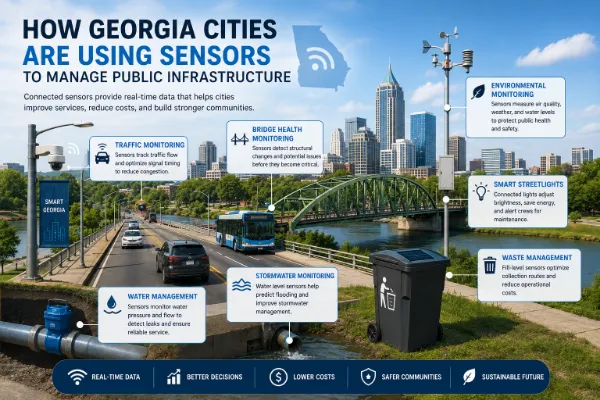
Traffic sensors help transportation departments monitor vehicle volumes, traffic speeds, and congestion throughout the day. This information supports adaptive traffic signal systems that improve traffic flow while helping planners identify areas requiring future roadway improvements.
Real-time traffic data also improves emergency response planning and allows transportation agencies to better manage construction zones and special events.
Water utilities are increasingly using connected sensors to monitor pressure, flow rates, water quality, and leak detection throughout municipal water systems. Early detection of abnormal conditions helps reduce water loss while minimizing costly emergency repairs.
Continuous monitoring also provides better visibility into overall system performance and supports preventive maintenance planning.
Bridges represent some of the most valuable public assets maintained by local governments. Structural sensors measure vibration, movement, strain, and environmental conditions that may affect long-term performance.
Rather than relying only on periodic inspections, engineers can receive continuous information about structural conditions, allowing them to schedule maintenance before small issues become major repairs.
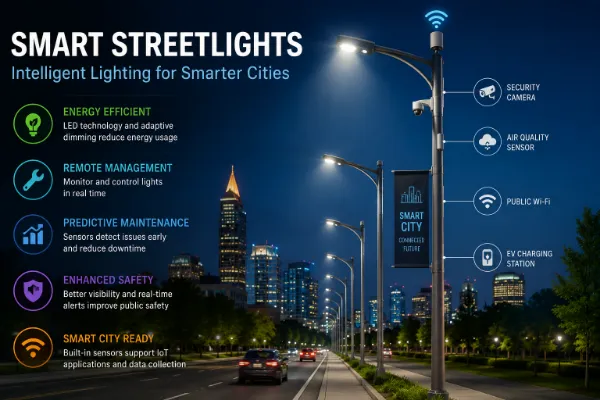
Modern streetlights do much more than illuminate roadways. Many smart lighting systems include connected sensors that monitor energy consumption, detect equipment failures, and automatically notify maintenance crews when repairs are needed.
Some systems can also adjust lighting levels based on traffic activity or weather conditions, improving energy efficiency while maintaining public safety.
Environmental sensors help cities monitor air quality, temperature, humidity, flooding risks, and noise levels. This information supports emergency planning, sustainability initiatives, and public health programs.
Communities can also use environmental data to improve urban planning and better understand changing weather conditions.
| Benefit |
Impact |
| Predictive Maintenance |
Detects problems before failures occur. |
| Reduced Costs |
Minimizes emergency repair expenses. |
| Improved Public Safety |
Identifies infrastructure risks earlier. |
| Operational Efficiency |
Helps prioritize maintenance resources. |
| Better Decision Making |
Supports long-term infrastructure planning. |
| Greater Sustainability |
Reduces energy and resource consumption. |
- Modernizing aging infrastructure
- Cybersecurity for connected devices
- Managing large volumes of sensor data
- Integrating multiple technology platforms
- Funding long-term deployments
- Training municipal staff
Successful implementations typically begin with pilot projects before expanding to larger citywide deployments.
As sensor technology becomes more affordable and communication networks continue to improve, Georgia municipalities are expected to expand connected infrastructure across transportation, utilities, environmental monitoring, and public safety. Artificial intelligence and predictive analytics will further enhance how cities interpret sensor data, enabling even more proactive maintenance strategies.
Communities that invest in connected infrastructure today will be better positioned to improve service delivery, reduce operating costs, and support future smart city initiatives.
IoT sensors are changing how Georgia cities manage public infrastructure by providing continuous visibility into roads, bridges, utilities, buildings, and environmental conditions. Instead of reacting to failures, municipalities can identify issues earlier, improve maintenance planning, and make better use of public resources.
As smart city technologies continue to evolve, connected sensors will remain one of the most valuable tools for building safer, more efficient, and more resilient communities throughout Georgia.
Frequently asked questions
IoT sensors monitor roads, bridges, utilities, environmental conditions, traffic, lighting, and other public infrastructure in real time.
They provide continuous monitoring that allows cities to detect problems early and perform preventive maintenance before costly failures occur.
Transportation, water utilities, public safety, environmental monitoring, energy management, parks, and municipal buildings all benefit from connected sensors.
Yes. Many Georgia municipalities are investing in connected transportation systems, smart utilities, environmental monitoring, and other IoT-based infrastructure projects.
Yes. Predictive maintenance, automated monitoring, and improved resource allocation help reduce maintenance expenses and improve operational efficiency.
Future deployments will combine IoT sensors with artificial intelligence, edge computing, and predictive analytics to create even smarter and more responsive municipal infrastructure.
Related articles

 Smart Cities