As cities continue to grow, local governments face increasing demands to improve transportation, public safety, utilities, sustainability, and public services while managing limited resources. Smart city technology helps address these challenges by using connected infrastructure, Internet of Things (IoT) devices, artificial intelligence, and real-time data to make city operations more efficient and responsive.
A smart city is more than simply adding new technology. It is a community that uses digital innovation to improve everyday life for residents, businesses, and visitors. By connecting infrastructure and collecting real-time information, cities can make faster decisions, reduce operating costs, improve public safety, and deliver better public services.
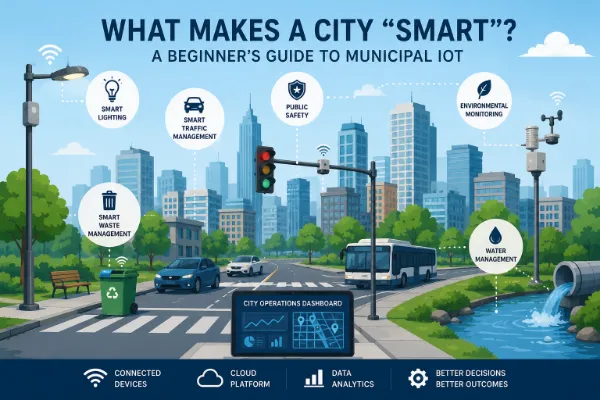
A smart city uses connected technologies to monitor and manage public infrastructure more effectively. Sensors, cameras, communication networks, cloud platforms, and data analytics work together to collect information from roads, utilities, buildings, parks, and transportation systems.
Instead of relying on manual inspections or fixed schedules, city departments can monitor infrastructure continuously and respond to changing conditions in real time.
- Internet of Things (IoT) sensors
- Artificial Intelligence (AI)
- 5G and fiber connectivity
- Cloud computing platforms
- Edge computing
- Big data analytics
- Geographic Information Systems (GIS)
- Cybersecurity solutions
Connected traffic signals, intelligent intersections, and real-time traffic monitoring help reduce congestion, improve travel times, and enhance emergency response.
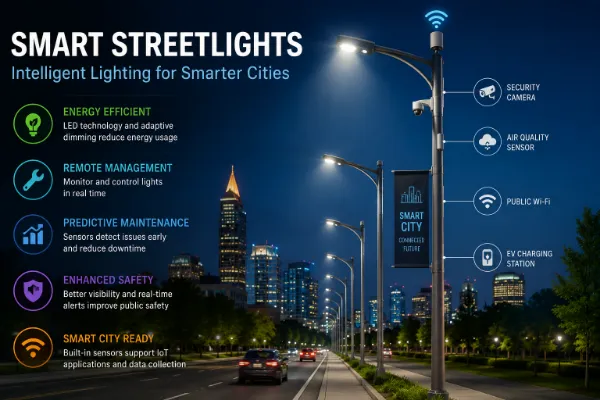
IoT-enabled streetlights automatically adjust brightness, report maintenance issues, and reduce electricity consumption while supporting additional smart city technologies.
Connected cameras, emergency communication systems, and environmental sensors provide first responders with better situational awareness and faster response capabilities.
Water, electricity, and gas utilities use connected sensors to monitor infrastructure, detect leaks, improve efficiency, and reduce service interruptions.
Air quality sensors, flood monitoring systems, weather stations, and noise detection devices help cities improve sustainability and respond to environmental challenges.
Smart waste bins and route optimization software improve collection efficiency while reducing fuel consumption and operating costs.
| Benefit |
How It Helps |
| Reduced Congestion |
Adaptive traffic management improves traffic flow. |
| Lower Operating Costs |
Automation reduces maintenance and energy expenses. |
| Improved Public Safety |
Real-time monitoring supports faster emergency response. |
| Greater Sustainability |
Connected systems reduce energy and resource consumption. |
| Predictive Maintenance |
Infrastructure problems are identified before failures occur. |
| Better Resident Experience |
Citizens benefit from more reliable public services. |
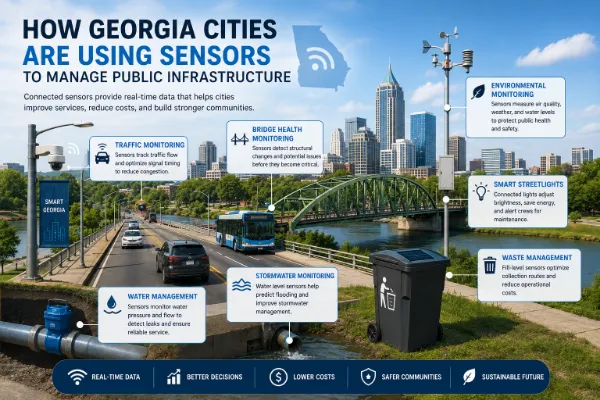
Georgia has become an emerging leader in smart city innovation. Communities are investing in connected transportation systems, intelligent infrastructure, digital public services, and municipal IoT technologies.
Peachtree Corners is widely recognized for its Curiosity Lab innovation ecosystem, where connected vehicles, intelligent transportation systems, and smart infrastructure are tested in real-world conditions. Other Georgia municipalities continue exploring technologies that improve mobility, sustainability, and infrastructure management.
- Funding infrastructure modernization
- Cybersecurity and data privacy
- Integrating legacy infrastructure
- Managing large volumes of data
- Developing long-term technology strategies
- Training municipal employees
Successful smart city initiatives begin with clearly defined community goals rather than implementing technology simply for its own sake.
Artificial intelligence, edge computing, digital twins, autonomous vehicles, and predictive analytics will continue transforming how cities operate. Future municipalities will increasingly rely on connected infrastructure to anticipate problems, optimize resources, and improve the delivery of public services.
As communication networks continue to improve, smart city technologies will become more connected, scalable, and accessible for communities of all sizes.
Smart cities combine connected technology with practical decision-making to improve transportation, infrastructure, utilities, public safety, and sustainability. Rather than replacing existing infrastructure, these technologies help municipalities operate more efficiently while providing better services for residents.
As Georgia continues investing in digital infrastructure and municipal IoT, smart city initiatives will play an increasingly important role in creating safer, more resilient, and more sustainable communities for future generations.
Frequently asked questions
A smart city uses connected technologies, IoT devices, and real-time data to improve public services, infrastructure, transportation, and sustainability.
Common technologies include IoT sensors, AI, cloud computing, 5G, edge computing, smart cameras, connected traffic systems, and environmental monitoring.
Residents experience improved transportation, safer streets, lower energy consumption, better public services, and more efficient city operations.
Yes. Smart technologies help reduce energy use, improve resource management, lower emissions, and support sustainability initiatives.
IoT devices collect real-time data from infrastructure, allowing cities to monitor conditions, automate processes, and make informed decisions.
As Georgia communities continue to grow, smart city technologies help improve infrastructure, transportation, public safety, and municipal services while supporting long-term economic development.
Related articles

 Smart Cities