Many cities have already replaced traditional streetlights with LED fixtures to reduce electricity consumption and maintenance costs. While LEDs offer significant energy savings, today's smart streetlights go much further. By combining LED lighting with Internet of Things (IoT) technology, connected sensors, and remote management software, municipalities can create intelligent lighting networks that improve efficiency, enhance public safety, and support broader smart city initiatives.
Across Georgia, growing communities are exploring smart lighting systems as part of their long-term infrastructure modernization strategies. These connected streetlights provide valuable data while reducing operational costs and preparing cities for future technologies.
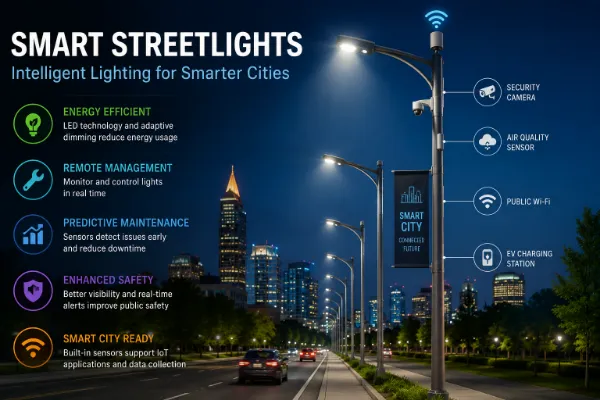
Smart streetlights are LED lighting systems equipped with communication technology, sensors, and intelligent controllers that allow municipalities to monitor, control, and optimize street lighting remotely.
Unlike traditional streetlights that simply turn on and off at scheduled times, smart lighting systems continuously collect operational data and automatically adjust performance based on real-world conditions.
- LED fixtures reduce electricity consumption.
- Wireless controllers connect lights to a central management platform.
- Sensors monitor movement, weather, and environmental conditions.
- Remote software controls brightness and operating schedules.
- Maintenance alerts notify crews when equipment requires attention.
- Performance data helps cities improve energy efficiency.
Remote monitoring eliminates many routine inspections by identifying outages and equipment failures automatically. Maintenance teams can respond faster while reducing labor costs.
Smart streetlights can automatically dim during periods of low activity and increase brightness when pedestrians, cyclists, or vehicles are detected. This balances energy savings with public safety.
Better lighting improves visibility for drivers, pedestrians, and emergency responders. Some systems can also support emergency response by increasing brightness during incidents.
Connected lighting systems continuously monitor fixture performance, allowing cities to replace components before failures occur and minimize unexpected outages.
Lower electricity consumption reduces greenhouse gas emissions while supporting municipal sustainability goals.
Modern smart streetlights can serve as connected infrastructure platforms for additional smart city technologies.
- Environmental sensors
- Traffic monitoring
- Public Wi-Fi access points
- 5G small-cell equipment
- Security cameras
- Parking sensors
- Emergency communication devices
- Air quality monitoring
This allows cities to expand digital infrastructure without installing separate poles or communication networks.
Growing communities throughout Georgia are evaluating smart streetlight deployments to improve transportation corridors, downtown districts, parks, university campuses, and public spaces. Combined with connected traffic signals and intelligent transportation systems, smart lighting can contribute to safer and more efficient urban environments.
Innovation hubs such as Peachtree Corners continue demonstrating how connected infrastructure can support broader municipal IoT initiatives.
| Challenge |
Possible Solution |
| Initial investment |
Implement projects in phases |
| Network connectivity |
Deploy reliable wireless infrastructure |
| Cybersecurity |
Use encrypted communications and secure device management |
| System integration |
Select open, scalable technology platforms |
Future smart streetlights will increasingly integrate artificial intelligence, edge computing, and predictive analytics. Cities will use lighting infrastructure to collect real-time data that supports traffic management, environmental monitoring, emergency response, and infrastructure planning.
As connected infrastructure expands, streetlights will become valuable digital assets that contribute far beyond illumination.
Smart streetlights represent one of the most practical and cost-effective starting points for smart city development. While LED technology delivers immediate energy savings, connected lighting systems provide additional value through remote management, predictive maintenance, adaptive lighting, and support for future municipal IoT applications.
For Georgia cities investing in modern infrastructure, smart streetlights offer an opportunity to reduce operating costs while creating safer, more connected, and more sustainable communities.
Frequently asked questions
A smart streetlight combines LED lighting with IoT sensors, communication technology, and remote management software that allows cities to monitor and control lighting in real time.
They use efficient LED fixtures and automatically adjust brightness based on traffic, pedestrian activity, or scheduled operating conditions.
Yes. Better lighting, faster maintenance, and integration with public safety technologies help improve visibility and emergency response.
Streetlight poles can support cameras, environmental sensors, public Wi-Fi, 5G equipment, parking sensors, and traffic monitoring devices.
In many cases, maintenance costs decrease because connected systems automatically report equipment issues, reducing manual inspections and emergency repairs.
They help municipalities lower energy costs, modernize infrastructure, improve public safety, and create a foundation for future smart city technologies.
Related articles

 Smart Cities