 Agriculture IoT

Livestock Monitoring 101: Tracking Health and Location With IoT
Agriculture IoT
Published by IOT Georgia Research & Editorial Team
- The Two Different Problems "Livestock Monitoring" Actually Solves
- Location Tracking and Virtual Fencing
- Health and Reproductive Monitoring
- Georgia's Other Major Livestock Sector: Poultry House Environmental Monitoring
- Getting Data From the Sensor to a Usable Decision
- What to Consider Before Adopting Livestock Monitoring Technology
- The Bottom Line
Georgia's cattle industry doesn't look like Texas or Montana ranching there's no single sprawling operation running tens of thousands of head across one contiguous range. Instead, the Georgia Cattlemen's Association counts roughly 15,000 cattle producers running over one million head of cattle spread across all 159 of the state's counties, with combined beef and dairy cattle standing as the state's second-largest agricultural commodity by value. That's a genuinely dispersed industry, made up mostly of small and mid-size operations rather than a handful of massive ranches and that structure changes which parts of livestock IoT actually matter most for a typical Georgia producer.
The Two Different Problems "Livestock Monitoring" Actually Solves
IoT-based livestock monitoring covers two genuinely distinct categories of technology, and it's worth separating them clearly before evaluating either:
- Location and containment knowing where animals are and controlling where they graze, historically handled entirely with physical fencing.
- Health and reproductive monitoring tracking individual animal condition, behavior, and biological events (illness, estrus, calving) that are difficult or impossible to observe manually across a herd at any real scale.
These solve different problems, use different hardware in many cases, and have different adoption calculus for a Georgia operation, so it's worth walking through each separately.
Location Tracking and Virtual Fencing
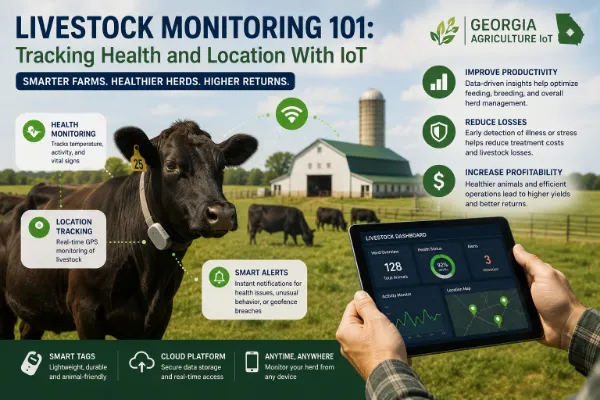
GPS-based livestock tracking has existed for years in a passive form a collar or ear tag reporting an animal's location so a producer can find scattered cattle across a large or wooded pasture without physically searching for them. The more significant recent development is virtual fencing: a GPS-enabled collar that creates a movable, software-defined boundary instead of a physical fence, using an audio cue as an animal approaches the boundary, followed by a mild electrical stimulus if it continues forward.
Published research on this technology including controlled trials on both beef cattle and dairy cows has generally found that animals learn virtual boundaries within one to two days and can be reliably contained within a defined area more than 95 percent of the time after that adjustment period, with welfare indicators generally comparable to traditional electric fencing. Commercial systems (Vence and eShepherd being two of the more established platforms) use base stations covering several thousand acres of range, with each animal's collar combining GPS positioning with a radio transceiver to receive updated boundary instructions remotely, allowing a producer to redraw grazing zones from a phone or computer rather than physically moving fence lines.
Why This Matters More for Rotational and Pasture-Based Operations
For a Georgia cattle operation practicing rotational grazing moving cattle between paddocks to manage pasture health and forage quality virtual fencing removes a genuinely significant amount of physical labor: no fence to build, move, or maintain when a rotation schedule changes. For an industry as widely distributed as Georgia's, where many operations are mid-size and pasture-based rather than large-scale rangeland, this labor savings on rotational management is often the more immediately relevant benefit than the location-tracking function alone.
Health and Reproductive Monitoring
The second major category of livestock IoT focuses on what an animal's behavior and physiology reveal about its condition, using wearable sensors typically ear tags, boluses (sensors housed in a capsule the animal swallows and retains in the rumen), or collars to continuously track indicators like:
- Rumination and eating behavior a drop in rumination time is often one of the earliest detectable signs of illness or stress in cattle, frequently appearing before visible symptoms a producer would catch during a routine visual check.
- Activity and movement patterns reduced movement can indicate illness or injury, while a spike in activity is a well-established indicator of estrus, useful for timing breeding decisions precisely rather than relying on visual heat detection.
- Calving detection specialized sensors can detect the onset of labor, allowing a producer to be present for a difficult birth without needing to continuously monitor a pasture manually, particularly valuable overnight or across a herd spread over a large area.
- Body temperature an elevated temperature can be an early indicator of infection or illness, often detectable through sensor monitoring before other symptoms become visually apparent.
For a dispersed industry like Georgia's, where a single producer may be managing cattle across multiple pastures without the labor available for constant in-person observation, automated health monitoring effectively extends a producer's attention across the whole herd continuously, rather than relying entirely on scheduled visual checks.
Georgia's Other Major Livestock Sector: Poultry House Environmental Monitoring
While cattle monitoring centers on location and individual animal health across open pasture, Georgia's other dominant livestock sector poultry, concentrated around Gainesville and north Georgia uses a different category of IoT entirely, since broiler chickens are raised in enclosed, climate-controlled houses rather than grazing open land. Here, the relevant sensors monitor house-level environmental conditions: temperature, humidity, ammonia levels, and ventilation performance, since poultry are highly sensitive to environmental stress and a ventilation or cooling system failure can affect an entire flock within hours. This is a genuinely different application of livestock IoT than cattle tracking, but it's worth noting for Georgia specifically, since poultry represents a larger share of the state's total livestock economy than cattle does.
Getting Data From the Sensor to a Usable Decision
As with precision irrigation, sensor hardware alone doesn't tell a producer what to do it needs a platform that aggregates readings across the herd and surfaces the ones that actually require action. Most commercial livestock monitoring systems, whether for location or health tracking, pair the wearable hardware with a smartphone app or web dashboard that flags individual animals for attention rather than requiring a producer to review raw data for every animal manually. This matters especially for a dispersed, mid-size operation: a system that simply generates more raw data without prioritizing what needs a producer's attention adds workload rather than reducing it. When evaluating a platform, it's worth asking specifically how alerts are prioritized and delivered, and whether the system distinguishes between a minor deviation worth noting and a genuine health or containment concern requiring immediate action.
What to Consider Before Adopting Livestock Monitoring Technology
- Match the technology to your actual operation type. A rotational grazing beef operation gets the most value from virtual fencing; a cow-calf operation focused on breeding timing gets more value from reproductive/estrus monitoring; a poultry operation needs house environmental sensors entirely, not cattle-style wearables.
- Understand the connectivity requirements. Most GPS collar and virtual fencing systems require a base station with a defined coverage radius, meaning very large or geographically fragmented operations may need multiple base stations, which affects total system cost.
- Factor in the adjustment period for virtual fencing specifically. Research consistently shows a one-to-two-day learning period for cattle adapting to a virtual boundary, and producers should plan for closer observation during that window rather than assuming immediate full containment.
- Consider herd size and labor savings realistically. For a small operation with only a handful of animals, the labor savings from automated monitoring may not yet justify the per-head technology cost; the economics generally improve as herd size grows.
The Bottom Line
Livestock IoT in Georgia isn't a single technology category it covers location and containment tools like virtual fencing, individual animal health and reproductive monitoring through wearable sensors, and, for the state's larger poultry sector, an entirely different category of house-level environmental monitoring. Given that Georgia's roughly 15,000 cattle producers are spread across all 159 counties rather than concentrated in a handful of massive operations, the labor-saving case for this technology less physical fence-building, fewer manual health checks, earlier detection of problems across a dispersed herd tends to matter more for the state's typical mid-size, pasture-based operations than the location-tracking function in isolation.