In 2007, the Georgia Public Service Commission approved a request that's easy to overlook in hindsight but was a significant infrastructure commitment at the time: Georgia Power's plan to replace all 2.5 million of its mechanical electric meters with digital AMI smart meters over a six-year rollout. That timing mattered. By 2016, U.S. Energy Information Administration data placed Georgia among just eight states and jurisdictions nationally with a residential AMI penetration rate above 80 percent putting Georgia's electric grid years ahead of most of the country in smart meter coverage, well before AMI became the default assumption it's closer to today.
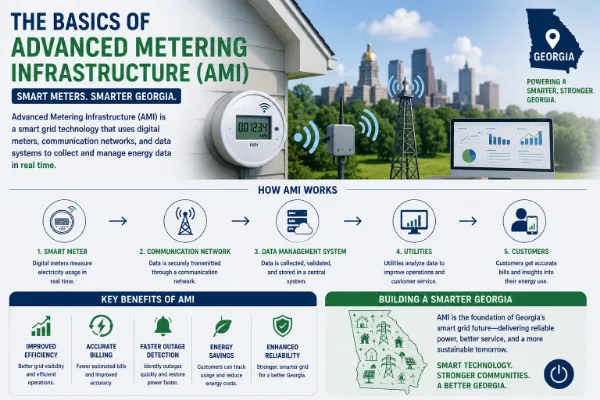
Advanced Metering Infrastructure is the combination of three components working together, not just the meter itself:
- The smart meter a digital device replacing the traditional mechanical meter, capable of recording usage at short intervals (commonly hourly or more frequently) rather than accumulating a single total between manual readings.
- The communication network the system transmitting meter data back to the utility, which can be a dedicated fixed-network of radio towers, a cellular connection, or a mesh network where meters relay data between each other back to a central collection point.
- The data platform often called a Meter Data Management System (MDMS), which processes, stores, and makes the incoming meter data usable for billing, analytics, and operations, rather than leaving raw readings unprocessed.
The distinction between AMI and its predecessor, AMR (Automated Meter Reading), is worth understanding specifically: AMR systems generally support one-way communication, transmitting a meter reading to a passing utility vehicle without requiring a technician to physically read the meter, but without ongoing two-way interaction. AMI systems support two-way communication, meaning the utility can also send information or commands back to the meter enabling functions like remote service connection and disconnection, time-based rate signaling, and outage detection, none of which a one-way AMR system can support.
Georgia Power's 2007-approved rollout wasn't a pilot program or a partial deployment it was a commitment to replace effectively the entire mechanical meter base across the company's service territory within six years. That scale and speed is part of why Georgia's residential AMI penetration reached the high-80s-percent range faster than most states, according to EIA tracking. Today, Georgia Power's parent company, Southern Company, manages more than 4.6 million smart meters across its Georgia Power, Alabama Power, and Mississippi Power territories combined, with roughly 2.8 million of those specifically on Georgia Power's system a dataset the company has more recently begun applying modern cloud analytics and machine learning to, extending well beyond the original billing-automation purpose the meters were installed for.
The original business case for AMI was largely operational efficiency automating meter reading eliminates the cost of sending a technician to physically read every meter monthly. That's still true, but it was always just the starting point. Established uses of AMI data today include:
- Remote connect/disconnect starting or stopping service without a truck roll, useful for both routine account changes and faster response to service requests.
- Outage detection and restoration support a smart meter's last-gasp signal when it loses power can help a utility identify the scope of an outage more precisely than waiting for customer-reported outages alone.
- Time-based rate programs interval data makes it possible for utilities to offer rate plans that vary by time of day, which a monthly-total mechanical meter has no way to support.
- Usage anomaly and leak detection for both electric and water AMI systems, continuous interval data allows automated detection of unusual consumption patterns, covered in more depth elsewhere in this guide for water utilities specifically.
- Grid and transformer analytics aggregated AMI data increasingly feeds broader grid planning, helping utilities understand load patterns at a granularity that supports better capacity and infrastructure investment decisions.
Not every Georgia Power customer is required to have a smart meter. Following the Commission's approval of a Smart Meter Opt-Out tariff in December 2013, as part of Georgia Power's 2013 rate case, customers who prefer to keep a traditional mechanical meter can do so for a basic service charge, currently structured as a monthly fee for maintaining the older metering and manual-reading process. This detail is worth knowing for any Georgia customer evaluating AMI it's not a mandatory technology, though it is the default installation across Georgia Power's territory today.
Here's a detail that's genuinely specific to Georgia rather than a general AMI concept: Georgia Power operates its statewide AMI network not just for its own electric meters, but as a service other Georgia cities and counties can use for their water and gas metering, without needing to build separate network infrastructure of their own. Municipalities can either purchase AMI-compatible meters and use Georgia Power's transmitter and tower network to relay the data, or in some arrangements, have Georgia Power fund the hardware and installation entirely in exchange for a monthly service fee.
The city of Darien, Georgia is a documented example: facing a failing water system with significant revenue, water, and efficiency losses, Darien worked with Georgia Power's AMI team to evaluate the system's loss ratio and implement a remediation plan built on the shared AMI network, rather than developing an entirely separate metering infrastructure from scratch. This model a private electric utility's statewide network doubling as shared infrastructure for municipal water and gas metering is a notably efficient approach for smaller Georgia cities and counties that couldn't independently justify the capital cost of building a dedicated AMI network for a single utility service.
- Evaluate whether Georgia Power's existing shared AMI network is available in your area before assuming a standalone network build is necessary for many Georgia municipalities, leveraging existing statewide infrastructure is both faster and lower-cost than an independent deployment.
- Understand the difference between a data package and a full service package. Georgia Power's municipal AMI offerings range from providing hourly meter reads and analytics on a city's existing meters, to a fully managed option where Georgia Power purchases, installs, and programs the meters and transmitters directly.
- Use AMI data specifically to address non-revenue water or gas loss, as Darien did, rather than treating the technology purely as a meter-reading automation upgrade the leak, unbilled consumption, and exception reporting AMI systems generate is often where the clearest financial return shows up.
- Consider a phased rollout if budget or staff capacity is limited, easing into the new system and its data processes incrementally rather than converting an entire customer base at once.
AMI in Georgia isn't a new or emerging technology the state's largest electric utility completed a full-scale rollout starting in 2007, putting Georgia ahead of most of the country in smart meter penetration for the better part of the last two decades. What's newer is how that infrastructure is being used: Southern Company's shift toward advanced analytics on its multi-million-meter AMI dataset, and Georgia Power's distinctly Georgia model of extending its statewide AMI network as shared infrastructure for municipal water and gas utilities that would otherwise face the full cost of building a separate system alone. For any Georgia city or county evaluating a metering upgrade, that existing statewide network is worth investigating before assuming a standalone deployment is the only path.
Frequently asked questions
AMR (Automated Meter Reading) typically supports one-way communication, transmitting a reading without requiring physical technician access but without ongoing interaction. AMI (Advanced Metering Infrastructure) supports two-way communication, allowing the utility to also send commands or information back to the meter, enabling functions like remote connect/disconnect and outage detection that AMR can't support.
The Georgia Public Service Commission approved Georgia Power's plan to replace all 2.5 million of its mechanical meters with AMI smart meters in 2007, as part of a six-year rollout across its service territory.
Yes. Following a Commission-approved Smart Meter Opt-Out tariff in December 2013, customers can request to keep a traditional mechanical meter for a monthly basic service charge.
Yes. Georgia Power offers its statewide AMI network as a service to Georgia municipalities for reading water and gas meters remotely, allowing cities to avoid building separate dedicated network infrastructure for those utilities.
The smart meter itself, the communication network that transmits data back to the utility, and the data platform (often called a Meter Data Management System) that processes and makes that data usable for billing, analytics, and operations.
According to Georgia Power's published customer information, usage data is not shared with third parties and remains between the utility and its customers, subject to the specific privacy policies in place at the time of service.
Related articles

 Smart Utilities