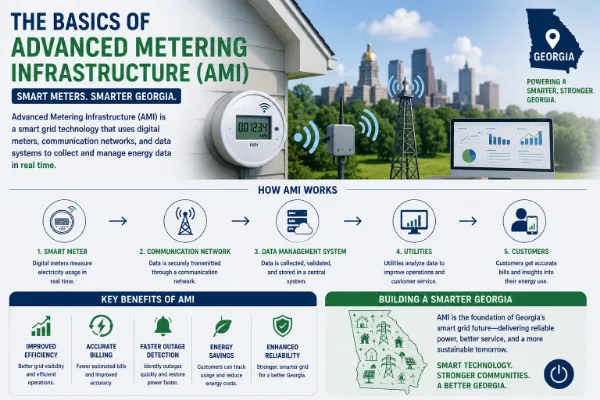
Most Georgia homes and businesses already have a smart meter. Georgia Power, the state's 41 electric membership cooperatives and many municipal utilities installed advanced metering infrastructure, or AMI, over the past decade and a half, mainly to replace manual meter reading. Those meters did that job well. Now utilities are asking them to do much more.
A smart meter is, in effect, a sensor at the edge of the grid. It can report voltage, outages, power quality and how load changes through the day. As data centers, electric vehicles, rooftop solar and new manufacturing plants reshape demand across Georgia, utilities are using meter data as grid intelligence: a way to see conditions on distribution lines they could not see before, manage peaks and plan upgrades more precisely. This article looks at that shift, what next-generation meters add, and what it means for Georgia's cooperatives, cities and customers. For the basics, see our guide to advanced metering infrastructure.
| Utility Type | Examples | Why Grid Intelligence Matters |
|---|
| Investor-owned utility | Georgia Power | Rapid large-load growth, statewide network, regulatory reporting |
| Electric membership cooperatives | 41 EMCs covering about 73 percent of Georgia's land area | Wholesale power costs tied to peak demand, long rural lines |
| Municipal utilities | City-owned electric, water and gas systems | Small staffs, multiple utility services, tight budgets |
Each group has different priorities, but all face the same pressures: rising demand, more distributed energy resources, extreme weather and customers who expect faster restoration and better information.
| Use | What Meter Data Shows | Benefit |
|---|
| Outage detection | Meters report when they lose and regain power | Faster dispatch and confirmation that restoration is complete |
| Voltage optimization | Voltage at the end of feeders | Lower voltage within safe limits to reduce peak demand and losses |
| Transformer loading | Combined load of customers on each transformer | Identify overloaded transformers before they fail |
| Distributed energy visibility | Exports from solar, charging patterns from EVs | Plan for new load and generation on local circuits |
| Theft and losses | Unusual consumption patterns and meter tampering | Reduce revenue losses |
| Customer engagement | Interval usage data | Time-based rates, usage alerts and better billing questions |
Cooperatives have a strong reason to manage peaks, because most buy power from generation and transmission suppliers under rates tied to peak demand. Central Georgia EMC offers a useful example. According to its AMI vendor, the cooperative uses its metering network to support dynamic voltage reduction, confirming available voltage headroom with near real-time readings from selected "bellwether" meters before lowering voltage at substation regulators during peak events. It combines that with load management programs for HVAC systems, water heaters and electric vehicle chargers. Real-time data lets the cooperative reduce demand only when needed, limiting the impact on members while lowering wholesale power costs.
Many Georgia utilities are now considering the next generation of meters and networks, often called AMI 2.0. Compared with earlier systems, these offer:
- Edge computing in the meter. Meters can run applications that analyze high-resolution data locally and report only what matters, such as detecting an EV charger or a loose neutral connection.
- Faster, richer data. Higher sampling rates and lower latency support real-time grid applications.
- More connectivity options. Some systems use multi-carrier cellular or private LTE networks in addition to traditional mesh radio.
- Better coordination of distributed resources. Meters can help manage solar, batteries and EV charging at the grid edge.
The trade-off is cost. AMI 2.0 meters and communications cost more than earlier systems, so utilities must build business cases around specific operational benefits. The federal Grid Resilience and Innovation Partnerships program has supported AMI upgrades and grid analytics at utilities nationally, which some utilities use to offset costs.
An interesting Georgia feature is that electric AMI networks can serve other utilities. Georgia Power offers cities and counties access to its statewide AMI network to read water and gas meters remotely, funding hardware and installation for a monthly service fee. That lets smaller municipal systems gain remote reading, leak alerts and usage data without building their own networks. Our article on connected water systems explains how that data helps water utilities.
Georgia's electricity demand is growing faster than at any point in decades, driven largely by data centers. Georgia Power's planning estimate for new generation rose from 400 megawatts in 2022 to 8,500 megawatts in 2025. Large loads mostly connect at the transmission level, but growth also shows up on distribution systems through new housing, EV charging and commercial development. Grid intelligence helps utilities find where local upgrades are truly needed, use voltage optimization and demand flexibility to shave peaks and defer some capital spending. For the transmission side of this story, see our article on Georgia's data center boom and grid technology.
Hurricanes, tropical storms and severe thunderstorms regularly cause widespread outages in Georgia. Meter outage data helps utilities see the scale and pattern of damage faster, prioritize crews and confirm restoration without relying solely on customer calls. After major storms, utilities can also use meter data to identify customers who are still out when nearby circuits have been restored, often pointing to damage at individual service lines. Our article on grid monitoring and power outages covers storm response technology.
EV adoption tends to cluster in particular neighborhoods, and a few Level 2 chargers on one transformer can push it past its rating on hot evenings when air conditioning is already running. Rooftop solar creates the opposite challenge at midday, raising voltage on lightly loaded circuits. Georgia has no statewide net metering law, so each cooperative sets its own solar buyback terms, but every utility still needs to know where solar and EVs are connected and how they behave. Interval and voltage data from meters reveal both patterns, often before customers report problems. That information supports targeted transformer upgrades, managed charging programs and better interconnection reviews.
Detailed meter data reveals when people are home and how they use energy, so utilities must protect it carefully. Good practices include clear policies on data use and sharing, customer control over third-party access, strong encryption and segmented networks for metering systems. As meters gain computing power and connect to more systems, cybersecurity becomes more important. Meter networks are part of critical infrastructure and should be monitored and tested like other operational technology. See our IIoT security primer for the basics.
Utilities do not need to replace every meter to gain value. Practical steps include:
- Turn on unused capabilities. Many installed meters can report voltage and outage events that are not currently collected.
- Integrate meter data with outage and distribution systems. Data is most useful when it reaches operators in the tools they already use.
- Build a transformer-to-meter map. Accurate connectivity models make transformer loading and outage analysis possible.
- Start with one use case. Voltage optimization or transformer loading often delivers measurable savings quickly.
- Plan the next generation. Evaluate AMI 2.0 against specific needs, such as EV growth or solar adoption on particular circuits.
- Which grid applications can run on meters we already own, and which require new hardware?
- How does meter data integrate with our outage, SCADA and planning systems?
- What communications options are available for rural service areas?
- How are firmware updates and security patches delivered and tested?
Consider a hypothetical municipal electric utility in Middle Georgia serving 15,000 customers. Its meters were installed a decade ago and used only for billing. As EV adoption grew in newer subdivisions, two transformers failed during a summer heat wave. The utility began collecting hourly load and voltage data already available in its meters and mapped customers to transformers. Analysis showed a dozen transformers regularly exceeding their ratings on hot evenings, mostly in neighborhoods with EV chargers. The utility replaced the most stressed units before the next summer, adjusted voltage settings on one feeder and launched a voluntary off-peak charging program. It also began using meter outage events during storms to confirm restoration street by street.
Expect more Georgia utilities to treat meters as grid sensors, combining meter data with distribution automation, outage management and planning tools. AMI 2.0 pilots and deployments will expand where EVs, solar and new development are changing local load patterns. Demand flexibility programs will grow as utilities and cooperatives look for alternatives to costly peak capacity. And customers will see more time-based rates, usage alerts and options to help manage their own bills. The meters on Georgia homes and businesses are becoming one of the most important sources of insight into how the grid actually performs.
For related reading, see our article on the AMI business case for Georgia water utilities and our guide to grid edge IoT and demand response. To find utility technology partners, browse the IoT Georgia company directory or explore smart utilities providers in Atlanta and Macon. Browse more of our Smart Utilities coverage.
Frequently asked questions
It means using smart meter data beyond billing, such as outage events, voltage readings and load patterns, to see conditions on distribution lines, manage peaks and plan upgrades.
Cooperatives use meter data to support voltage reduction and load management during peak periods, lowering wholesale power costs tied to peak demand. Central Georgia EMC is one example.
AMI 2.0 refers to next-generation smart meters and networks with edge computing, higher-resolution data, lower latency and better support for solar, batteries and EV charging.
Yes. Georgia Power offers cities and counties access to its statewide AMI network to read water and gas meters remotely for a monthly service fee.
Meters report when they lose and regain power, helping utilities see outage patterns faster, prioritize crews and confirm restoration without relying only on customer calls.
Utilities should protect meter data with clear use policies, customer control over third-party access, encryption and secure, segmented networks.
Related articles

 Smart Utilities