For a technical look at how smart meters detect leaks and communicate usage data, see our Smart Water Meters and Leak Detection guide. This piece is aimed at the budget conversation that comes before any of that hardware gets installed: how a utility director actually builds the financial case for advanced metering infrastructure that a city council, county commission, or utility authority board will approve.
One of Georgia's smallest counties was losing more than a million dollars a year in water revenue, not because customers weren't paying their bills, but because the meters themselves were undercounting usage. The Clayton County Water Authority discovered the problem only after analyzing its entire metering operation and quantifying what the water industry calls apparent loss, water that is consumed but never properly measured, billed, or accounted for. That single finding, and the funding case that followed it, is the template for how Georgia utilities actually get an AMI budget approved: not with a technology pitch, but with a documented revenue number.
Non-revenue water refers to any water that a utility treats and supplies but never bills for, whether due to leaking pipes, unauthorized consumption, aging meter inaccuracy, or administrative error. In Georgia, this issue is compounded by two forces working against each other. The state's water resources, particularly in areas tied to the long-running Apalachicola-Chattahoochee-Flint river basin disputes, are under real scarcity pressure, while much of the state's underlying water infrastructure was built decades ago and was never designed with continuous digital monitoring in mind. The Georgia Environmental Protection Division now requires every utility in the state to maintain a water loss control program and submit annual audits demonstrating results, turning what used to be an internal operational concern into a formal regulatory obligation.
The technology itself, AMI meters, low-flow detection, district metered areas, is covered in the guide linked above. What actually gets a budget approved is a request built around three specific figures a council or board can evaluate quickly.
Georgia's Environmental Protection Division already requires every utility to submit an annual water loss audit, which means most utilities already have, or can readily produce, a baseline figure for non-revenue water as a percentage of total supply. This is the single most persuasive number in a budget request because it is not a projection. The City of Dallas's audit found nearly 20 percent of its total annual water supply, more than 31 million gallons, going unbilled before its metering upgrade, a figure pulled directly from its own required compliance reporting rather than a vendor's sales estimate.
Requesting funding for a system-wide AMI rollout in a single ask is a harder sell than requesting a smaller pilot budget with a defined measurement period. The City of Dallas replaced approximately 320 meters in a single subdivision and documented an additional 600,000 gallons billed within four months, a result concrete enough to build the case for the full system-wide rollout that followed. A utility director presenting a pilot-first budget request, with a specific dollar or gallon figure attached to a specific, limited scope, is asking a board to approve a much smaller and more defensible number.
Because water rates and billing cycles vary by utility, the payback calculation needs to be run against the requesting utility's own rate structure rather than a generic industry average. Clayton County's documented recovery of more than $1 million annually became the anchor for its own capital planning precisely because it was calculated against the county's actual billing data, not an assumed national average for apparent water loss.
| Approval Body |
What Tends to Persuade Them |
| City council or county commission |
A documented compliance obligation (the EPD-mandated water loss audit) paired with a specific recovered-revenue figure from a comparable Georgia utility |
| Independent water authority board |
A pilot-scale result from the utility's own service area, since boards overseeing utility-specific budgets tend to weight direct evidence over statewide benchmarks |
| Rate-setting or public service commission review |
A clear connection between the capital request and reduced future rate increases, since AMI-driven revenue recovery can offset the need for a larger rate hike elsewhere |
| Georgia Utility |
Documented Outcome |
| Clayton County Water Authority |
Identified and addressed more than $1 million in annual lost revenue tied to meter inaccuracies through a data-driven meter management program |
| City of Dallas |
Discovered nearly 20 percent of total annual water supply, more than 31 million gallons, was going unbilled before launching a smart meter pilot and full AMI rollout |
| City of Dallas pilot program |
Billed an additional 600,000 gallons of water in a single subdivision within four months of installing approximately 320 upgraded residential meters |
These are not hypothetical projections. They reflect actual audits and deployments completed at Georgia utilities, which matters because water loss is one of the few IoT investment categories where a utility can often point to a specific, documented dollar figure before making the case for a system-wide rollout.
Consider a mid-sized Georgia municipal water system serving roughly 15,000 connections, similar in scale to several county and city utilities across the state, that has never conducted a full audit of its metering accuracy. Following EPD's annual water loss reporting requirement, the utility's team runs a water balance analysis and discovers apparent losses consistent with the roughly 5 percent industry average for retail water going unregistered or unbilled at the meter, representing a meaningful share of the utility's top-line revenue. Rather than replacing every meter system-wide immediately, the utility follows the City of Dallas model, piloting AMI meters in a single subdivision or district metered area first, measuring the billing improvement over a few months, and using that documented result to build the budget case for a phased, system-wide rollout. This approach lets a utility with limited capital budget demonstrate a return before committing to the full investment.
Many of Georgia's water systems are run by small municipalities or county authorities without the financial resources or technical expertise of a large metro utility, making a full AMI rollout a significant capital commitment that often requires phased implementation or state funding assistance.
Georgia's water infrastructure varies enormously by region, from newer suburban systems around Atlanta to aging rural infrastructure in South Georgia, meaning a one-size-fits-all metering strategy rarely fits every utility's actual conditions and failure patterns.
Installing smart meters generates a substantial volume of consumption and diagnostic data that requires trained staff or a managed analytics platform to actually interpret and act on, which can be a real constraint for utilities without a dedicated data or engineering team.
Because EPD's annual water loss audit requirement creates a compliance deadline, some utilities risk treating the reporting itself as the end goal rather than using the underlying data to drive actual infrastructure investment decisions, which limits the long-term financial benefit of the technology.
- Digital twins for water distribution networks. Software models of physical water infrastructure that let utility managers simulate scenarios, predict risk points, and verify regulatory compliance in real time are gaining recognition from industry bodies like the American Water Works Association as a significant emerging trend for reservoir and distribution management.
- AI-driven predictive maintenance for water infrastructure. Combining real-time monitoring with predictive analytics is increasingly reducing both energy costs and unplanned downtime for utility pumping and treatment infrastructure, mirroring trends already well established in industrial IoT.
- Faster growth in water-specific smart metering compared with electricity. Water smart metering is currently growing at a faster rate than electricity metering nationally, reflecting how much further behind water utilities generally are in digital infrastructure adoption compared with electric utilities.
- Greater state and federal funding support. As non-revenue water becomes a more visible regulatory and public finance issue, expect continued state-level attention to funding assistance for smaller Georgia utilities that cannot self-finance a full AMI transition.
- Pull the utility's existing EPD-mandated water loss audit as the baseline figure for the request, since it is compliance data the utility already has, not new analysis.
- Scope a pilot in a single district metered area or subdivision rather than requesting full system-wide funding in the first ask.
- Calculate the payback timeline against the utility's own rate structure and billing data, not a generic industry benchmark.
- Match the framing to the specific approval body, compliance and comparable-utility results for a council, direct pilot evidence for a utility authority board, and rate-impact framing for a public service commission review.
- Use the pilot's documented result to request the full rollout budget in a follow-up cycle rather than trying to secure both at once.
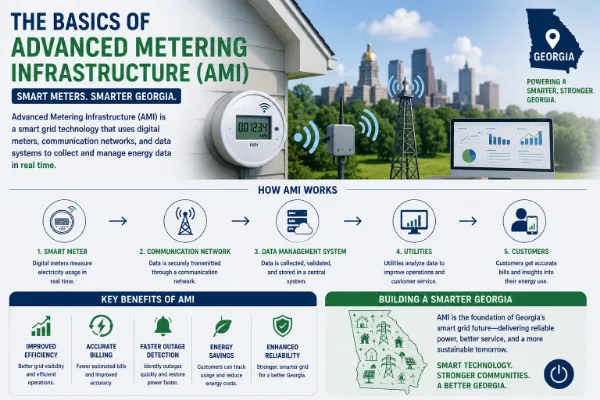
Utilities can find complementary technical detail in Advanced Metering Infrastructure basics and grid monitoring fundamentals, since water and electric AMI programs frequently share vendors and communication infrastructure. The Smart Utilities category and Augusta Smart Utilities directory track regional providers and developments.
Non-revenue water is one of the rare utility problems where the return on a technology investment can be measured almost immediately in dollars recovered rather than years of projected savings. Clayton County's million-dollar discovery and the City of Dallas's rapid pilot results are not outliers so much as evidence of how much revenue has likely been quietly slipping through aging meters at water utilities across Georgia for years. As EPD's annual audit requirements continue to put a spotlight on this issue, smart metering is shifting from an optional upgrade to the standard tool Georgia utilities use to find out exactly how much water, and how much revenue, they have actually been losing.
Frequently asked questions
Non-revenue water is water that a utility treats and supplies but does not bill for, resulting from causes such as leaking pipes, unauthorized consumption, inaccurate metering, or administrative errors in billing systems.
Yes, the Georgia Environmental Protection Division requires every water utility in the state to maintain a water loss control program and submit annual water loss audits demonstrating results.
Results vary by utility, but documented Georgia examples include the Clayton County Water Authority recovering more than $1 million annually and the City of Dallas identifying nearly 20 percent of its total water supply going unbilled before its metering upgrade.
No. Some of the most detailed documented results come from smaller Georgia systems like the City of Dallas, which serves roughly 14,000 residents, showing that smart metering can deliver meaningful returns even for utilities well below the scale of a major metro water system.
A district metered area is a smaller, isolated zone within a larger water distribution network that allows a utility to monitor consumption and losses at a more granular level, making it easier to pinpoint exactly where water loss is concentrated rather than diagnosing an entire system at once.
Documented Georgia pilots have shown measurable billing improvements within a few months of installation, as seen in the City of Dallas case, where a single-subdivision pilot identified significant additional billable consumption within four months.
Related articles


 Smart Utilities