In June 2024, a ruptured 36-inch water main near Joseph E. Boone Boulevard in west Atlanta set off six days of cascading water emergencies across the city, eventually reaching a second major break at 11th Street and West Peachtree in Midtown. Thousands of residents lost water service or were placed under a boil water advisory, the Georgia Aquarium closed, and Atlanta's Chief Operating Officer told City Council plainly: "We are repairing pipes from the 1920s, 1930s, 1940s. Our infrastructure is crumbling." City officials later confirmed the system includes roughly 3,000 miles of pipe, some of it more than a century old and made of brick or terra-cotta, and that the city experiences up to 30 water main breaks or emergency repairs in a typical month. A city councilman put the underlying question about as directly as it can be asked: "Does the department know where its biggest problems are?" That question is exactly what smart water metering and leak detection technology exists to help answer, before a slow, undetected problem becomes the next multi-day emergency.
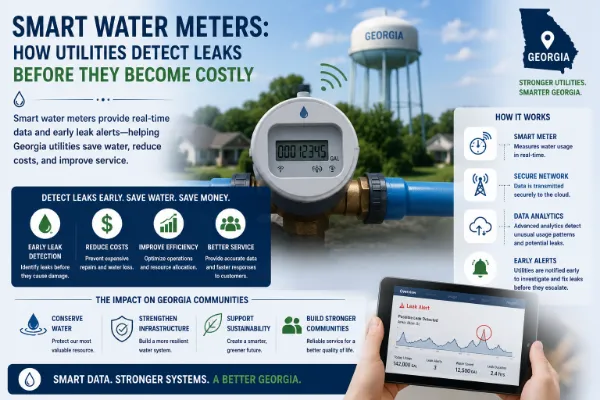
A smart water meter replaces a traditional mechanical meter one that requires a person to physically read it, typically monthly with a digital meter that measures consumption continuously and transmits that data automatically, usually every 15 minutes to an hour, to the utility. This shift from monthly manual reads to continuous automated data is the foundational change that makes leak detection possible in the first place: a monthly read can only tell a utility that more water was used this month than last month, long after a leak started and after the associated cost has already accumulated.
It's worth being precise about what smart metering actually catches, since "leak detection" covers two genuinely different situations that get monitored differently.
A running toilet, a cracked irrigation line, a slow leak in household plumbing these show up in smart meter data as continuous, unusual water flow that doesn't match a normal household usage pattern, particularly flow that continues 24 hours a day rather than in the expected pattern of morning and evening use. Modern AMI (Advanced Metering Infrastructure) platforms can flag this kind of anomaly automatically and alert both the utility and the customer, often before the customer notices a spike on their own bill. This category of leak is squarely what smart meters are built to catch, and it directly addresses non-revenue water loss water the utility has produced and delivered but never gets paid for.
A large-scale event like Atlanta's 2024 main breaks is a different category: a failure in the large-diameter pipes that move water from treatment facilities through the distribution network, before it ever reaches an individual customer's meter. These failures are typically caught through pressure monitoring across the distribution network rather than customer meter data alone, since a major main break shows up as a sudden, dramatic pressure drop across a wide area rather than an anomaly on any single customer's meter. That said, the two systems are increasingly connected: modern AMI networks can incorporate pressure and acoustic sensors at strategic points throughout the distribution system, not just at the customer endpoint, feeding the same kind of real-time data platform that customer-side leak detection relies on.
Atlanta's Department of Watershed Management has faced both types of problems simultaneously. On the customer-metering side, a city audit found the department had lost 10,000 water meters at one point and had failed to collect roughly $200 million from customers a billing and asset-visibility failure that modern AMI, with its automated, continuous, remotely readable data, is specifically designed to prevent. On the distribution side, the department is now confronting a genuinely aging network, with pipe segments over a century old, where the real fix requires physical infrastructure investment that no amount of sensor data alone can substitute for.
This is an important nuance for any utility, not just Atlanta's: smart metering technology solves the visibility and billing-accuracy problem extremely well, and it can meaningfully reduce non-revenue water loss from customer-side leaks. It does not, by itself, replace the physical pipe replacement that aging transmission infrastructure eventually requires. What it does provide, when paired with distribution-level pressure monitoring, is exactly the kind of systemic answer to "does the department know where its biggest problems are" that officials were asking for in the aftermath of the 2024 crisis a real-time, granular picture of where water is being lost across the entire system, both at the customer level and within the distribution network, rather than discovering a major problem only after a pipe has already ruptured.
Behind the "smart" part of smart metering is pattern analysis applied to the continuous consumption data:
- Continuous flow detection identifying water usage that never drops to zero over a 24-hour period, a strong indicator of a running toilet or an undetected pipe leak, since even an occupied household normally has periods of no water use.
- Usage pattern deviation comparing a customer's current usage against their own historical pattern, flagging a meaningful and sustained increase that doesn't match seasonal or behavioral explanations.
- Acoustic leak detection some advanced systems use acoustic sensors that listen for the specific sound signature of water escaping through a crack in a pipe, which travels differently through pipe material than normal flow, allowing detection even before a leak becomes visible at the surface.
- Pressure-based anomaly detection monitoring pressure at multiple points across the distribution network to catch the kind of sudden, large-scale pressure drop associated with a major main break, ideally catching a developing problem before it fully ruptures rather than only after service is already disrupted.
Non-revenue water water that's treated and pumped into the system but never billed, whether from leaks, metering inaccuracy, or theft is a direct financial loss for any utility, and it compounds over the life of an aging system where meters are old, inaccurate, or in Atlanta's case, sometimes literally unaccounted for. Smart metering directly addresses two components of this loss simultaneously: accurate, continuous billing that eliminates the estimation and reading errors mechanical meters are prone to, and early leak detection that shortens the time between when a leak starts and when it's found and fixed.
- Start with an accurate asset inventory. Atlanta's own audit history shows how easily a utility can lose track of physical meters at scale; a smart metering rollout should start with confirming exactly what's currently deployed before adding new technology on top of an uncertain baseline.
- Prioritize customer-side leak detection as the faster, lower-cost win. AMI deployment addresses non-revenue water loss and billing accuracy relatively quickly compared to the multi-year, capital-intensive process of replacing aging transmission infrastructure.
- Layer in distribution-level pressure and acoustic monitoring where budget allows, recognizing this is a separate investment from customer metering, aimed at catching major main failures earlier rather than customer-level leaks.
- Treat sensor data as a prioritization tool for capital planning, not a replacement for it the data helps identify which segments of an aging network are highest-risk, informing where limited infrastructure replacement budget should go first, rather than eliminating the need for that investment.
Smart water meters are genuinely effective at what they're built for: catching customer-side leaks early, improving billing accuracy, and reducing non-revenue water loss through continuous, automated data instead of monthly manual reads. What Atlanta's 2024 water crisis makes clear is that this technology is one part of a larger systemic answer, not a complete fix for a distribution network with century-old pipe segments the real long-term solution requires the kind of physical infrastructure investment city officials have since requested from the federal government. But the visibility smart metering and distribution-level sensor data provide is exactly the tool a utility needs to know, with real specificity, where its biggest problems actually are, rather than finding out only when a pipe fails under Midtown.
Frequently asked questions
Not directly on their own. Customer-facing smart meters primarily detect leaks and usage anomalies at the household level, not large transmission main failures. Distribution-level pressure and acoustic monitoring, a related but separate technology investment, is more directly relevant to catching a developing main failure before it fully ruptures.
A smart meter is the physical device measuring consumption digitally. AMI refers to the full system, including the meter, the communication network transmitting data back to the utility, and the software platform that analyzes that data for billing, leak detection, and usage insights.
Since data is typically transmitted every 15 minutes to an hour rather than read monthly, a continuous-flow leak, such as a running toilet, can often be flagged within a day or two of onset, compared to potentially a full billing cycle with traditional metering.
Non-revenue water is water that's treated and delivered into the system but never billed, due to leaks, metering inaccuracy, or other losses. It represents a direct financial loss for a utility and tends to compound in aging systems with outdated or inaccurate metering infrastructure.
No. Smart metering improves visibility into leaks and consumption but doesn't address the physical condition of aging transmission and distribution infrastructure. For a system with century-old pipe segments, physical infrastructure investment remains necessary regardless of metering technology.
Acoustic sensors listen for the specific sound signature created by water escaping through a crack or break in a pipe, which travels differently through pipe material than normal flow. This can allow a utility to detect a developing leak before it becomes visible at the surface.
Related articles

 Smart Utilities