Hurricane Helene made landfall in September 2024 as, in Georgia Power's own assessment, the most destructive hurricane in the company's history, at one point leaving more than 1.3 million customers without power across the state. What happened next is the clearer story for understanding grid monitoring technology: Georgia Power restored 95 percent of affected customers within eight days, using a grid that the company says has benefited from more than $10 billion invested over the past decade in smart grid technology and resiliency, approved by the Georgia Public Service Commission. That investment, and the sensor-driven "self-healing" technology it funded, is what grid monitoring is actually for not preventing every outage a storm this severe causes, but containing and recovering from them dramatically faster than a traditional, unmonitored grid could.
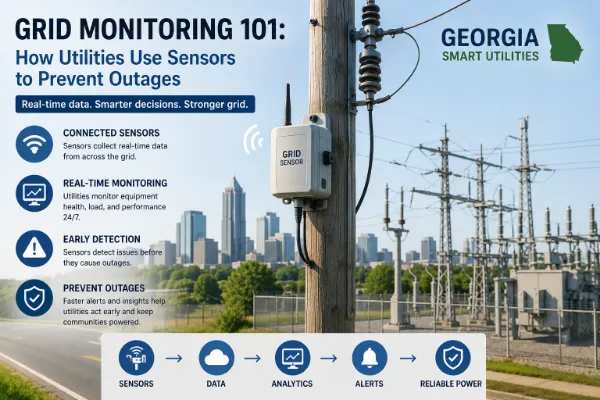
Grid monitoring refers to the network of sensors, communication systems, and automated switching equipment utilities install throughout the electric distribution and transmission system not at the customer's meter, but on the poles, substations, and circuits that carry power to that meter in the first place. This is a distinct layer of technology from smart metering: a smart meter tells a utility about conditions at a single customer's connection point, while grid monitoring watches the health and status of the infrastructure delivering power to potentially thousands of customers on a single circuit.
The centerpiece of modern grid monitoring is what utilities call a "self-healing" grid, built around devices called sectionalizers and smart reclosers installed at strategic points along distribution circuits. Georgia Power's post-Helene infrastructure report describes more than 90 of these devices upgraded or added in the Augusta area alone as part of ongoing grid resiliency work. Here's the mechanism that makes them valuable during a storm specifically:
- Fault detection when a tree limb, downed line, or other fault interrupts a circuit, sensors at each sectionalizing point detect the disruption within a fraction of a second.
- Automatic isolation rather than the fault causing a blackout across the entire circuit, the sectionalizing devices closest to the fault open automatically, isolating just that segment of the line.
- Automatic rerouting power to the unaffected portions of the circuit, on either side of the isolated fault segment, is automatically restored within seconds, often before a customer even fully registers the outage, by rerouting through alternate paths in the network.
- Fault location for crews critically, this same sensor data tells restoration crews precisely where the fault occurred, rather than requiring a crew to drive an entire circuit looking for the point of failure a genuinely significant time savings when thousands of individual faults need to be located and repaired simultaneously across a storm-affected region.
This is the mechanism behind Georgia Power's public framing that smart grid technology enabled "remote restoration while storm conditions were still at their worst" some outages were resolved automatically by the grid itself, without a truck ever needing to roll, in the hours immediately following Helene's landfall, while conditions were still too dangerous for crews to be in the field at all.
Under normal conditions, sectionalizing and self-healing technology mostly prevents small, routine outages (an isolated equipment failure, a squirrel on a line) from taking down an entire neighborhood circuit unnecessarily. The much larger value shows up during a mass-casualty event for the grid itself, like Helene, where the alternative to automated fault isolation and location is a slower, entirely manual process: crews physically patrolling every mile of affected line to find each individual point of failure, one at a time, across a geographic area the size of much of the state.
Georgia Power's restoration of the Helene event drew on more than 20,000 personnel at peak effort, including partner utility crews from across the country, using helicopters, boats, and unmanned aerial vehicles to reach damage in hard-hit, hard-to-access areas including Valdosta, Augusta, and Savannah. Grid sensor data doesn't replace that physical restoration work downed lines and broken poles still require crews to make actual repairs but it dramatically improves how efficiently that labor gets deployed, by telling dispatchers precisely where the highest-impact repairs are needed first, rather than discovering the extent of damage only as crews physically encounter it.
Supervisory Control and Data Acquisition systems monitor voltage, current, and equipment status at substations continuously, giving operators real-time visibility into the health of major grid infrastructure and allowing remote control of certain switching operations without requiring a technician on-site.
Combining grid sensor data with weather forecasting allows utilities to anticipate demand surges extreme heat driving air conditioning load, for example and proactively manage grid capacity before strain becomes an outage risk, rather than reacting only after equipment is already overloaded.
Some utilities are increasingly pairing grid sensor data with aerial and satellite imagery analysis to identify vegetation encroaching on power lines a leading cause of outages, particularly during storms before it causes a fault, supporting proactive vegetation management rather than only reactive repair after a tree has already brought down a line.
Georgia Power's post-Helene resiliency work included moving select lines underground and reconductoring circuits with larger wire in areas like Hahira and East Valdosta physical infrastructure decisions informed directly by outage and damage data from the storm, illustrating how grid monitoring data doesn't just support real-time response, it also informs where future capital investment should be prioritized.
Grid monitoring and smart water/electric metering solve related but distinct problems. Smart metering, covered elsewhere in this guide for water utilities specifically, focuses on the customer endpoint: consumption data, billing accuracy, and customer-side leak or usage anomalies. Grid monitoring focuses on the delivery infrastructure itself the poles, wires, and substations that carry power (or water, in the case of a water distribution network) to that endpoint. A mature utility infrastructure program generally needs both: customer-level visibility to catch billing and usage problems early, and grid-level visibility to catch and contain infrastructure failures before they cascade into large-scale outages.
- Sectionalizing and self-healing technology delivers the fastest, most visible value during major storm events, where the alternative is a slow, entirely manual fault-finding process across a wide geographic area.
- SCADA and substation monitoring provide the steady-state visibility that prevents smaller equipment issues from escalating, and gives operators the real-time picture needed to manage the system day to day.
- Sensor data increasingly informs long-term capital planning, not just real-time operations the same outage data that helps restore power after a storm also identifies which specific circuits and areas justify investment like undergrounding or reconductoring before the next storm.
- None of this technology eliminates the need for physical infrastructure investment or field crews it makes both dramatically more efficient and better-targeted, which is a meaningfully different claim than "prevents all outages."
Grid monitoring sensors didn't prevent Hurricane Helene from causing damage across Georgia's electric grid no sensor network can stop a storm the company itself called the most destructive in its history from knocking down lines and poles. What the sensor-driven self-healing grid and the $10 billion in resiliency investment behind it actually did was compress the recovery timeline: automatically isolating faults and rerouting power in seconds where possible, and directing more than 20,000 restoration personnel to exactly where they were needed most, resulting in 95 percent restoration within eight days of the most destructive storm the company has faced. That's the realistic, well-documented case for grid monitoring technology not eliminating outages entirely, but containing and resolving them far faster than a grid without this sensor infrastructure could manage.
Frequently asked questions
A self-healing grid uses sensor-equipped sectionalizing and recloser devices installed along distribution circuits to automatically detect a fault, isolate the affected segment, and reroute power to restore unaffected customers within seconds, without waiting for a manual crew response.
Smart metering focuses on the customer endpoint, tracking consumption and usage anomalies at an individual connection point. Grid monitoring focuses on the delivery infrastructure itself, such as substations, distribution circuits, and switching equipment, watching for faults and failures before they reach the customer level.
Not entirely. Georgia Power described Helene as the most destructive hurricane in company history, and widespread outages still occurred. Smart grid technology's documented value was in accelerating restoration, automatically resolving some outages within seconds and helping direct crews efficiently, resulting in 95 percent restoration within eight days.
It's a sensor-equipped switching device installed along a distribution circuit that can automatically detect a fault and isolate that specific segment of the line, preventing the fault from causing an outage across the entire circuit and helping crews locate the problem faster.
Outage and damage data collected during storm events helps utilities identify which specific circuits or areas are most vulnerable, informing decisions like moving lines underground or upgrading conductor size in the highest-risk locations, rather than distributing infrastructure investment evenly regardless of actual risk.
No. Sensor and automation technology can resolve some faults automatically and helps direct crews to problems more efficiently, but downed lines, broken poles, and damaged equipment still require physical repair by field crews.
Related articles

 Smart Utilities