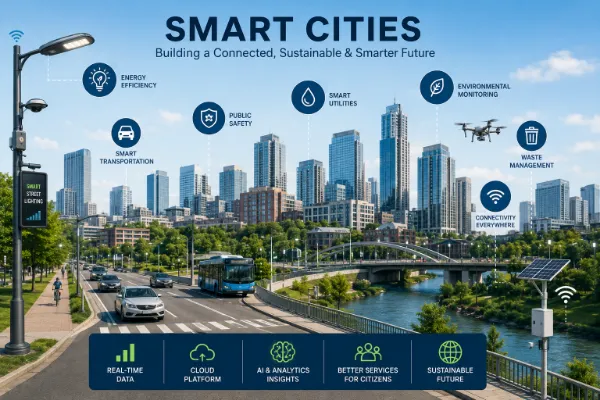
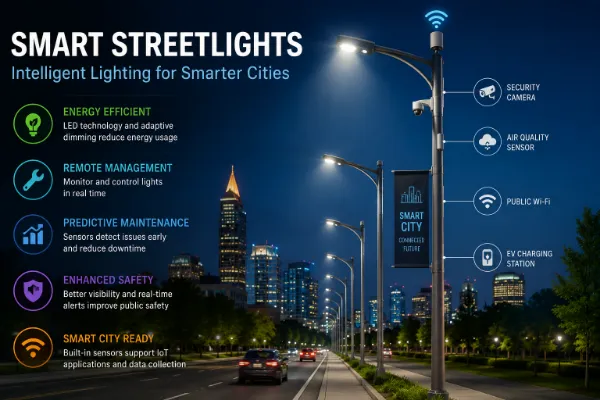
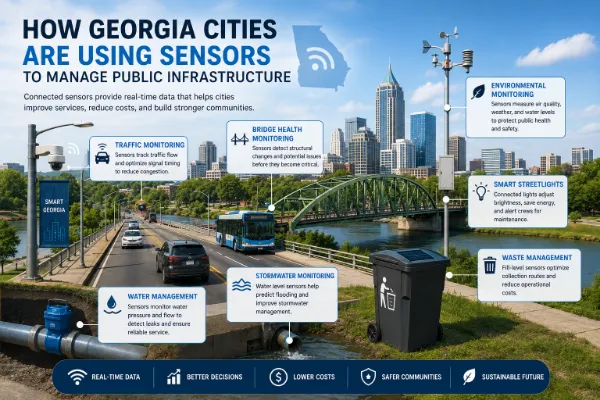
Across the United States, cities are exploring new ways to improve transportation, public safety, sustainability, and municipal services through connected technologies. While many communities have launched smart city initiatives, one Georgia city has distinguished itself by creating a real-world environment where emerging technologies can be safely tested before they are deployed at scale.
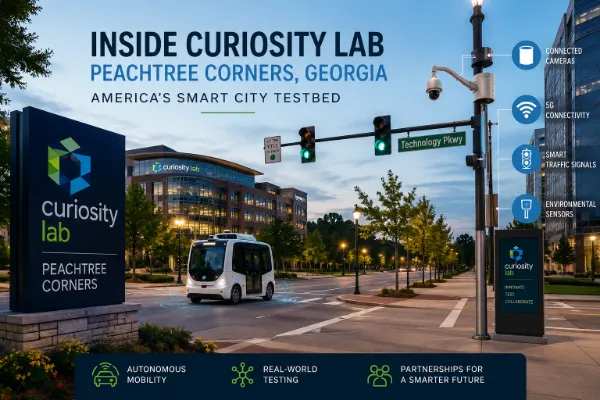
Located just outside Atlanta, Peachtree Corners has transformed itself into one of the country's most recognized innovation hubs through Curiosity Lab, a living laboratory where companies can evaluate connected infrastructure, autonomous vehicles, intelligent traffic systems, robotics, and next-generation wireless communications.
Rather than relying on simulations or closed testing facilities, Curiosity Lab allows technology developers to validate their solutions in an active city environment. The result is faster innovation, better collaboration between public and private organizations, and practical lessons that other municipalities across Georgia and the nation can apply.
Curiosity Lab is a smart city innovation ecosystem created by the City of Peachtree Corners. Instead of functioning as a traditional research center, it operates as an open innovation district where technology companies, startups, universities, and public agencies can test connected solutions under real operating conditions.
The facility combines modern city infrastructure with advanced communications technologies, making it possible to evaluate everything from connected vehicles to AI-powered traffic management systems.
- Autonomous vehicle testing
- 5G and private wireless networks
- IoT sensors
- Smart intersections
- Connected traffic management
- Robotics and automation
- Public safety technologies
- Environmental monitoring
Peachtree Corners was uniquely positioned to become a national smart city leader because city leadership viewed technology as long-term infrastructure rather than a short-term project.
Instead of waiting for technology vendors to approach the city, local officials created an environment specifically designed to attract innovators. This proactive strategy has encouraged collaboration between local government, private industry, universities, and technology providers.
The city's location within metro Atlanta also provides convenient access to major transportation corridors, research institutions, engineering talent, and corporate headquarters, making it an attractive destination for IoT companies.
Unlike conventional testing facilities, Curiosity Lab integrates technology directly into functioning public roads and infrastructure. Developers can observe how connected devices perform in realistic traffic patterns, changing weather conditions, and everyday city operations.
This real-world approach helps identify issues that often remain hidden during laboratory testing.
Companies can evaluate:
- Vehicle-to-Infrastructure (V2I) communication
- Connected traffic signals
- Roadside IoT devices
- Autonomous shuttle navigation
- Pedestrian safety technologies
- Emergency vehicle prioritization
- Smart parking systems
Reliable connectivity is essential for modern smart city applications. Curiosity Lab incorporates advanced wireless infrastructure that supports low-latency communication between connected devices.
This enables applications that require immediate data exchange, including autonomous driving, intelligent traffic management, infrastructure monitoring, and industrial IoT deployments.
Rather than treating connectivity as an afterthought, the city designed its digital infrastructure as a foundation upon which future technologies can be built.
One of Curiosity Lab's most recognized initiatives involves autonomous mobility testing. Self-driving shuttles and connected transportation systems can safely navigate designated routes while interacting with traffic signals, pedestrians, and other connected infrastructure.
These projects help researchers understand how autonomous transportation can complement existing public transit systems while improving accessibility and reducing congestion.
Curiosity Lab is more than a technology showcase—it also serves as an economic development engine.
By attracting startups, established technology companies, researchers, and investors, Peachtree Corners has strengthened its position as an innovation destination within Georgia.
Businesses gain access to:
- Real-world product validation
- Government collaboration
- Potential customers
- Technology partnerships
- Research opportunities
- Pilot deployment programs
This collaborative ecosystem reduces development risks while accelerating commercialization.
Not every municipality needs to build an innovation district the size of Curiosity Lab. However, the underlying principles can be applied by cities of many sizes.
Successful smart city programs often begin with clearly defined community challenges rather than technology itself.
Examples include:
- Reducing traffic congestion
- Improving public safety
- Managing water infrastructure
- Monitoring road conditions
- Lowering energy consumption
- Increasing operational efficiency
By starting with measurable goals, municipalities can prioritize investments that deliver long-term value.
As connected technologies continue to mature, Georgia is well positioned to become a leader in municipal innovation. Lessons learned from Curiosity Lab are already influencing discussions around transportation, infrastructure modernization, environmental monitoring, and intelligent public services.
Future developments may include expanded AI-powered traffic systems, digital twins, connected utility infrastructure, predictive maintenance, and greater integration between public agencies and private technology providers.
Peachtree Corners demonstrates that successful smart cities are built through collaboration, strategic planning, and continuous experimentation rather than isolated technology projects.
Curiosity Lab has transformed Peachtree Corners from a growing suburban community into one of America's most respected smart city innovation environments. By combining connected infrastructure, advanced wireless networks, autonomous mobility testing, and strong public-private partnerships, the city has created a practical model for municipalities seeking to modernize public services.
As Georgia continues investing in connected infrastructure and digital transformation, Curiosity Lab offers valuable insights into how thoughtful planning, collaboration, and real-world testing can accelerate innovation while delivering measurable benefits for residents, businesses, and local governments.
Frequently asked questions
Curiosity Lab is a smart city innovation ecosystem where companies test connected technologies, autonomous vehicles, IoT devices, and intelligent infrastructure in a real-world environment.
The city has invested in connected infrastructure, advanced wireless networks, public-private partnerships, and real-world technology testing that supports smart city innovation.
Projects include autonomous vehicles, smart traffic systems, IoT sensors, robotics, AI applications, environmental monitoring, and connected transportation solutions.
Businesses can validate products, collaborate with city officials, access real-world testing environments, and accelerate commercialization.
Can other Georgia cities replicate this model?
Future initiatives are expected to include AI-driven traffic management, digital twins, predictive infrastructure maintenance, connected utilities, and expanded IoT deployments that improve municipal operations and quality of life.
Related articles

 Smart Cities