Ask ten Georgia companies what supply chain visibility means and you will hear ten answers. For one, it is knowing which truck is late. For another, it is knowing the temperature of every pallet of chicken between Gainesville and Shanghai. For a third, it is predicting a parts shortage three weeks before it stops a line. All of these are visibility, but they sit at very different levels of maturity and require very different investments.
IoT has changed what is possible. Low-cost trackers, connected trucks and containers, port and rail data feeds and cloud platforms make it practical to see far more of a supply chain than a decade ago. But the technology only pays off when companies know which level of visibility they actually need and how to share data with partners. This guide offers a five-stage maturity model, explains the data standards that make sharing easier and gives practical advice for Georgia shippers. For specific technologies, see our earlier article on connected sensors for supply chain visibility.
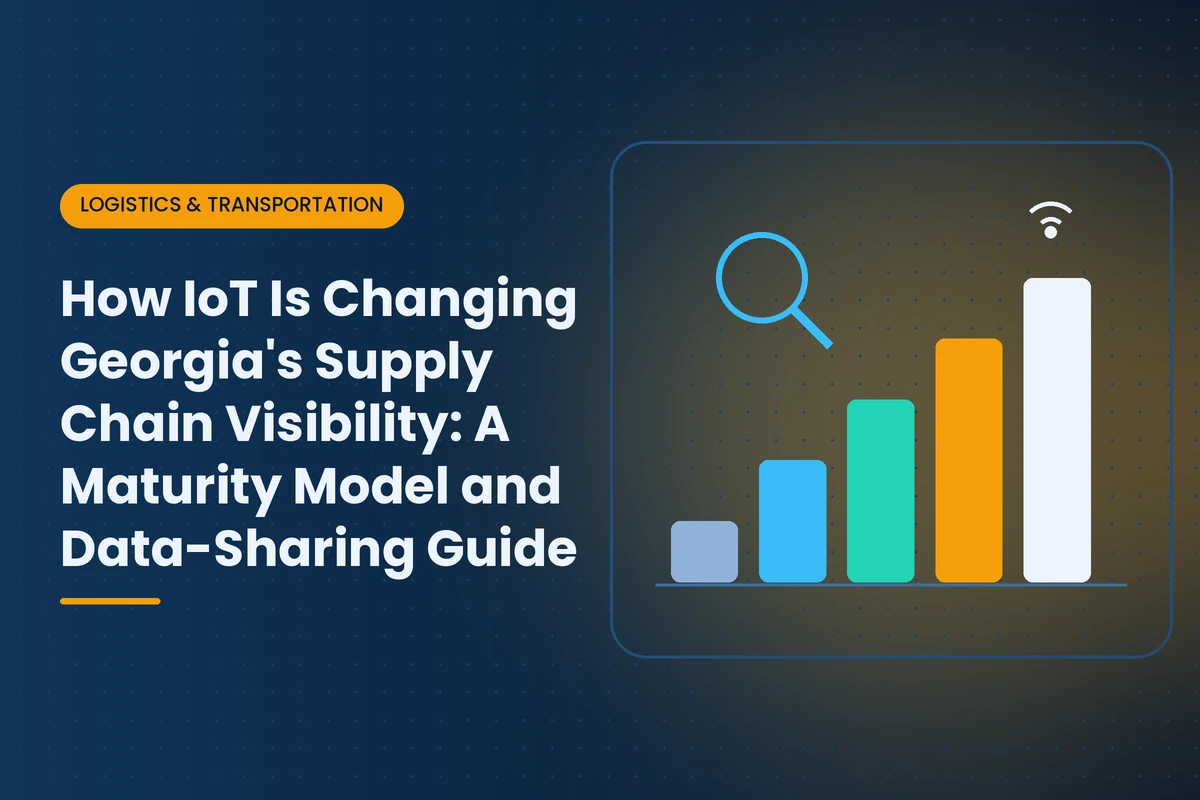
| Stage | What It Looks Like | Question Answered | Typical Tools |
|---|
| 1. Reactive | Status by phone and email, spreadsheets | Where is it? (after asking) | Carrier websites, manual updates |
| 2. Milestone | Key events captured automatically | Did it leave, arrive, clear? | Carrier and terminal event feeds |
| 3. Real-time | Continuous location and condition | Where is it now, and is it okay? | Trackers, telematics, reefer monitoring |
| 4. Predictive | ETAs and risk forecasts | When will it really arrive, and what might go wrong? | Visibility platforms with machine learning |
| 5. Prescriptive | Recommended or automatic responses | What should we do about it? | Integrated planning and execution systems |
Most Georgia companies operate somewhere between stages one and three. The right target depends on the business. A distributor of building materials may be well served at stage two. A food exporter or auto supplier delivering in sequence may need stages three or four for critical lanes.
The biggest jump for many companies is from manual status checks to automatic milestones. Port terminals, railroads, shipping lines and many trucking companies already generate electronic events such as gate in, loaded, departed and delivered. Pulling those events into one place, through a visibility platform or direct integrations, eliminates much of the time spent chasing updates. No new hardware is required, only data agreements and integration.
Stage three adds IoT devices: trackers on containers, trailers or pallets, telematics from trucks and reefer units, and sensors for temperature, humidity, shock or door openings. This is where visibility gaps between handoffs close, because the device follows the cargo regardless of who is moving it. It is also where costs rise, so most companies apply real-time tracking selectively to high-value, time-critical or sensitive freight.
Stages four and five rely on large amounts of historical and real-time data. Predictive ETAs combine location with traffic, weather, port congestion and past performance on each lane. Prescriptive tools go further, suggesting reroutes, inventory moves or production changes when disruptions are likely. These capabilities are increasingly built into commercial visibility platforms, but they only work well when the underlying data is complete and accurate.
Visibility depends on partners sharing data. Without common formats, every connection becomes a custom project. Several standards help:
- GS1 identifiers and EPCIS. Global standards for identifying products, locations and logistics units and for sharing event data about what happened, when, where and why. Widely used in retail, food and healthcare traceability.
- Ocean carrier track and trace standards. The Digital Container Shipping Association publishes standards for container events and schedules that many major carriers support.
- EDI. Traditional electronic data interchange messages for shipment status, advance ship notices and orders remain common, especially with large retailers and automakers.
- APIs. Modern application programming interfaces let systems exchange data in near real time and are increasingly offered by carriers, terminals and platforms.
Food companies preparing for the FDA's Food Traceability Rule, with a compliance date of July 20, 2028, and pharmaceutical distributors working under the Drug Supply Chain Security Act are already moving toward standardized event data. Our guide to IoT in food processing covers food traceability requirements.
| Approach | Best For | Watch Out For |
|---|
| Commercial visibility platform | Companies with many carriers and modes | Data coverage gaps on smaller carriers, subscription costs |
| Carrier and 3PL portals | Companies using few partners | Fragmented views, limited control of data |
| Custom integrations | Large shippers with unique needs and IT resources | Maintenance burden, slower to change |
| Hybrid | Most mid-sized Georgia shippers | Clear ownership of the combined view |
- A growing multimodal network. Inland ports in Crandall and Gainesville add rail handoffs that need tracking. See our article on Georgia's inland port network.
- Just-in-time manufacturing. Auto, battery and aerospace plants require precise delivery visibility from suppliers.
- Perishable exports. Poultry and produce need condition monitoring as well as location.
- Weather risk. Hurricanes and storms make predictive and prescriptive capabilities valuable. Our article on supply chain IoT and early warning covers this.
Visibility is not only for large corporations. Smaller Georgia shippers can make meaningful progress with modest budgets:
- Ask carriers and third-party logistics providers what data they already capture and whether they can share it automatically.
- Use freight forwarders or brokers that offer integrated tracking portals.
- Start with milestones on your most important lanes before adding devices.
- Add trackers only to shipments where delays or damage are most expensive.
- Agree internally on who responds to alerts and how.
Supply chain visibility often stops at the warehouse door, but many delays happen inside. Inventory accuracy, dock scheduling and yard management determine how quickly arriving goods become available to ship. Connecting inbound visibility with warehouse data shows when a container will arrive, which dock will receive it and when its contents will be ready. See our guide to smart warehouses in Georgia.
Leadership often asks why visibility is worth paying for. The strongest cases tie it to specific costs: expedited freight caused by late surprises, detention and demurrage charges, safety stock held because arrival times are uncertain, labor spent chasing updates and claims that could not be proven. Even modest reductions in these categories usually justify stage two investments, while stage three and four investments should target the lanes where these costs are highest.
Visibility investments should be measured in business terms. Useful metrics include the share of shipments with automatic milestones, average delay before an exception is noticed, ETA accuracy, time staff spend chasing status, expedited freight costs, inventory buffers held for uncertainty and claims tied to condition problems. Track a baseline before investing and review monthly.
- Which ocean carriers, railroads, terminals and trucking companies feed data into your platform today?
- How do you handle small regional carriers that lack electronic data?
- Can we bring our own trackers and sensors into the same view?
- How accurate are your predicted ETAs on Georgia lanes, and how do you measure it?
- Can we export all event and sensor data in standard formats?
- How do alerts integrate with our transportation, warehouse and ERP systems?
Answers to these questions reveal whether a platform will cover your actual network or only part of it.
Consider a hypothetical mid-sized auto parts supplier in Troup County that receives components from Asia through Savannah and ships to assembly plants in Georgia and Alabama. Its logistics team spent hours each day checking carrier websites. The company first adopted a visibility platform that pulled in ocean, port, rail and trucking milestones, moving from stage one to stage two in a few months. It then added trackers to containers carrying critical components, reaching stage three for those lanes. Within a year, predictive ETAs from the platform let planners adjust production schedules days before late containers would have caused shortages, and expedited air freight costs fell. The team now spends its time managing exceptions rather than searching for status.
- Buying stage five tools with stage one data. Prediction fails without reliable milestones.
- Tracking everything at the same level. Match visibility depth to freight value and risk.
- Ignoring partners. Visibility depends on carriers, suppliers and customers sharing data.
- No owner for exceptions. Alerts need people and processes to respond.
Expect more containers to carry built-in trackers from shipping lines, more standard data sharing between Georgia ports, railroads and carriers, and more AI-driven prediction in commercial platforms. Regulatory traceability requirements in food and pharmaceuticals will push standard event data into more supply chains. Companies that build a clear visibility roadmap, starting with reliable milestones and adding real-time and predictive layers where they pay, will gain the most.
For related reading, see our articles on export logistics from warehouse to port and Savannah's connected logistics ecosystem. To find visibility partners, browse the IoT Georgia company directory or explore logistics IoT providers in Atlanta and Savannah. Browse more of our Logistics and Transportation coverage.
Frequently asked questions
It is the ability to know where goods are, what condition they are in and when they will arrive across suppliers, carriers, ports and warehouses, ideally without manual status checks.
A practical model has five stages: reactive, milestone, real-time, predictive and prescriptive. Most companies operate between the first and third stages.
Not always. Automatic milestones from carriers and terminals require no new hardware. IoT trackers and sensors add real-time location and condition data where freight value or risk justifies them.
Common standards include GS1 identifiers and EPCIS for event data, ocean carrier track and trace standards, traditional EDI messages and modern APIs.
Most mid-sized Georgia shippers use a hybrid: a commercial platform for broad coverage plus integrations with key carriers and internal systems.
Track automatic milestone coverage, time to notice exceptions, ETA accuracy, staff time spent chasing status, expedited freight costs, inventory buffers and condition-related claims.
Related articles

 Logistics & Transportation