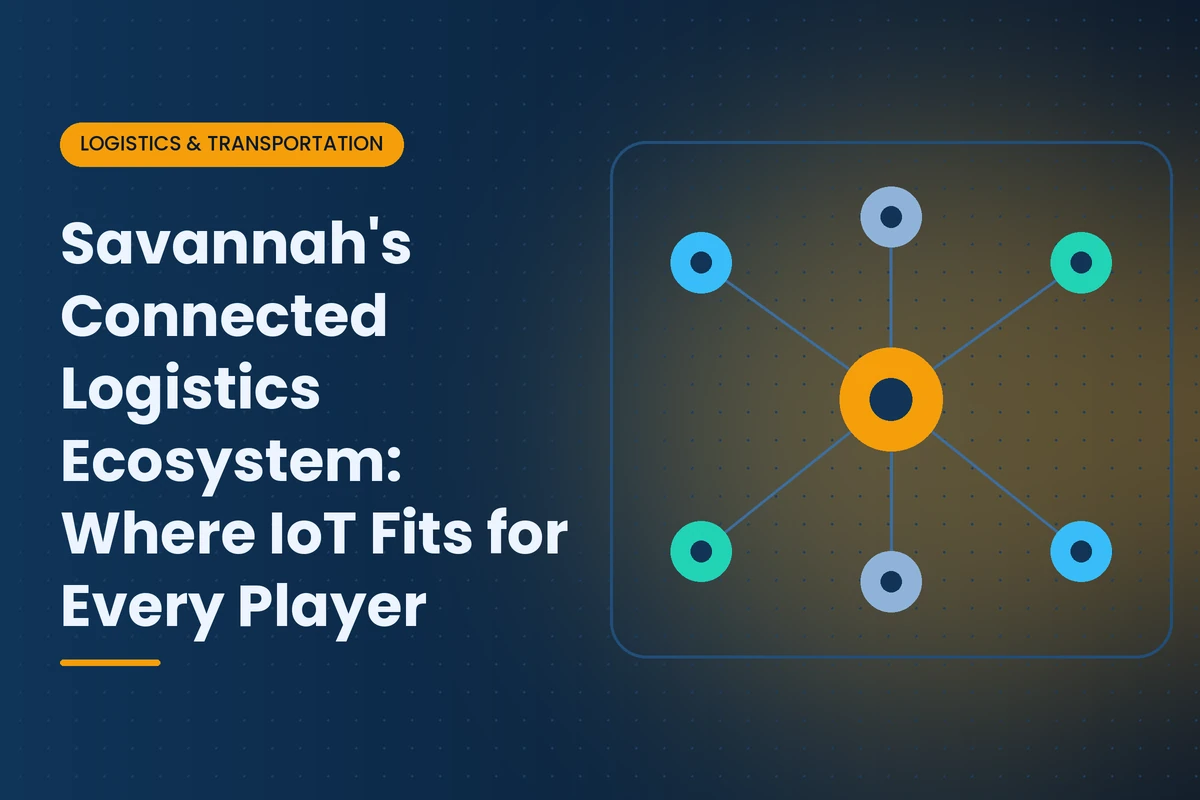
The Port of Savannah gets most of the attention, but the port is only one part of a much larger logistics ecosystem across Coastal Georgia. Around Garden City Terminal and Ocean Terminal sit railroads, drayage fleets, chassis providers, transload and cross-dock operations, cold storage warehouses, import distribution centers, manufacturers, freight forwarders, customs brokers and training institutions. Since 2024, the Hyundai Motor Group Metaplant in Bryan County and its suppliers have added another layer of demand.
Each player has its own systems and priorities, and freight succeeds or fails at the connections between them. This article maps Savannah's logistics ecosystem by role and explains where IoT and connected data fit for each. For the technology inside the terminal itself, see our article on Savannah port technology.
| Player | Role | Key IoT and Data Needs |
|---|
| Port terminals | Load, unload and store containers | Container tracking, gate automation, equipment telemetry, reefer monitoring |
| Railroads | Move containers inland via on-terminal rail | Railcar location, train schedules, arrival events |
| Drayage carriers | Move containers between terminals, warehouses and rail | Truck telematics, appointment data, container availability |
| Chassis providers | Supply the trailers containers ride on | Chassis location and condition tracking |
| Transload and cross-dock operators | Move cargo from ocean containers to domestic trailers | Dock sensors, inventory scanning, labor data |
| Cold storage | Freeze, store and ship perishables | Room temperature, refrigeration health, door monitoring |
| Import distribution centers | Store and distribute imported goods | Yard visibility, dock scheduling, automation data |
| Manufacturers and suppliers | Receive parts and ship finished goods | Inbound visibility, sequencing, traceability |
| Forwarders and brokers | Arrange shipping and customs clearance | Milestone data, document status, holds |
Garden City Terminal is one of the largest single container terminals in North America, and the Mason Mega Rail Terminal lets trains load directly on the terminal. The Georgia Ports Authority reports average vessel-to-rail times under 20 hours. For the rest of the ecosystem, the most valuable outputs from terminals and railroads are timely status events: when a container is discharged, available, loaded on a train or gated out. Partners that consume those events automatically plan better than those that check manually.
Drayage trucks connect almost every other player. Their efficiency depends on knowing when containers are available, booking appointments in good time windows, finding chassis and avoiding waits at warehouse docks. Telematics, appointment integration and container availability data turn drayage from a reactive service into a planned one. Turn times, the length of each terminal visit, are one of the most important metrics in the ecosystem, and connected data makes them measurable. Our fleet tracking primer covers the basics.
A container cannot leave the terminal by truck without a chassis. Chassis shortages, damaged chassis and chassis left at the wrong location cause delays that ripple through the ecosystem. GPS tracking and condition monitoring on chassis help pool operators position equipment where it is needed and identify units that need repair.
Many importers transload ocean containers into larger domestic trailers near the port before shipping inland. Transload operations depend on fast dock turns, accurate counts and quick labor scheduling. Dock door sensors, RFID or barcode scanning and labor data help them handle surges when several vessels arrive close together. See our guide to warehouse asset tracking.
Coastal Georgia's cold storage capacity has grown quickly. In September 2025, MEDLOG opened a facility in Rincon of nearly 300,000 square feet with large blast freezing capacity and a rail siding, and the Georgia Ports Authority said the region has nearly 2.4 million square feet of near-port cold storage. These facilities rely on room and equipment monitoring, reefer coordination with the terminal and records that satisfy food safety and export customers. See our article on Georgia cold chains.
Large import distribution centers line the I-16 and I-95 corridors in Chatham, Effingham and Bryan counties. Manufacturers, including suppliers to the Hyundai Metaplant, receive parts that may need to arrive in exact sequence. For these players, visibility into inbound containers and yard trailers is critical, along with dock scheduling and, increasingly, automation inside the building. Our articles on Hyundai's Georgia Metaplant and AMRs in distribution centers cover these topics.
Freight forwarders and customs brokers coordinate bookings, documents and clearance. They benefit from automatic milestones and alerts on holds, which let them resolve issues before containers miss trains or trucks. Their role is increasingly data-driven, connecting cargo owners to the rest of the ecosystem.
- Different systems, different formats. Each player uses its own software, making data exchange difficult without standards.
- Information arrives late. Partners often learn of changes only after they affect operations.
- Equipment mismatches. Containers, chassis and trucks are not always in the same place at the same time.
- Peak surges. Multiple vessel arrivals overwhelm docks, drayage and labor.
- Weather disruptions. Hurricanes and storms can close the port and scramble schedules across the ecosystem.
IoT and shared data address these breaks by giving each player earlier, more accurate information about what is coming. Our article on the supply chain visibility maturity model explains how companies can build that capability.
- Cargo owners: Which of my partners share data automatically, and where do I still depend on emails and phone calls?
- Drayage carriers: Do I receive container availability and appointment data early enough to plan my fleet?
- Warehouses: Can I see inbound containers and trucks before they arrive at my gate?
- Manufacturers: Do I have enough visibility to protect sequenced or just-in-time deliveries?
- All players: How would my operation respond if port systems or communications were unavailable for a day?
Coastal Georgia's ecosystem is exposed to hurricanes and tropical storms. Port closures, power outages and flooded roads affect every player at once. Shared visibility helps the ecosystem recover faster after storms: terminals publish reopening schedules, drayage carriers see where containers wait, and warehouses plan labor for the surge that follows. Our article on supply chain IoT and early warning covers storm preparation.
Savannah's ecosystem offers clear opportunities for IoT and software companies:
- Visibility and appointment tools tailored to drayage carriers.
- Chassis and container tracking solutions.
- Yard management and dock scheduling for distribution centers and transloaders.
- Cold storage monitoring and refrigeration analytics.
- Data integration services linking terminals, railroads and shippers.
- Cybersecurity for logistics operators connected to port systems.
U.S. Customs and Border Protection inspections, holds and releases affect when containers can move. Forwarders, brokers and importers that receive hold and release data quickly can arrange exams, fix documentation and reschedule drayage before containers sit unnecessarily. Connecting customs status with terminal availability and trucking plans is one of the simplest ways to cut dwell time.
A connected ecosystem needs people who can manage it. Savannah Technical College offers logistics and industrial programs, Georgia Tech-Savannah provides professional education, and Georgia Quick Start supports training for new and expanding companies in the region. Logistics companies increasingly need dispatchers, supervisors and analysts who are comfortable with data, along with technicians who maintain automation and connected equipment.
- Map your partners. List every terminal, railroad, carrier, chassis provider and warehouse you work with.
- Identify the data each one has. Many already capture the events you need.
- Agree on formats and timing. Standard events and APIs reduce custom work.
- Start with turn times and dwell. These metrics reveal where time is lost.
- Review performance together. Share data with partners in monthly reviews.
Consider a hypothetical third-party logistics provider in Effingham County that runs a transload facility and a 600,000-square-foot distribution center for retail importers. It works with several drayage carriers, a chassis pool and two railroads. Before connecting its data, it learned about arriving containers from emails and spent hours coordinating pickups. The company integrated terminal availability data, required drayage partners to share telematics and appointment times, added dock sensors and set up a yard management system. During a busy holiday import season, it could see which containers were available, which trucks were inbound and which docks were free, and adjust labor accordingly. Average truck wait times fell, and the company used turn time data to renegotiate rates and service levels with carriers.
The Ocean Terminal redevelopment, expected to open to larger ships by the end of 2028, and continued expansion of rail capacity will add volume to the ecosystem. More manufacturing around the Metaplant and the Bryan County megasite will increase demand for sequenced, time-critical deliveries. As volumes grow, the players that share data effectively will move freight faster, with fewer surprises, than those working in isolation.
For related reading, see our articles on port sensors for containers, equipment and cargo and IoT at the Port of Savannah. To find partners, browse the IoT Georgia company directory or explore logistics IoT providers in Savannah and industrial IoT in Savannah. Browse more of our Logistics and Transportation coverage.
Frequently asked questions
It includes port terminals, railroads, drayage carriers, chassis providers, transload and cross-dock operators, cold storage, import distribution centers, manufacturers, freight forwarders and customs brokers.
Drayage trucks connect terminals, rail, warehouses and plants. Their efficiency depends on container availability, appointments, chassis and dock readiness, all of which connected data improves.
Transloading moves cargo from ocean containers into domestic trailers, often near the port, before it ships inland. It depends on fast dock turns and accurate counts.
The Georgia Ports Authority said the region has nearly 2.4 million square feet of near-port cold storage, including MEDLOG's Rincon facility opened in September 2025.
Common breaks include incompatible systems, late information, equipment mismatches, peak surges and weather disruptions.
Opportunities include drayage visibility tools, chassis and container tracking, yard and dock management, cold storage monitoring, data integration and cybersecurity for logistics operators.
Related articles

 Logistics & Transportation